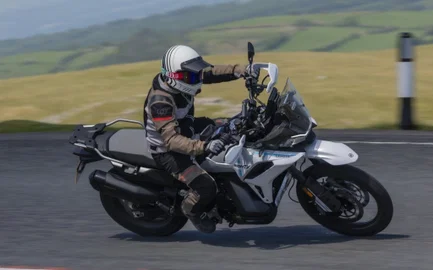
Triumph Trident 660 (2026) review
Triumph gives its entry-level Trident 660 17 per cent more power to take the fight to the competition.

* Easy to ride and highly accessible
* Strong value and generous standard equipment
* Limited suspension adjustment
* Ageing dashboard design
Revealed in January 2026, the updated Triumph Trident 660 gets a fairly comprehensive round of upgrades, headlined by a revised version of Triumph’s 660cc triple. Power climbs to 95 PS (93.7 bhp) and 68 Nm (50.15 lb ft), a jump of around 13 bhp over the previous model, thanks to mechanical changes including individual throttle bodies, revised internals, and a higher rev limit. The six-speed gearbox has also been updated, while chassis tweaks accompany the new engine setup.

Beyond the motor, Triumph has made several detail changes aimed at improving ride and feel. The bike gains revised frame elements and updated suspension, including a more adjustable Showa rear shock, plus ergonomic tweaks such as a wider handlebar and a new split rider-and-passenger seat. Styling also evolves slightly with a broader fuel tank and sharper knee cut-outs, while the standard electronics package includes cornering ABS, traction control, cruise control and a quickshifter.

Pricing for the 2026 Trident 660 starts at £8,095 in the UK, representing only a small increase over the previous model despite the extra performance and equipment. The bike is offered in several colour schemes, including Snowdonia White, Cosmic Yellow and Stone Grey, alongside updated graphics to match the refreshed styling.
For this review, we hand you over to the highly experienced hands of Adam ‘Chad’ Child, who jetted off to Spain for this press launch - it’s a tough job, yadda, yadda, yadda…
Trident 660 (2026) review

Test conditions in southern Spain were sunny, warm and dry. I couldn’t wait to throw a leg over the new Trident 660, as I’ve already ridden the excellent new Trident 800 at the press launch a couple of weeks ago.
When I last rode the outgoing 660, I was impressed by how good the standard package was and felt that just a handful more bhp would make it more fun. Now, for 2026, Triumph has obliged by not just sprinkling a few extra horses into the mix but by adding no less than 14, or some 17 per cent more horsepower, and pushing the triple’s redline up to 12,650rpm. You just know it is going to scream.

While sporty folk might become a bit giddy looking at those figures, Triumph has also made the new Trident as accessible as before, maintaining its appeal to new and young riders, including the female market. Design tweaks are subtle, but in the new yellow paintwork, the 2026 bike looks especially eye-catching. There’s a quality finish and a robust presence, too. I’m unsure if this is a plus or a minus, but it also looks very similar to the 800. (Paintwork aside, the lower-spec brakes of the 660 are the most obvious visual giveaway.)

On board, you are greeted by a familiar circular dash shared with the Trident 800 and other Triumph models. It first appeared back in 2021 and by modern standards isn’t exactly cutting edge, but it is simple to operate and navigate. There are three riding modes to choose from – Sport, Road and Rain. All change the traction control intervention and engine characteristics, but the TC can’t be trimmed or adjusted within those modes and can only be disabled at a standstill. Triumph's Shift Assist up-and-down quick-shifter and cruise control are both standard and very welcome features.

Our test immediately ran into heavy Spanish traffic, which confirmed that all the ease of use of the previous bikes does indeed remain. A span-adjustable brake lever, a light cable-operated clutch, smooth quick-shifter and throttle make slow-speed, urban riding second nature. Triumph’s quoted seat height is just 810mm, and there is an optional seat that drops that figure by 25mm to 785mm. The 660 may have gained a few kilos over the 2025 model but it’s still supremely poised and easy-going, ideal for new riders or those who have fitted the factory Triumph A2 kit.

I, however, couldn’t wait to get into the Spanish mountains and let those new British horses gallop. As mentioned, when I rode the older 81hp Trident 660 I wondered why Triumph didn’t push it to the 95hp limit (for an A2 bike to be restricted to 47hp). But now we have the full-fat entry-level Trident. There is still strong torque and drive from low down in the rev range, but also far more power towards the top.

On the twisting and challenging test route laid on by Triumph, I could easily have changed gear sooner and made brisk progress simply by riding that midrange grunt – but where would the fun in that be? Instead, I held on to the gear for longer and let the revs rise and rise to nearly 13,000rpm. Here, the Trident comes alive. Throttle response is instant. Tap on the quick-shifter between 11,500rpm and 12,000rpm and it feels like a naked race bike. I found myself dancing up and down the shifter – second to third to fourth and back to second – exhaust wailing, intake system roaring, and wanting to repeat the process until the sun went down. It’s a genuine, uncomplicated joy to thrash. In this class of entry-level nakeds I don’t think any machine will be able to match the fun and giggles the Trident's rev-happy motor now provides.

Don’t be misled by my immaturity, though. Peak power and torque may now be higher in the rev range but there’s a smoother and still spirited ride to be had without going north of 10,000rpm. The 660 will happily loft its front wheel in the first two gears from relatively low rpm (with a little help from the clutch), and while there’s a slight dip in the power curve between 6000rpm and 7000rpm, it’s barely noticeable. With an upgraded slipper clutch and a taller first gear, the engine is stronger as well as more fun in every department.

Any assessment of a bike's handling and stopping ability, as well as the effectiveness of its rider aids, ultimately depends on how you ride – and whether you see the glass as half full or half empty. I, for one, had to remind myself that this is a motorcycle aimed at new riders and is priced close to just £8000.
Less experienced riders are going to love its light steering and innate agility, and the way it's wonderfully easy to just jump on and ride. The suspension setup is relatively soft, making for a flexible ride. New and wider bars (by 10mm each side) enable you to turn the 660 with barely a thought. Unchanged Nissin brakes are progressive and not too sharp. The rider aids work in the background, making sure you’re safe. The bike is perfectly trimmed and tuned for its target market – but there is a but.

While Triumph has added all that extra power and all those extra revs, and met the increases with a clutch upgrade and revised gearing, aside from a new Showa shock the chassis and brakes remain largely unchanged. The forks are still non-adjustable, meaning the setup has to remain on the soft side. On a few occasions I found myself approaching tight hairpins at speed and wanting more stopping power. The soft suspension needed more control when pushed hard, and while the Michelin Road 5 tyres are good all-round tyres, they lacked feel on the edge, like running a tyre with too much psi.
I was obviously riding too hard, but with nearly 13,000rpm to play with and the power on tap of a race-fit Supersport bike from not so long ago (late ’90s), who can blame me? I was having fun and the Trident was loving it. But on the very limit it lacked the feedback and trust I was hoping for.

I did experiment with the rear suspension by adding more spring preload, and ground clearance and stability were excellent. But the sporty side of me wanted more control from the suspension, more stopping power, sportier rubber, and the ability to remove the TC on the move. Most of those demands are accommodated by the larger Trident 800 – and again I have to remind myself that this is an entry-level bike – but if engine performance has jumped significantly, shouldn’t the chassis and handling follow?

I wrestled with this question during the short, steady ride back to the hotel at the end of our ride, but failed to come up with a definitive answer. Certainly, it was nice to sit in comfort with the cruise control on and enjoy the bike's easy nature again. More power and revs mean, in theory, worse fuel consumption, but the 660's economy is still respectable at 4.9l/100km or 57.6mpg. A full 14-litre tank should give a range of about 178 miles, or up to 150 before panic sets in. Comfort is acceptable over a day of riding and, unlike some bikes in this class, the Triumph appears to fit riders of all sizes. Triumph also claims that the cost of ownership is considerably less than the competition due to wider service intervals.
Triumph Trident 660 (2026) verdict

I have a lot of praise for the new Trident 660. The extra power makes it much more exciting to ride, more appealing, and possibly one of the most entertaining engines in this segment.
It retains the many excellent qualities of the original bike and is supremely easy to jump on and ride. It's forgiving, poised and manageable at low speed, and has a suite of lean-sensitive rider aids to keep inexperienced riders safe in all conditions. A quick-shifter, cruise control, Bluetooth connectivity and a high level of finish all add to the appeal.
On the downside, a small percentage of riders who want to make full use of the uprated engine may want more from the handling. And the dash, although functional, splits opinion. But you can’t argue with a price of £8000 – a fraction of an increase for significantly more power makes the Trident something of a bargain.
Competition is strong from Europe and Japan, as almost every manufacturer has a naked offering that can be restricted for A2 licence holders. I think the Trident is one of the most exciting and is equally easy to ride, but only a group test will give us the answers. Whatever the outcome, new riders have never had it so good.
Triumph Trident 660 (2026) Spec
Specification | Detail |
Capacity | 660cc |
Engine type | Liquid-cooled, 12v, four-stroke, DOHC, three-cylinder |
Bore x Stroke | 74 x 51.1mm |
Compression ratio | 12:1 |
Fuel system | Bosch electronic fuel injection |
Transmission | Six-speed, chain drive |
Clutch | Wet, multi-plate slip and assist |
Power | 70kW / 95bhp / 95PS @ 11,250rpm (claimed) |
Torque | 68Nm / 50.2lb-ft @ 8,250rpm (claimed) |
Fuel consumption | 4.9L/100km – 57.6mpg (claimed) |
Rider aids | Riding modes (x3), lean-sensitive ABS and traction control |
Rider modes | Road, Rain, Sport |
Frame | Tubular steel, perimeter |
Rake | 24.5° |
Trail | 108mm |
Wheelbase | 1402mm |
Front suspension | Showa 41mm USD BP-SFF forks, 120mm travel |
Rear suspension | Showa single shock, preload and rebound adjustment, 130mm travel |
Wheels | Cast aluminium alloy, five-spoke |
Front wheel | 3.5 x 17 |
Rear wheel | 5.5 x 17 |
Tyres | Michelin Road 5 |
Front tyre | 120/70 ZR17 |
Rear tyre | 180/55 ZR17 |
Brakes | Cornering ABS |
Front brakes | Twin 310mm discs, two-piston calipers |
Rear brake | 255mm disc, single-piston caliper |
Weight | 195kg (wet) |
Seat height | 810mm |
Width | 815mm |
Height | 1088mm |
Length | 2024mm |
Fuel capacity | 14 litres |
Service interval | 16,000km (10,000 miles) / 12 months |
Warranty | 24 months |
Price | £8,095 |
Colour options | Snowdonia White, Cosmic Yellow, Stone Grey |
Website | triumphmotorcycles.com |

Simon (AKA Toad) has been working within the motorcycle industry for more than twelve years, and a member of the motorcyclist family since birth. Growing up around British-built single and twins, it was inevitable that a life on two wheels was on the cards, from a very early age!