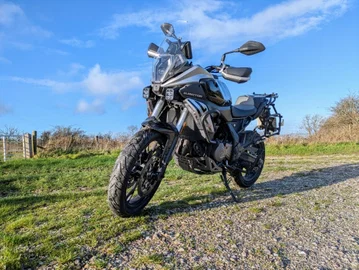
2026 Honda CB750 Hornet E-Clutch - Full review and specs
Honda brings its innovative clutchless riding tech to its popular middleweight naked.

- E-Clutch works so well you forget about it
- Excellent build quality
- Styling may not stir the soul
I don’t want to shoot myself in the foot here, but one might argue that Honda didn’t need to fly me to Portugal to test ride the 2026 CB750 Hornet E-Clutch.
Because, in most ways, it’s not that different from the CB750 Hornet that Editor Toad Hancocks reviewed in 2023 when the iconic model first returned to the scene.
READ: 2023 Honda CB750 Hornet review – The legend returns
Although, admittedly, the way in which it’s different is pretty big: Honda’s E-Clutch system. A fancy bit of technology that Toad has also written about.
READ: What is Honda E-Clutch, why is it here, and who is it for?

The combination of those two elements demands a fresh look. Besides, who am I to turn down a trip to Portugal?
In application, the E-Clutch offers an experience somewhere between a traditional quickshifter and a fully automatic transmission. I’m a bit confused by its existence. I mean, Honda already had quickshifters. It already had DCT. Why add this?
Why ask why, I suppose. It just is. And now it is on the Hornet 750. I spent a day getting to know the bike and its fancy new transmission. Here’s what I learned.
The Hornet Pedigree
The Hornet name stretches back to the late 1990s with the fruity CB600F—a bike that was the perfect mix of cheap, fun, and reliable. In 2023, Honda brought the name back as a fizzy 755cc parallel-twin. Sticking to that original formula, the modern CB750 Hornet has been massively successful, selling upward of 42,000 units across Europe and consistently sitting in the top three best-selling mid-size nakeds.

I’ll be honest: until I actually rode the Hornet 750 with E-Clutch, I didn’t have much interest in either the bike or the tech. Naked bikes aren’t usually on my dream list, and E-Clutch just didn’t sound like a need waiting to be fulfilled.
But - as I mentioned in my review of the WN7 - Honda has a habit of working toward a future that no one else is able to see. So, spoiler alert: I was wrong in my dismissal.
The main event: What is E-Clutch?
Perhaps the easiest way to think of E-Clutch is as a really fancy up-and-down quickshifter. But it’s a really fancy quickshifter that actually works, and one that you can use from a dead stop.
You choose the gear. You choose when that gear is applied. Your foot does the work. You just never squeeze anything with your left hand.

That’s it. It’s not an automatic transmission; it’s just clutchless shifting. Honda still equips the bike with a clutch lever, and you can use it to override the system at any time if so inclined, but the point is that you don’t need to.
The physical E-Clutch system is contained in a smallish box that sits on the right side of the engine. It contains two tiny motors and roughly half a dozen sprockets that work in tandem with the bike’s electronics to make your left hand redundant.
Equipping the Hornet 750 with this system adds just 4 kg to the bike’s wet weight (bringing it to 196 kg) and adds a mere £100 to the £7,449 base price tag.
Riding with E-Clutch
Where this system gets impressive is in how smooth, reliable, and easy it is. Unlike a traditional quickshifter, it works at any RPM. There is no need to find a rev-range sweet spot; just click the shifter pedal up or down as you see fit. When you do, the E-Clutch coordinates with the ride-by-wire throttle and traction control to apply the gear change without a jerk or stutter.

We’ve all had that moment of coming into a corner hot, focusing so much on lane position, throttle, and braking that we flub the downshift. We clunk down a gear, let out the clutch like a newb, and unsettle the whole show. E-Clutch takes your idiot downshift in its stride, smooths it out, and allows you to enter the corner safely with one less thing on your mind.
Another key advantage comes when taking off from a standstill. At a traffic light, E-Clutch allows you to sit in first gear without holding the clutch in or using the brakes. You just sit there. When the light turns green, you twist the throttle and go. No Hendon Shuffle, no accidentally stalling with a white van breathing down your neck. Just go.
It also means your left hand remains free to bring your visor down even as you’re accelerating into second gear.
It isn’t absolutely perfect, however. I wonder whether people riding two-up would appreciate the system as much. I felt a few times that an experienced hand feathering the clutch would have offered a smoother gear change.
Engine, Chassis, and Handling
The bike’s 755cc parallel-twin engine claims 90.5 bhp and 55.3 lb-ft of torque. Those aren’t "clutch your pearls and call to Jesus" numbers, but Honda makes the most of them.

The engine is punchy and willing to play. Power delivery is smooth, linear, and feels more torquey than the spec sheet suggests, largely thanks to the 270-degree firing order giving it a distinct V-twin feel.
There are five riding modes (Sport, Standard, Rain, and two User modes) that adjust power delivery, engine braking, and traction control. In the User modes, you can turn the traction control off entirely, though it will automatically turn back on the next time you start the ignition.
Handling is brilliant. The bike is flickable - wearing its 196 kg well - but never skittish or aggressive. The 41mm Showa front fork is non-adjustable, while the rear shock offers seven-stage preload adjustability. I suspect particularly aggressive riders might ask for the Nissin brakes to have a smidge more bite, but for regular road riding, they allow for excellent, nuanced braking.
The weather in Portugal turned out to be wet and miserable (hence the presence of ugly waterproof gear in the riding photos) but even in those conditions the Hornet proved confidence-boosting. I found myself willing to shift my weight and body position more, being a little more daring than usual.
The Hornet 750 is approachable. Don’t confuse my meaning there. It’s not tame or lacking in fun factor. It’s just not terrifying.

I agree with what Toad said about the bike back in 2023: “The Hornet is a slightly more mature take on what a mid-weight naked can be, and don’t think by mature I mean boring. This bike is certainly not boring.”
Look, Fit, and Maintenance Fears
Aesthetically, not much has changed since 2023, save for a tweaked headlight housing - which makes it look more insect-like. I’ll admit the styling underwhelms me. Others are happy to disagree.
Deimanté of the Tomboy a Bit YouTube channel was also on the ride. At pretty much every stop she would pull up next to me and shout: "This motorcycle is so beautiful!"
My test bike wore the Goldfinch Yellow paint scheme and Design Pack, and I will admit that it looked a little better than some other liveries.
Build quality of the bike is top tier. The only real ergonomic critique is that Honda has placed the mirrors too close to one another, so you end up seeing a whole lot of your own arms and not enough of what’s behind you.

Throw a leg over the 795mm seat and the bike is instantly comfortable. The riding position is relaxed enough for big-mile days, with an uncluttered 5-inch TFT screen sitting in your lower periphery.
On a servicing note, Honda should be commended for being one of the last manufacturers to equip bikes with a tool roll under the seat. But the home mechanic in me recoils slightly at the idea of eventually having to fiddle with the E-Clutch’s motors and sprockets just to access the clutch plates.
Competition
The Hornet 750 exists in a crowded field. Here’s a look at some (but not all) of the bikes it’s up against:
ENGINE | OUTPUT | STARTING PRICE | |
Honda CB750 Hornet E-Clutch | 755cc parallel twin | 90.5 bhp | £7,549 |
Aprilia Tuono 660 | 660cc parallel twin | 105 bhp 51.6 lb-ft | £11,495 |
CFMoto 800 NK | 799cc parallel twin | 94 bhp 59.7 lb-ft | £5,999 |
Kawasaki Z650 S | 649cc parallel twin | 67.3 bhp 47.2 lb-ft | £7,199 |
KTM Duke 790 | 799cc parallel twin | 94 bhp 59.7 lb-ft | £7,999 |
QJMotor SRK 800 | 778cc parallel twin | 95 bhp 55.3 lb-ft | £6,699 |
Suzuki GSX-8S | 776cc parallel twin | 82 bhp 57.5 lb-ft | £7,999 |
Triumph Trident 660 | 660cc triple | 81 bhp 47 lb-ft | £8,095 |
Yamaha MT-07 w/ Y-AMT | 689cc parallel twin | 73.4 bhp 50.1 lb-ft | £7,854 |

Verdict
The CB750 Hornet E-Clutch is a genuinely good motorcycle. It is well-built, comfortable, instantly easy to get on with, and a whole lot more fun than I was expecting.
Does it set my heart on fire? Aesthetically, no. I’ve owned two Hondas over the years, and both suffered from the curse of being utterly reliable but not terribly exciting to look at. For me, the Hornet 750 suffers the same affliction.
That said, the overall package here is so deeply fun and competent that it almost doesn't matter.
And at £7,549, it undercuts rivals like the Yamaha MT-07 (with Y-AMT), Suzuki GSX-8S, and Triumph Trident 660, while offering more power than almost all of them. And none of those rivals have E-Clutch.
There are so many things to think about when riding a motorcycle. E-Clutch removes one of them, freeing up mental space without dulling the riding experience. It’s still motorcycling as you know it - just without the clutch lever.

2026 Honda CB750 Hornet E-Clutch specs
ENGINE | 755cc liquid-cooled parallel twin with 270-degree crank |
TRANSMISSION | Six-speed w/ E-Clutch |
POWER | 90.5 bhp at 9500 rpm |
TORQUE | 55.3 lb-ft at 7250 rpm |
TOP SPEED | 127 mph |
SEAT HEIGHT | 795 mm |
GROUND CLEARANCE | 140 mm |
WEIGHT | 196 kg |
FUEL CAPACITY | 15.2 liters |
FRONT TIRE | 120/70 R17 |
REAR TIRE | 160/60 R17 |
FRONT BRAKES | Radial mounted four-piston Nissin brake caliper, 296 mm floating double disc |
REAR BRAKE | Single piston caliper, 240 mm single disc |
FRONT SUSPENSION | Showa 41 mm SFF-BP USD, 130 mm travel |
REAR SUSPENSION | Monoshock damper, Prolink swingarm, 150 mm travel |
Read more motorcycle reviews on Visordown.

Chris Cope is a fourth-generation journalist, originally from Texas. He has lived in the UK for roughly two decades and has been writing about motorcycles for most of that time. He has written for dozens of publications and websites in the UK, US, Canada, and Australia.