Honda CB1000F (2026) review: The most authentic retro bike you can buy?
The Honda CB1000F takes inspiration from the legendary CB750F, but underneath its 1980s styling is a thoroughly modern litre naked. We ride it to find out whether Honda has got the retro formula right.

* Beautiful styling and graphics
* Seat comfort - vibes aside - is great
One bike of the last five years that seems like it’s been taking it an age to arrive is the Honda CB1000F. Patent filings, photos and patent filings have been steadily arriving since 2020, and now, having ridden the bike, it seems like Honda had waited all that time just to get the CB1000F exactly right.
Before we get into the review, why now, and why is this arguably Honda’s most important retro of the last decade?
“Creating Honda’s superbike identity”

The early 1980s were a wild time in motorcycle racing. Riders would regularly swap classes from 250 to 500 GP, and the pre-World Superbike era threw up some interesting contests. One such race was the U.S. versus Britain Transatlantic Trophy. The 1980 BTT saw a clean-cut, well-spoken 18-year-old from Louisiana line up alongside some of the biggest names in the sport. On his own US team were Kenny Roberts, Wes Cooley, Randy Mamola and Dave Aldana, while the British team included legends such as Barry Sheene, Ron Haslam, Mick Grant and Keith Huewen.
Spencer arrived at a track he’d never seen before, secured a race win, and went on to be the outright winner by outscoring his rivals. But it wasn’t this race that secured Spencer’s place in motorcycle racing lore. For years he’d been plying his trade with his relaxed, compact riding style in the AMA. There he raced a CB740F, a bike which, when bored out to over 1,000cc made around 140bhp, and arguably helped to usher in the Superbike era as we know it.

Spencer’s exploits in AMA spawned an army of replicas, and even today, Facebook is still brimming with fan pages and groups that love nothing more than showing off their Honda CB750F AMA rep’.
For Honda, the CB750F was more than just another four-cylinder road bike. In the hands of Freddie Spencer, it became a rolling demonstration of what the company’s superbikes could do, with his AMA sccuess helping turn the CB750F into a machine with genuine competition credibility. That mattered at a time when production-based racing was rapidly becoming a serious part of the motorcycle landscape, and Spencer’s success helped cement Honda’s reputation for building fast, usable and raceable superbikes. The influence went beyond the results, too, with replicas appearing across the US and the CB750F becoming one of the bikes that helped shape Honda’s performance identity through the 1980s. Four decades on, that connection between a production Honda, a young American racer and the emerging superbike scene remains an important part of the company’s history.
“It’s a tribute, not a replica”

And that brings me to today, standing a stone’s throw from the home of the British GP, staring at the new CB1000F for the first time outside of an exhibition hall. This bike has been so long coming that even the first time you see it in the flesh, you kind of already feel like you know it.
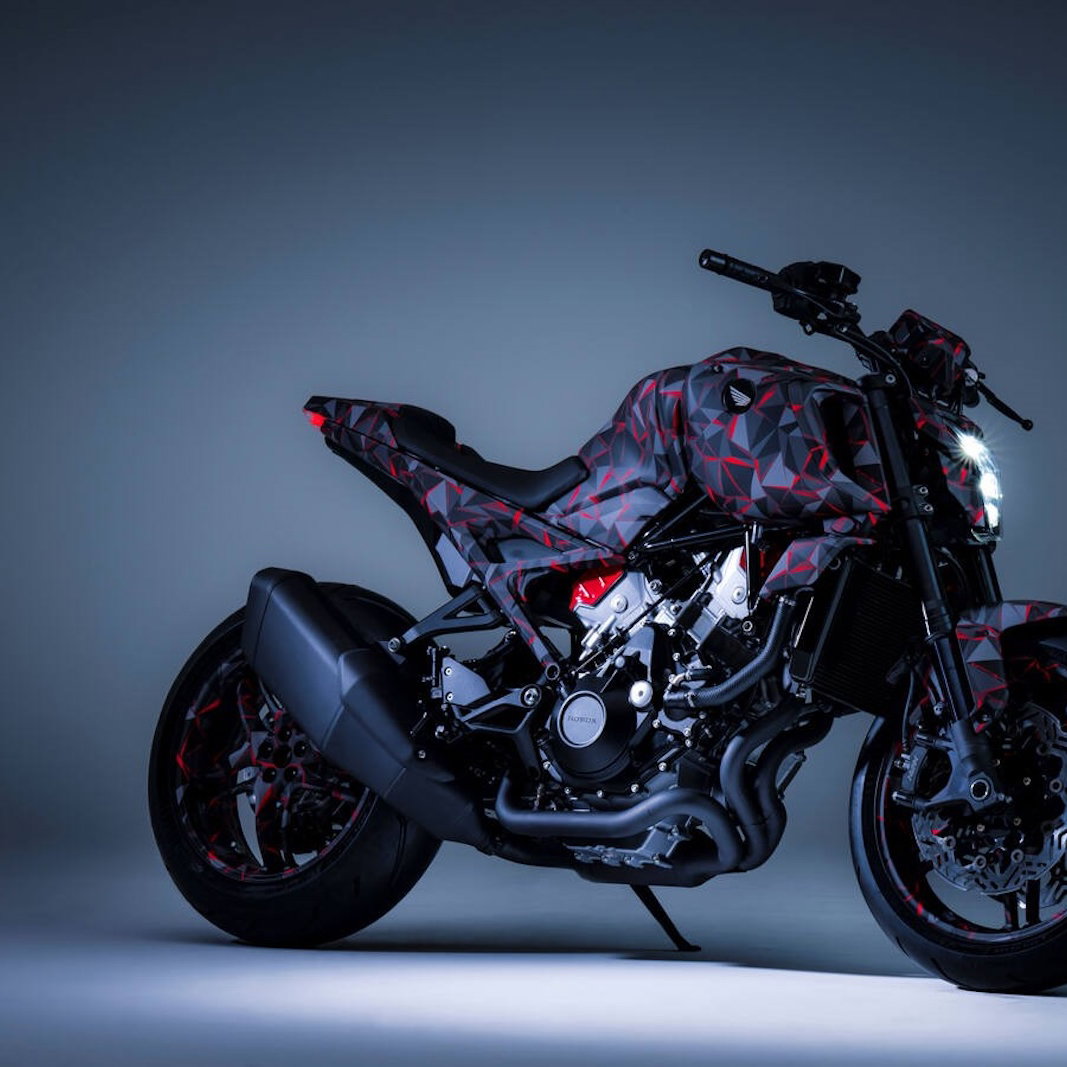
That’s helped massively by how deftly Honda has styled the bike. From the chunky, wider-than-it-looks fuel tank to the achingly evocative decals and the flicked-up seat unit. Every non-mechanical part of this thing screams 1980s AMA. Obviously, there are lots of pointers that this isn’t a genuine 1980s bike, like the engine, brakes and swingarm. That said, Honda has done all it can to draw your eye away from them, and back onto the good stuff.

Climbing onto the bike for the first time reveals an extremely accommodating machine. The seat is super low, extremely plush, and comfortable, while the bars, despite looking a long way away across the expanse of silver in front of me, are a comfortable reach for my stubby bingo wings.
Having been at the launch events for both the CB1000 Hornet and GT, I thought I knew what to expect from the F. What strikes me as I fire it up, though, is how different it sounds to either of those machines. The exhaust has a rich, mechanical bark to it, which is totally at odds with the sporty shriek you get from the Hornet or the slightly muted tone the GT produces.

Everything else at this point of the ride is pure Honda. The switchgear is pared back, and everything is placed where you want it. The clutch is feather-light, and as I select first gear, there is a satisfying thunk from below. Pulling away reveals an extremely short first gear, but that’s deliberate. The first two cogs are both lower than you find on the Hornet and GT. Paired with the revised engine tune, which puts an emphasis on low and mid-range grunt, and you have extremely quick acceleration off the line. So much so, in fact, that on several occasions, I opt for pulling away in second, with first mostly redundant save for some slow-speed power wheelies.

The short initial ratios and revised delivery do highlight one slight bugbear, but only when riding around town and when using the sportiest riding mode. The throttle is extremely direct, to the point that feathering the throttle at low speed can introduce a little on/off throttle chop, which can become annoying.
Out of town and on the open road is where the CB really delivers, though, and it’s where I encounter the real subtleties of the bike. Ride it gently, and it's forgiving and easy-going. The soft suspension soaks up the bumps, and you just waft along. The brakes are super strong and the ABS, on dry warm roads at least, isn’t overly intrusive. At those speeds, it’s all very amenable and almost friendly.

As you push the pace up, though, the bike changes almost beyond recognition. First of all, at these speeds, it doesn’t handle like any other modern naked. It slithers under power, squirms on the brakes, and rears its head when you crank on the power coming out of a corner. Compared to the Hornet, and pretty much every other naked and super naked on the road, it’s soft, really soft. But the more you ride it, the more it starts to make sense. This isn’t an out-and-out naked sports bike, with a foot on the track and a toe on the road. This is a back road scratcher with a style all of its own. Take it on track, and most of the middleweight nakeds would blow it into the weeds, but that’s beside the point. The enjoyment of riding this bike isn’t the speed or the apex you just nailed; it comes from riding a modern bike that seems to have been engineered to give you a taste of what a different era felt like.

A big part of that comes from the exhaust note, which sounds like its been crafted by people in white coats and tuning forks, not by Euro regulations and noise meters. To help get the authentic, retro soundtrack, Honda used a period-correct four-into-one exhaust, but really went to town with the silencer, which features a three-chamber megaphone muffler. It doesn’t just look the part, it sounds it too, with an initial mechanical bark and then a wail as it heads north toward the 12,000rpm redline.
But it’s not just the backside of the system that is helping to create the aural delight. It all actually starts at the other end of the bike.

The F is running a drastically different engine to the ones found in the Hornet and GT. Sure, there are lots of ECU and mapping tweaks going on, but the real magic sauce comes starts at the intake with mismatched-sized intake funnels. This causes a ‘pulsating’ intake sound, which flows through the engine, creating the symphony that exits from the pipes. It’s not loud, but it does sound very, very nice.
"Old school looks with just enough modern tech"

Electronically, there are obviously a lot of things here you won’t find on an OG CB750F. The TFT, for starters, is a world away from the twin-clock set up that Mr Spencer would have glanced to as he chased around the Daytona banking at 160mph. Within the TFT your’ll find all the usual tech and features, including Honda Roadsync, HISS, traction control, wheelie control, engine brake control and an adjustable quickshifter.

One of the most interesting features here, though, is the riding modes, of which you have three to choose from and two user modes. Rain is exactly as you’d expect, with a soft throttle, lots of traction control and ABS that’s always on DEFCON 1. Sport is where I spend most of my time, due to the reduced intervention and punchiest delivery, although the Standard riding mode is arguably the most interesting.
Instead of just creating a halfway house between Sport and Rain, Honda decided to try and build an electronic bridge to the bike that inspired its latest tribute. To do that, the engineers designed a mode that is supposed to replicate the feel of a bank of carbs. Look, I’m not going to pretend that I could feel that – my experience of riding carb’d inline fours isn’t huge. I can, though, say that it definitely feels different when you roll on the throttle, and when its backed by that beautiful exhaust note, it makes riding the thing feel like much more of an event.
“Comfort, with a caveat”

Overall the CB1000F is very comfortable. The seat is extremely plush and expansive, the ergonomics are very relaxed, and the ergonomics (for my 5 foot seven inch frame) are spot on. The one thing I did notice was some high frequency vibes through the pegs and the bar.
The vibes through the pegs are not a surprise to me, I picked up similar vibrations on the CB1000 Hornet, and the two bikes are very similar. The vibes, though, are ramped up through the bars, possibly owing wider 835mm items found on the retro.
And that's actually a pretty good summary of the CB1000F. It isn't trying to be the fastest, sharpest or most technologically sophisticated litre naked Honda makes. In fact, if that's what you're looking for, a CB1000 Hornet is sitting a few feet away in the very same showroom.
What the F does instead is take that same basic performance potential and wrap it in something considerably more interesting.
Verdict: “More than just retro cosplay”

That brings me to the question I had when I first saw the bike: is the CB1000F just a styling exercise? No. Not even close.
It is easy to look at the tank, graphics, seat unit and exhaust and assume Honda has simply taken a modern naked and dressed it up in 1980s clothing. But spend some time riding it and you realise there is much more going on than that. The engine has been recalibrated, the gearing has been changed, the intake system has been reworked and the electronics have been given their own character. Even the suspension has been chosen to deliver something quite different from the increasingly firm, aggressive set-ups you find on many modern performance nakeds.

Honda hasn’t just styled the CB1000F to have the look of a retro from the early 1980s, it has engineered the machine feel more like a retro. It’s not totally authentic, it won’t steadily leak oil and starting it won’t require you to twiddle the choke on a cold morning. But I think it does at least give you a whiff of what riding an actual bike from this era was like.
There are plenty of retro motorcycles that look backwards but ride like perfectly modern machines. The CB1000F is different because Honda has allowed some of the character of the original idea to influence the way the bike actually feels. It moves around, it squats under power and dives on the brakes. It isn't quite as precise as a modern super naked, and that's precisely why it is so enjoyable.
To sum up the CB1000F, I'd call it the litre super naked for grown-ups. It's extremely comfortable, fast enough for any UK road, packed with enough technology to make it easy to live with and styled like nothing else currently on the market.
The CB1000F doesn't try to recreate the past. It takes the bits that made those old Hondas special and asks what they might feel like if you built one today.
That's what makes it much more than just retro cosplay.
Find the latest motorcycle news on Visordown
Honda CB1000F specs
ENGINE | |
Engine Type | Liquid-cooled DOHC 4-stroke 16-valve 4-cylinder |
Engine Displacement | 1000 cc |
Bore x Stroke (mm) | 76 mm × 55.1 mm |
Compression Ratio | 11.7:1 |
Max. Power Output | 91.0 kw at 9,000 rpm |
Max. Torque | 103 Nm at 8,000rpm |
Max Speed | 230 km/h |
Oil Capacity | Lower 3.0 L / Upper 3.5 L |
Starter | Electric starter |
FUEL SYSTEM | |
Carburation | PGM-FI Fuel Injection |
Fuel Tank Capacity | 16 L |
CO2 Emissions WMTC | 129 g/km |
Fuel Consumption | 5.6 L / 100km |
ELECTRICAL SYSTEM | |
Battery Type | AGM |
Battery Capacity | 12 V 6.3Ah |
DRIVETRAIN | |
Clutch Type | Wet multiple, assist slipper clutch |
Transmission Type | Six-speed manual transmission |
Final Drive | Chain |
FRAME | |
Frame Type | Diamond frame |
CHASSIS | |
Dimensions (L´W´H) | 2,135 mm x 835 mm x 1,125 mm |
Wheelbase | 1,455 mm |
Caster Angle | 25 ° |
Trail | 98 mm |
Seat Height | 795 mm |
Ground Clearance | 135 mm |
Kerb Weight | 214 kg |
Turning radius | 2.8 m |
SUSPENSION | |
Suspension Front | 41 mm Showa USD SFF-BP Fork 130 mm travel |
Suspension Rear | Separate pressurized single-tube type cushion unit Pro Link 140mm travel |
WHEELS | |
Wheels Front | 17M/C X MT3.50 |
Wheels Rear | 17M/C X MT5.50 |
Tyres Front | 120/70ZR17M/C (58W) |
Tyres Rear | 180/55ZR17M/C (73W) |
BRAKES | |
ABS Type | Dual-channel cornering ABS |
Brakes Front | Radial mounted Nissin four-piston brake caliper, 310 mm floating double disc |
Brakes Rear | Nissin mono-piston caliper, 240 mm single disc |
INSTRUMENTS & ELECTRICS | |
Instruments | Five-inch TFT Panel Multi information display |
Headlight | LED |
Taillight | LED |
Connectivity | Roadsync |
USB | USB-C |
Security System | HISS |
Riding mode | Standard, Rain, Sport + 2x User |
HSTC | Yes |
Wheelie control | Yes |
Rear lift control | Yes |
SMART Key | Yes |
Additional Features | ESS |

Simon (AKA Toad) has been working within the motorcycle industry for more than twelve years, and a member of the motorcyclist family since birth. Growing up around British-built single and twins, it was inevitable that a life on two wheels was on the cards, from a very early age!