LiveWire S4 Honcho Trail review
The LiveWire S4 Honcho Trail is a tiny electric off-roader with 14.6bhp, 30Nm of torque, 73 miles of claimed range and a distinctly mischievous character.

* As simple as motorcycles get
* Build quality seems to be great
* Brakes feel wooden
* Usability limited – in the UK at least
LiveWire continues to play the EV long game, chipping away at the two-wheeled world’s toughest nut to crack. It’s done the big, premium bikes, and also the lighter, cheaper and easier-to-justify mid-weight stuff thanks to the S2 range.
Now, though, it’s jumping into uncharted territory, with its two-bike (for now, at least) S4 Honcho family.
Right from the outset, you can tell this isn’t a bike that takes itself particularly seriously. With tiny wheels and a distinctly toy-like appearance, it looks more like something you'd find lurking in the back of a barn than parked outside a bike dealer.
The Trail version of the S4 is the first to arrive in Europe, and as its name suggests, it's the off-road-only one. That does raise some questions in the UK, where non-homologated bikes can easily become the vehicles of choice for anti-social behaviour, and because of that it needs to be ridden on private land and with the owner's permission.

For this press launch, we had just that, thanks to a beautiful gîte a stone’s throw from the Palace of Versailles, Paris.
The sleepy, straw-filled barns and ageing farm machines were the perfect backdrop for a bike that will, in some regions anyway, be spending lots of time in the wild.
Our ‘wild’ for this event consisted of a load of tracks and trails, either carved into the hillside or cut out of long grass meadows. There were some tighter wooded sections, dusty climbs, and deeply rutted and decidedly dicey ploughed fields.
We had two loops to get our riding impressions, photos and video in order. On any other off-road or adventure bike, that would never be enough. Thankfully the Honcho isn’t a bike you really need to get under the skin of!
S4 Honcho Trail spec, tech, and pricing

The Trail variant of the Honcho will be landing in UK dealerships priced at £4,599, with the Street variant (which is arriving later this year) coming in at £4,999. That makes the LiveWire in either variant a more expensive option than the £4,199 Honda Monkey 125, although it’s not a million miles away in terms of PCP affordability.
Honda Monkey 125 | LiveWire S4 Honcho Trail | |
Power | 9.2 bhp | 14.6 bhp |
Torque | 10.7 Nm (7.8 lb ft) | 30 Nm (22 lb ft) |
Weight | 105 kg (kerb) | 114 kg |
Range (claimed max) | 232 miles | 73 miles (at 20mph sustained) |
One of the more interesting aspects of this bike is that it’s the first model to arrive thanks to LiveWire’s technical partnership with KYMCO. So while the branding and decals proudly declare it is “Designed in Milwaukee”, the casting marks on the brake calipers and discs tell a different story, and carry the name of the Taiwanese brand.
On the build quality and fit and finish front, I have no complaints. The powder-coated frame has a deep, quality finish to it, and when you ride the Honcho, there are none of those annoying squeaks and rattles you get from some electric motorbikes.
Powering the bike are two removable batteries that can be charged from LiveWire’s own external charger. The two batteries weigh 10 kg each, making them chunky, but not so heavy that most people couldn’t remove them and carry them a reasonable distance to recharge them.

When that is required, a domestic socket will get you from 20 to 80 per cent in around two hours. A full, zero to 100 per cent charge will take around three and a half hours. Should you not be able to wheel the bike to within reach of a plug socket, you’ll need to remove the Ionix battery units and take them to one to charge them separately. That will ultimately alter those charging times.
The two batteries give a combined capacity of 3.48 kWh, giving the bike a claimed maximum range (at a sustained 20mph) of 73 miles. A more realistic figure of 53 miles is given when the WMTC standard is applied.
Freed from the homologation rules that control road bikes, the Honcho Trail is refreshingly stripped back. There’s no traction control, no ABS and not even the now-obligatory TFT.
You do get two rider modes, high and low power, each with dedicated throttle and regenerative braking maps. Battery capacity and riding mode are conveyed to you via two LEDs mounted in the handlebar top clamp.
Is the Honcho worth the hondo?

Our first lap on the bike begins after a very short intro to the controls. There isn’t much to cover here: turn it on, switch to full power mode, and off we go. The bike runs a conventional braking set-up, with the front brake on the right handlebar and the rear brake on the right footpeg.
It seems a slightly odd decision, given that many lightweight EVs adopt a scooter rear brake on the left handlebar, and I think doing so in this case might make the bike easier to live with for those moving up from a scooter or electric-assist bicycle.
And while we are on the subject of brakes, they are a bit wooden. There’s not really any feel from either the front or the back, and with no ABS to lean on, you have to be really careful when negotiating steep and dusty descents so as not to lose the front.
It’s only a two-piston system at the front, with a dinky 240mm disc. That does make locking the front a very real possibility. I also think it's this that’s robbing the bike of that all-important feel. You might be able to get more feedback with some better pads, but for the Honcho’s funbike remit, it’s not a huge issue.
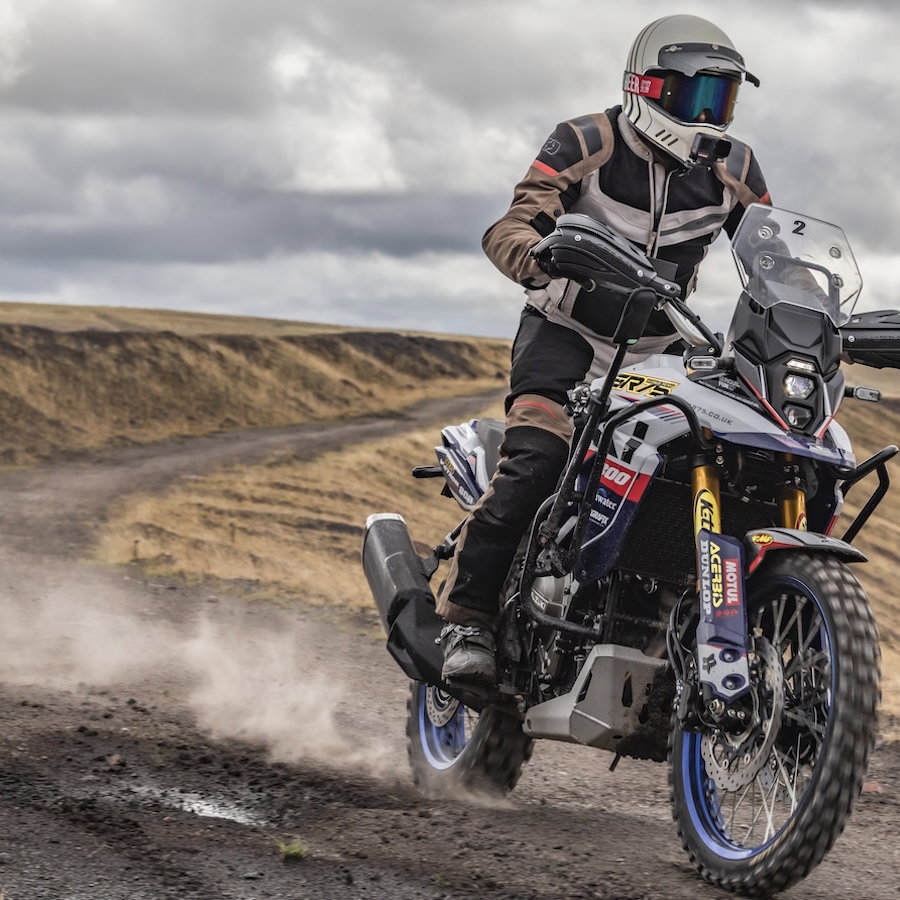
Out on the trails around the gîte, the Honcho is huge amounts of fun. It’s obviously been created by people with a sense of humour, and that comes across in the riding experience. The first part of the lap is a mad dash across a field that was scarified to create our path, and it’s fair to say this isn’t the most accurate and sure-footed thing I’ve ever ridden off-road.

The tiddly 12-inch knobbly tyres do their best to find traction, but once you are up to speed, it begins to have a mind of its own. It scurries along the ground like a mongoose chasing after a squirrel. And like a mongoose, it also seems to dart about like it's never quite sure which bit of the trail it wants to be on. It gives you the feeling that you are in control of the thing, but only just, and every fast section of riding ends with me giggling uncontrollably.
That feeling is probably not helped by the fact that for most people, it will be almost impossible to get standing up on the pegs. You can, in a kind of BMX rider fashion, but it doesn’t feel natural, and for the most part I found myself riding scrambler style with my backside on the seat and leg outstretched.
One thing the honcho does very well is soak up abuse. The route we used featured several big hits, from ditches crossing the trails (which we’d hit at around 30mph) to a rabbit warren that had collapsed, leaving a two-foot crater. If this lap was anything, it wasn’t easy going on the little Honcho.
You only have 260 mm of front and 285 mm of rear suspension travel, and the ground clearance is just 194 mm. That does mean you’ll be bottoming the bike out without too much trouble, but the little bike just soaks up the hits and carries on.
There were more than twenty journos at the event, riding in three waves on just a handful of bikes. After all that, the only mechanical issue to speak of happened to me. A branch caught the chain and pulled it off the sprocket, but with the Honcho being so light and small, within a couple of minutes it was back on, and we were on our way again.

That’s the kind of thing that could mean the end of playtime on a bigger off-roader or adventure bike, but on the Honcho you can fix it like you’re out riding a BMX with your mates.
If there is one element of the riding experience that could be fixed quite simply, it’s the regenerative braking. This takes real wheel rotation and uses that to put some energy back into the battery.
On most electric bikes I’ve ridden, it feels like the engine braking effect you get from a four-stroke. On the Honcho, it feels like a two-stroke, giving you the impression that you could coast on a closed throttle for miles on end.
I’d like a bit more engine braking effect, either through a setting update or the ability to adjust it myself. Better still, if LiveWire/KYMCO could develop a system like the one found on the Flying Flea C6, whereby the rider can manually increase regen braking by twisting the throttle backwards against the stop, it might help to mask some of the shortcomings of the mechanical brakes.
LiveWire S4 Honcho verdict

You know as soon as you set eyes on the Honcho that this isn’t a serious bike for serious people. And when you take it at face value, it’s great. It’s hilarious fun to ride, rugged and, thanks to the super-low seat and lack of complicated controls and technology, very accessible. The Honcho is a great fun little toy, but that’s really about all.
I loved hooning around on it, and it’s an absolute giggle factory, but there’s no getting away from the fact that there’s a very specific type of customer who can actually buy one and properly use it.
Unless you have a farm with acres of space and a network of trails, and fancy having the coolest shepherd bike in the county, you’re basically going to be limited to riding it around your garden. The alternative, and one I obviously wouldn’t recommend, is riding it somewhere you shouldn’t, like on the road or in public spaces.
LiveWire will argue that the Street variant is there to solve exactly that problem, and it does make considerably more sense for most people. The trouble is, it just doesn’t look quite as cool as this Trail. There’s something about the tiny wheels, chunky tyres and stripped-back design that makes the off-road version far more appealing.
In the UK, especially, that makes the Honcho Trail a bit of an oddity. At £4,599, it’s around double the price of a used Honda Grom, and while the two bikes are obviously very different things, that puts the LiveWire into an awkward part of the market.

In the USA, and some other regions, it will be a totally different story. With miles of public land that are accessible to off-road bikes, I’m sure it will be a much easier sell, and quite possibly something many ICE manufacturers will want to be wary of. Here in the UK, it’s a very different story.
So yes, I’ve had a brilliant time on it, but I’m not entirely sure there are enough people in the UK with the right combination of private land, money and desire for a tiny electric off-roader to make the Honcho Trail an easy sell. For everyone else, it’s probably going to remain the sort of bike you have an enormous amount of fun riding when someone else hands you the keys.
Find the latest motorcycle news on Visordown

Simon (AKA Toad) has been working within the motorcycle industry for more than twelve years, and a member of the motorcyclist family since birth. Growing up around British-built single and twins, it was inevitable that a life on two wheels was on the cards, from a very early age!