Akaso 360 review: Motorcycle action camera bundle tested
I've been testing the Akaso 360 motorcycle action camera for the last few months to find out whether it can genuinely challenge Insta360's dominance of the market.

* Excellent Accessories and hardware
* Battery life and ease of use
* Not fully waterproof without a case
* Audio quality is poor at speed
If you've spent any time scrolling through motorcycle content on YouTube, Instagram or TikTok over the past few years, chances are you've seen footage shot on an Insta360 camera.
The brand has effectively become the default choice for riders wanting to create third-person riding shots, dramatic tracking footage and slick social media clips without needing a second person to follow them around. The problem is that getting into 360 filming isn't cheap. An Insta360 X5 will currently set you back around £500 – and that’s before you've even started adding a few must-have accessories.
That's where Akaso reckons it can tempt people away from the established market leader.
The Chinese camera brand has built a reputation for producing affordable action cameras aimed squarely at riders, cyclists and content creators who don't necessarily want to spend flagship money. Its latest effort, simply called the Akaso 360, is the company's first crack at the increasingly popular 360-degree camera segment, and, on paper at least, it appears to tick many of the same boxes as the established competition.
Dual lenses? Check. 5.7K 360-degree video? Check. Horizon lock, image stabilisation and AI-assisted editing? Also present. More importantly than any of that, though, is that it arrives with a significantly lower asking price than its biggest rivals – £299.99 for the motorcycle bundle I have, although prices for the camera alone begin at just over £200.
I've been using the Akaso 360 for the last few months on road rides, track launches and off-road events to find out whether it's a genuine alternative to the likes of the Insta360 X5 and X4, or simply another budget camera with a long specification sheet.
Akaso 360 Motorcycle Combo specifications and features

Price as tested: £299.99 (correct at the time of writing)
- Dual 1/2-inch CMOS sensors
- 5.7K 360-degree video recording
- 72MP photo mode
- 360-degree Horizon Lock stabilisation
- SuperSmooth image stabilisation
- 2.29-inch touchscreen display
- WiFi and Bluetooth connectivity
- MicroSD card support up to 512GB
- Claimed battery life of up to 120 minutes
- Splash-resistant construction
- Weight: 180g
First impressions and getting started

The pack I received from Akaso was the 360 Action Camera Motorcycle Combo, which, going by the Akaso Amazon store, currently comes in at £299.99, although the price does appear to change fairly regularly.
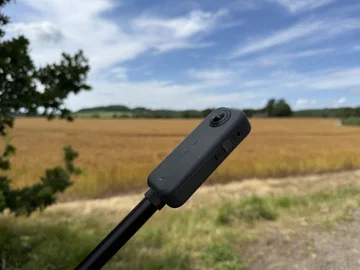
Inside the box, you get a surprisingly generous amount of kit. Alongside the camera itself, there's an invisible selfie stick, two batteries, a 128GB microSD card, a pair of clamps, a charging cable, lens wipe, soft carrying case and a rubber lens protector for when the camera isn't being used.
It's all packaged neatly and, unlike some accessory bundles that can seem cheap and tacky, the mounting hardware actually feels decent. The clamps in particular are extremely robust and inspire far more confidence than some of the generic kit I've accumulated over the years.
The camera itself is immediately familiar, being roughly the same size and shape as an Insta360. The lenses appear slightly smaller than those fitted to an Insta360 X5, but visually the two cameras are very close in design, size and weight.
Using it is similarly straightforward. The button layout differs slightly, but anyone who has previously used a 360 camera will be comfortable using it within minutes.

My first opportunity to use it came during the Ducati Hypermotard V2 SP launch, where I mounted it to the bike before heading out onto the track. Since then, it's also been used on a variety of road rides, off-road events and additional track launches.
Importantly, there was very little learning curve involved. I loaded in a memory card, formatted it via the touchscreen menu and started recording. The menu structure is logically laid out, making it easy to find the functions you actually need without endless digging through sub-menus.
Once that first track session was complete, however, I ran into my first frustration.
Unlike Insta360's software, the Akaso desktop application isn't available through the MacBook App Store. After ten minutes of hunting around online, I eventually discovered that the desktop version needs to be downloaded directly from the Akaso website. It's hardly a deal breaker, but it does feel like an unnecessary complication in 2026. It’s worth noting that the mobile version of the app is available via the Apple App Store.
Video quality and editing tools

Once installed, the software is perfectly usable, although it's clear that Akaso hasn't had years to refine its editing ecosystem in the way Insta360 has, and that goes for both the desktop and mobile versions; they both have the same quirks.
Viewing footage within the application reveals the first noticeable compromise. Image quality isn't bad by any means, but it lacks some of the crispness and detail found in footage from an Insta360 X5. On the plus side, the colours are extremely bright and vibrant, almost to the point that I want to start pulling back the vibrancy a bit once the footage is rendered.

The reframing tools work well enough and allow you to create the same style of dynamic camera movements that have made 360 footage so popular. The software starts to struggle, though, if you begin stacking lots of reframe points close together. Edits that would feel seamless in Insta360 Studio can require a bit more patience here.
Object tracking is perhaps the weakest area. While the feature works, it's noticeably slower and far less reliable than the equivalent Insta360 system. On a motorcycle, where subjects are moving quickly, and other bikes are constantly entering and leaving the frame, the software regularly becomes confused and loses its target.
For occasional use, it's acceptable. For creators relying heavily on tracking features, it would quickly become frustrating.

There is also a fairly visible stitch line between the front and rear lenses, which isn't disastrous, but it does mean you need to think carefully about camera orientation when mounting it to the bike - which is something you really shouldn’t have to consider with a 360 camera.
One area where the Akaso genuinely impresses is stabilisation. The horizon lock and image stabilisation are genuinely excellent. Even during aggressive track riding with plenty of rapid direction changes, the camera rarely loses its bearings, with the footage remaining stable, smooth and easy to watch.
When exporting clips, it's worth paying close attention to the settings, as the default export options don't do the footage any favours. Selecting the highest available resolution and pushing the bitrate to maximum dramatically improves the finished result. The downside is the time it takes to render the footage. Exporting a decent-sized clip can easily take 15 to 20 minutes, but the additional wait is well worth it.
Battery life, waterproofing and accessories

Battery performance is one of the stronger aspects of the Akaso package, and while the claimed up to 120 minutes of runtime is a little ambitious, I’ve got a respectable runtime of around 55 minutes per battery. The fact that Akaso includes two batteries in the box is also a major plus point. Once one battery runs low, it's simply a case of swapping in the second and carrying on filming.
Where the camera is less impressive is weather protection, as unlike some rivals, the Akaso is only splash resistant and isn't designed to be submerged without additional protection. For motorcyclists, that's a significant limitation. It means I've largely restricted my use to dry weather riding because I'd be reluctant to expose the camera to prolonged rain and road spray.

The included accessories go some way towards making up for that shortcoming. The selfie stick is impressively sturdy, featuring twist-lock sections that prevent it from extending or collapsing unexpectedly while riding. The included double-clamp setup is also particularly useful, allowing you to brace the extended selfie stick against another mounting point to reduce vibration and movement. It's a simple addition, but one that clearly shows somebody at Akaso has spent a bit of time thinking about how riders actually use these cameras.
Is the exported video quality of the Akaso 360 as good as the Insta360?

In a word, no. The gap isn't enormous, but it's definitely there. While the colours are as vibrant as the Insta360 X4 or X5, the overall sharpness and detail of the video are closer to what you'd expect from an older Insta360 X3. When viewed on a phone screen or used for social media content, most people probably won't notice. Start viewing footage on a larger monitor, or uploading to the lion's den that is YouTube, however, and the difference becomes much more obvious.
Audio quality is another weak point, despite Akaso's claims of stereo audio recording. On a bike, the microphones quickly become overwhelmed by wind noise. Anything much above 40mph sounds like the camera has been strapped to the side of a jet engine. That’s forced me to largely avoid using the camera's native audio in Visordown videos. Instead, I've either muted it completely or synced audio recorded separately through my Insta360 Ace Pro, which delivers vastly superior sound quality.
Akaso 360 Verdict

The Akaso 360 isn't an Insta360 X5 killer; in fact, it isn't even particularly close.
The footage isn't as sharp, the audio performance is miles behind, and the software lacks the polish that Insta360 has spent years refining. That's especially noticeable when you start using features like object tracking or building more complex edits. It’s here where the Akaso can feel a little rough around the edges.
There is a ‘but’ to all this, though, and it’s quite a big one. At around £300 for the Motorcycle Combo, complete with a decent spread of accessories, spare battery, SD card, selfie stick and mounts, the Akaso is targeting riders who want to get into 360 filming without spending north of £600 on a camera alone and another £100 on kit and accessories. Take out all the accessories, and you could bag yourself the camera on its own for around £220.
For road rides, trackdays, green lanes and the odd social media reel, it does enough. The stabilisation is impressive, the camera itself is easy to operate, and the included mounting kit is among the best bundled setups I've used.
If you're already running an Insta360 X3, X4 or X5, there's very little reason to switch. The Akaso doesn't really offer anything those cameras can't already do better.
If, however, you've been curious about 360 filming but couldn't quite justify premium-camera money, the Akaso is a relatively safe bet. It delivers most of the experience, most of the features, and enough image quality to keep casual creators happy.
To bring this review back to the world of motorcycles, the best way I can describe the gap between these two is like this: The Yamaha MT-09 is a class-leading naked bike, full of top-level race-derived technology and shod with class-leading equipment. It’s been honed over the years and is now one of the best naked middleweight bikes on the planet. The QJ Motor SRK900 is also a middleweight naked bike. It doesn’t do anything quite as well as the MT-09 does, but it costs roughly half as much to buy.
So there we have it, action cameras are actually just like middleweight naked motorbikes; you really do get what you pay for.
You can check out the 360 and the full Akaso range over on the official website.
Find the latest motorcycle news on Visordown.com

Simon (AKA Toad) has been working within the motorcycle industry for more than twelve years, and a member of the motorcyclist family since birth. Growing up around British-built single and twins, it was inevitable that a life on two wheels was on the cards, from a very early age!