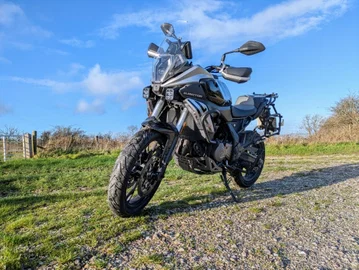
2026 Honda XL750 Transalp E-Clutch - Review
Honda brings E-Clutch technology to its excellent middleweight adventure machine.

- Excellent showcase of E-Clutch technology
- Punchy engine with great exhaust note
- Tubed tyres may annoy some
- Cruise control would be nice
Ladies and gentlemen, Honda may have built the perfect middleweight adventure bike.
Usually, I can find things to complain about with the bikes I test ride. Not so with the 2026 Honda XL750 Transalp with E-Clutch.
That’s a feat made all the more impressive by the fact that the Transalp 750 shares much of its platform with another bike (in other words, it is not unique).
Yet, somehow, despite sharing an engine, frame, and E-Clutch tech with the CB750 Hornet, the Transalp 750 does it better. Everything makes more sense in this context. It’s more functional, and dare I say, more fun.

You may also want to read my review of the 2026 Honda CB750 Hornet E-Clutch.
The Resurrection of a Legend
The Transalp 750 borrows a much-loved name from Honda’s not-too-distant past. The original XL600V Transalp was launched in 1986, powered by a 583cc V-twin engine that promised peak outputs of 55 bhp and 38.8 lb-ft of torque. In 2000, capacity was boosted to 647cc (XL650V), then up to 680cc (XL700V) in 2008.
The model was ultimately dropped in 2012, with Honda making the questionable decision of seemingly replacing it with the NC700X, which then became the NC750X that is so favoured by European commuters. While the NC750X is a middleweight with adventure styling, it is definitely not a middleweight adventure motorcycle.
After roughly a decade of leaving competitors free to eat up market share with great bikes like the Yamaha Ténéré 700, Honda resurrected the Transalp name in the form of a 755cc parallel-twin.
Launched in 2023, the XL750 Transalp has gone on to sell in excess of 30,000 units across Europe. A year later, Honda rolled out its E-Clutch system – a technology that effectively eliminates the need for a clutch lever while maintaining the overall motorcycling experience.
Now, for 2026, all the pieces have come together. Honda has brought E-Clutch tech to its 750 adventure platform, tweaked the suspension, and created a bike that has me constantly thinking: “How can I get my hands on £10,000?” (The Transalp 750 E-Clutch asking price is £9,999).

Look, Fit, and Feel
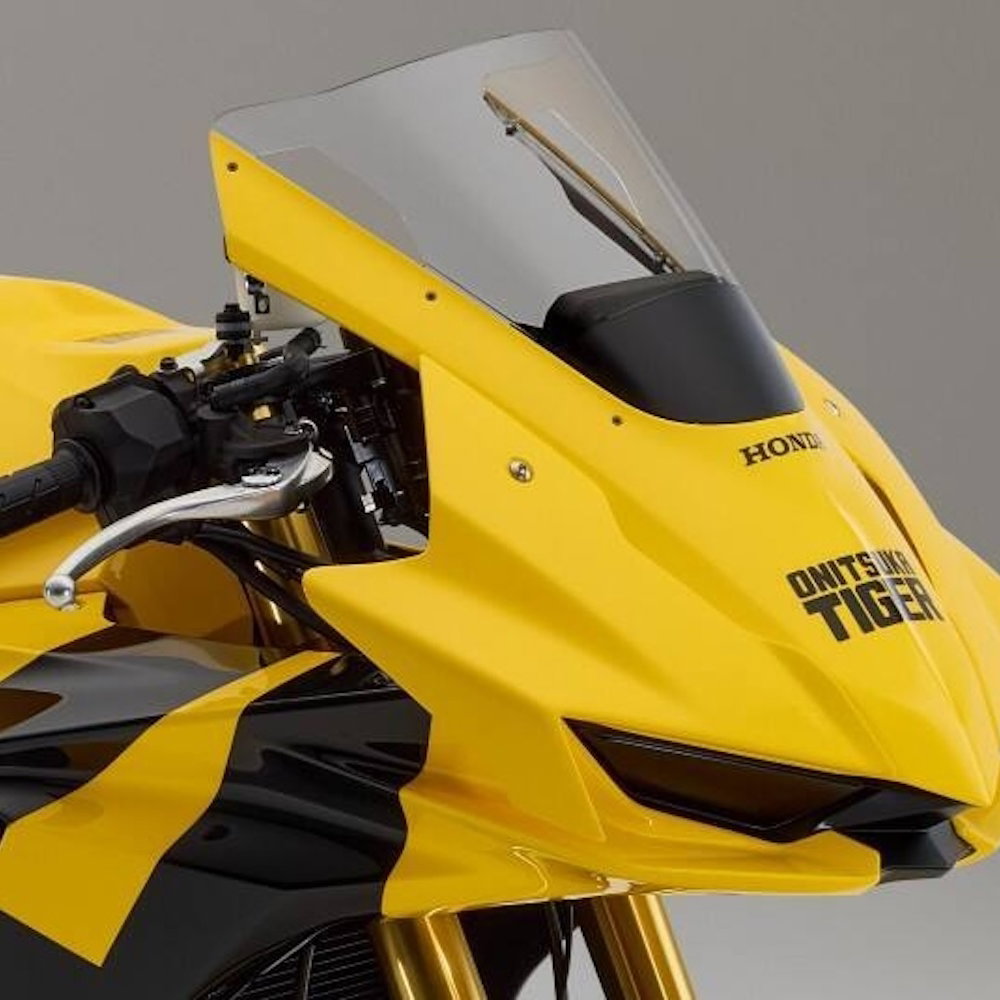
The Transalp 750 E-Clutch is a good-sized motorcycle but not intimidating. Too often, manufacturers try to make their adventure bikes look like some kind of a war machine. The Transalp 750 looks more like a bike that’s made to be used.
Its styling ties it somewhat to the CRF1100L Africa Twin, but there are also clear nods – especially in the cowling and windscreen shaping – to the original Transalp. I appreciate when designers seek to maintain consistency with the past.
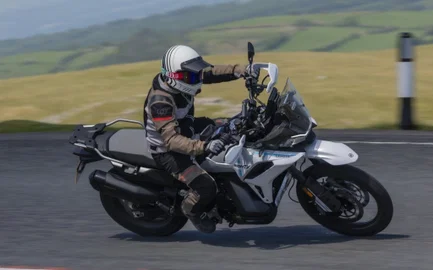
The 2026 model comes in three paint schemes: Ross White Tricolour, Mat Ballistic Black Metallic, and Pearl Deep Mud Gray. The last of those is the one you see me riding in the photos – bedecked in Comfort Pack accessory trim. It has turquoise pinstriping that, from a distance, makes it look as if the bike is wearing CFMoto colours. I can’t imagine that was intentional, though it is ironic given how the Chinese brands so often emulate the Japanese.
The bike comes standard with a rear carrier and an aluminium bash plate that’s now 2.5mm thick and designed specifically to protect the E-Clutch system. A USB socket is handily tucked under the seat.
Build quality, as you would expect from Honda, is excellent. It’s not opulent luxury, just well-built and right. It has the look of a motorcycle that will still be up for daily use 20 years from now.

Hoist a leg over the bike’s 850mm seat (a lower 820mm option is available) and you’ll encounter a saddle that is all-day comfortable. There’s plenty of room for a passenger on the one-piece seat, though an adult might be unsure about a multi-day jaunt to the Carpathian Mountains.
Honda says the ergonomics have been designed to offer “natural leverage” when both sitting and standing. I’m not sure I understand the marketing speak, but certainly, it’s true that everything falls naturally into place: hands to bars, feet to pegs. The riding position is upright and commanding.
The switchgear is uncluttered. There is a simple, backlit, four-way switchcube on the left grip to help you navigate the bike’s menus. Looking straight ahead, a 5-inch TFT display sits in the lower periphery of your view, just behind a non-adjustable windscreen. I would complain about the lack of adjustability were the screen not as good as it is. Honda included a “central duct” in the upper fairing to direct airflow around the helmet and reduce buffeting. At 6-foot-1, I found that this works brilliantly—even at highly illegal speeds.

Engine: The 750 Platform Perfected
The Transalp uses the same 755cc liquid-cooled parallel-twin engine as the Hornet 750, producing the same peak figures of 90.5 bhp at 9,500 rpm and 55 lb-ft of torque at 7,250 rpm. Yet, somehow, it’s so much better in this application.
It sounds better. It feels better. Honda says the Transalp has a mapping ‘flavour’ that’s in keeping with long-distance touring work, but I think the engine also feels punchier here, more willing to have fun.
Power delivery is strong when you want it to be, smooth always, and torquier than you’d expect. The soundtrack is fantastic. Honda has given it a slightly dirt-bike snarl. It's not so loud that you’ll be getting the stink eye from neighbours, but enough that you’ll be cracking the throttle constantly just to hear it.
There are five different ride modes: Sport, Standard, Rain, and Gravel, as well as two User modes that allow bespoke settings. Each affects power delivery, engine braking, traction control, and ABS. As far as fuel consumption is concerned, Honda claims a range of around 240 miles is possible from the 16.9-litre tank.

The Fancy New Thing: E-Clutch Off-Road
Honda has invested a tremendous amount of time, effort, and money to make your left hand redundant. E-Clutch is not an automatic transmission; it’s still up to you to choose which gear you want and when you want it, and you’re still selecting said gear with your foot. The main difference is that you no longer need to squeeze the clutch lever.
You can if you want to – doing so will seamlessly override the E-Clutch system – you just don’t have to. And if you’re particularly averse to the idea, you can shut it off entirely.
The system makes use of a slightly Rube Goldberg-esque mechanism consisting of two small motors and about half a dozen sprockets sitting inside the right-side engine cover. The mechanism responds to the input of your foot and works with the bike’s throttle-by-wire and torque control systems to deliver smooth, judder-free gear changes at any RPM.
In some ways, E-Clutch is a really fancy quickshifter. In other ways, it’s vastly better. The system will blip the throttle as needed, making idiot downshifts clever. This is handy when riding on twisty roads, but it shines off-road. The system detects the ‘hop’ that comes from rapid downshifting and deploys a "half-clutch" to stabilise things. Equally, on off-road upshifts, the system monitors front/rear wheel speed discrepancy to ensure a smooth gear change even if the rear wheel is spinning in the mud.
One aspect I found particularly useful is the fact that you can be at a stop with first gear engaged. When a traffic light turns green, you just twist the throttle and go. Say goodbye to filtering to the front of a long traffic queue only to accidentally stall with a white van breathing down your neck.
Of course, say goodbye to clutch-up wheelies, too – unless you override the system with the lever. Ninety-five percent of the time, the E-Clutch is as slick as a human would be. I suspect there are still technical off-road situations where I’d trust my left hand more than Honda’s tech, but for the vast majority of riding, it is a revelation.

Chassis and Brakes: Fixing the Soft Spots
Another big change for 2026 comes in the Transalp 750’s suspension. When the bike was first launched, some reviewers felt it was too soft, especially for pillion work. For 2026, Honda has taken those criticisms on board, tweaking the 43mm Showa SFF-CA front fork and Pro-Link rear shock, and ensuring that both are now adjustable for compression and rebound damping.
All of this works in conjunction with a steel diamond frame that is shared with the Hornet, paired with a more rugged subframe aimed at better supporting passengers and luggage. The whole show weighs 216 kg wet, yet manages to feel incredibly light and manageable.
Off-road, it is stable and confidence-inspiring – user-friendly enough to reinvigorate an interest in exploring beyond the pavement. On-road, the Transalp 750 is planted, steady, and smooth. It really is a ‘best of both worlds’ motorcycle.
I suspect particularly aggressive riders might ask for brakes with a smidge more bite, but the dual two-piston Nissin calipers working 310mm wave discs up front allow for nuanced, predictable braking.
One genuine point of contention for modern adventure riders: the Transalp’s 21/18-inch wheels wear tubed tyres. This wouldn’t be my first choice, and I suspect I’d become a lot more critical if I had to deal with a flat on the M25 in the pouring rain, but in the grand scheme of things, it’s a minor concession. Honda says it’s to save weight. I suspect it’s to save cost.

Electronics and Maintenance
The 5-inch TFT display is easy to read, with a menu that relies on clear icons. Phone connectivity is possible via the Honda RoadSync app for turn-by-turn navigation, calls, and music via a Bluetooth headset.
Indicators are self-cancelling and based on speed difference rather than a simple timer. You also get Emergency Stop Signal (ESS), which temporarily activates your hazard lights under hard braking to give vehicles behind you a heads-up that you are stopping fast.
As for maintenance, the Transalp comes with a tool kit under the seat. God bless Honda for continuing to trust riders to do basic stuff on their own. Recommended oil changes come every 8,000 miles. Getting at the sump plug isn’t too difficult, though you will have to turn a few more screws to remove the new bash plate. Inspecting the air filter, however, is straightforward but tedious, involving removing the tank and a few other bits and bobs.

Verdict
I said at the beginning of this review that the Transalp 750 is a bike for which I have no criticism. I will admit, though, that outside of the tubed tyres, there is one other quirk that makes me raise an eyebrow.
The off-road-focused "Gravel" mode does not shut off rear ABS entirely; it just drops it to level one. So, you can’t do those cool hooligan dirt slides that you always see in magazines. The solution, though, is easy: use one of the bespoke User modes to build your own off-roading set-up with the rear ABS disabled.
Outside of that, the bike is damn-near perfect.
The Transalp 750 is instantly rideable and confidence-inspiring – not in a boring or tame way, but in a way that makes you more willing and eager to ride closer to your limits. It stands ahead of its naked sibling, better delivering on the promise of the 750 platform.
It can go everywhere I want to go and do everything I want to do. It is friendly, fun, and easy to ride – Honda at its very best. If I have any real complaint it is simply that I don’t presently have the £10k needed to buy one. If you do, I envy you.

2026 Honda XL750 Transalp E-Clutch specs
PRICE | £9,999 |
ENGINE | 755cc liquid-cooled parallel twin with 270-degree crank |
TRANSMISSION | Six-speed w/ E-Clutch |
POWER | 90.5 bhp at 9500 rpm |
TORQUE | 55.3 lb-ft at 7250 rpm |
TOP SPEED | 121 mph |
SEAT HEIGHT | 750 mm |
GROUND CLEARANCE | 210 mm |
WEIGHT | 216 kg |
FUEL CAPACITY | 16.9 liters |
FRONT TIRE | 21-inch, 90/90 |
REAR TIRE | 18-inch, 150/70 |
FRONT BRAKES | Dual 310mm discs, two-piston brake caliper |
REAR BRAKE | 256mm disc, single-piston caliper |
FRONT SUSPENSION | Showa 43mm SFF-CA USD, 200 mm travel |
REAR SUSPENSION | Monoshock damper, Prolink swingarm, 190 mm travel |
Read more motorcycle reviews on Visordown.


Chris Cope is a fourth-generation journalist, originally from Texas. He has lived in the UK for roughly two decades and has been writing about motorcycles for most of that time. He has written for dozens of publications and websites in the UK, US, Canada, and Australia.