Honda Motra revival rumours prompt a look back at 10 weird and wonderful bikes
Honda’s Motra could be making a comeback, so we’re looking back at 10 unusual production bikes from the Japanese manufacturer.

Honda could be looking at reviving the Motra, the chunky little 1980s machine that looked more like a two-wheeled utility vehicle than a conventional motorcycle.
The recently filed patents show designs for both a new petrol and electric version, putting one of the company’s more unusual models back on the radar.
There’s plenty of history to draw on if Honda really is considering a return to the Motra name. While the Japanese manufacturer is best known for mainstream machines such as the CBR, Africa Twin and Super Cub, its back catalogue also includes some rather less conventional creations.
From scooters with unusual transmission systems to miniature Monkey bikes and a 250cc sports machine with an aluminium frame, Honda has experimented with plenty of ideas that never quite became household names. Some were built in tiny numbers, others lasted barely a year, while a few were simply too odd to catch on outside their home market. With the Motra potentially back in the conversation, here are 10 weird and wonderful Honda production bikes worth revisiting.
10. Roller Through GoGo

Okay, we’re starting with a bit of a cheat here, as it hasn’t got an engine, but the Roller Through GoGo, or Kick’n’Go as it was called in America, was one of those attempts to create something new that didn’t quite work out as planned. The original was a tilting three-wheeled scooter for children, but instead of pushing along with a foot on the ground, riders kicked a lever at the back to get moving. A more conventional two-wheeled version and an adult-sized three-wheeler followed in 1976.
Originally the result of an in-house ideas competition at Honda, the scooters proved popular, with the first production run selling out in weeks. Large numbers were eventually sold, but production ended in 1976 after two children were killed in accidents while riding them, leaving the Roller Through GoGo as a rare curiosity today.
9. Z100 Monkey

Most people know the Honda Monkey, but fewer will be familiar with the machine that came before the famous Z50, the 1961 Z100. Launched six years before the Z50M, the Z100 and the CZ100 that followed it were the first models in a line that would go on to spawn countless imitators.
Originally intended for use in amusement parks, the Z100 was used for rides at the park on the Suzuka circuit. It was never sold to the public, and relatively few were made, making surviving examples highly sought-after today. The little machine helped establish the foundations of an entire sub-genre of motorcycles.
8. ZB50 Monkey R

There’s room for another Monkey in this list, particularly when it’s as unusual as the ZB50 Monkey R. Launched in 1987, it took inspiration from the growing trend of modifying Z50s, but came with a beam frame, a disc brake and more sophisticated suspension than the standard Monkey.
The ZB50 was only produced for a year, with production ending in 1988. It remains a lesser-known chapter in the history of Honda’s miniature motorcycles.
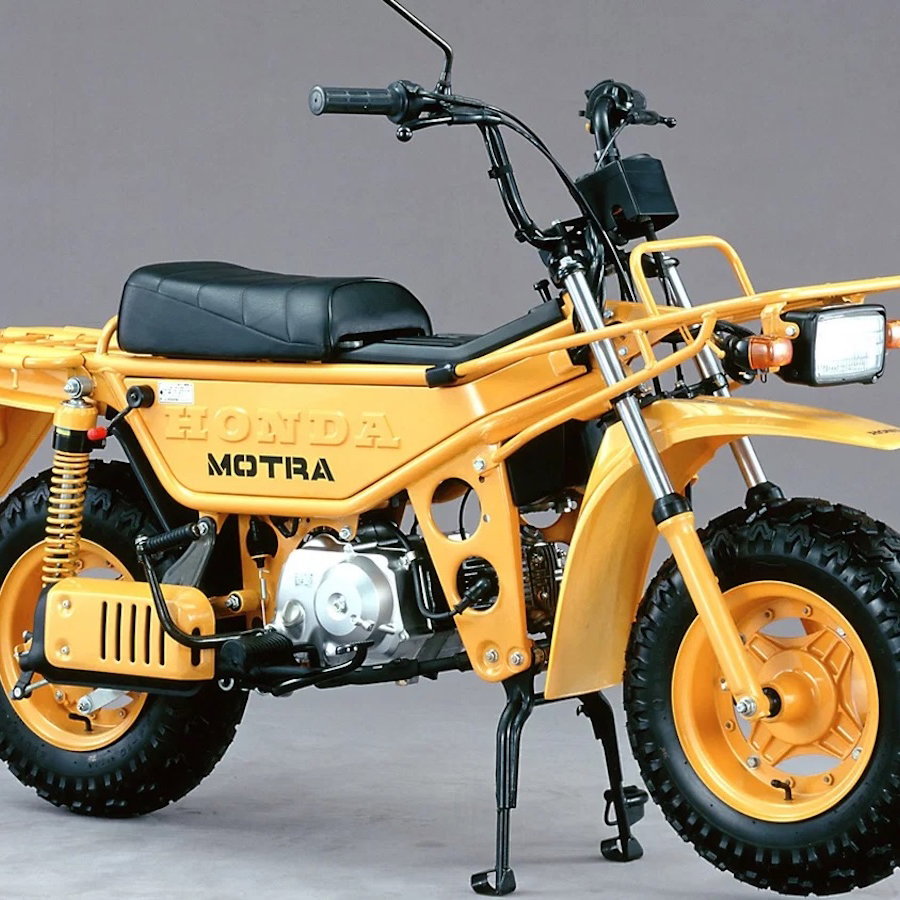
7. CT50 Motra

If Tonka made a bike, this would be it. Developed as a recreational machine with the look of a two-wheeled Jeep, the CT50 Motra combined its chunky styling with a transmission designed to offer more than the usual small-capacity commuter experience.
It used a three-speed gearbox similar to the one found in the Honda C90, but added a two-speed range selector to provide high and low ratios, much like the system used in off-road vehicles. Despite its solid appearance, the Motra weighed just 76kg.
Production began in 1982 and ended a year later, with the model sold exclusively in Japan. That short production run means finding one today can be a challenge, which makes the prospect of a modern interpretation particularly interesting.
6. Juno M80/M85

The M80 and its slightly larger M85 weren’t Honda’s first attempt at building a scooter, but they represented a substantial departure from the machines that had come before when they appeared in 1961.
The original Juno K, launched in 1954, already had some unusual features, including fibreglass bodywork and a tilting sunshade above the windscreen. The M80 and M85 looked more conventional, but their mechanical specification was anything but ordinary.
Power came from a boxer-twin engine, displacing 124cc in the M80 and 169cc in the M85, while the transmission was hydraulic and clutchless. Neither model enjoyed a long production life, with both dropped after roughly a year and fewer than 6,000 examples built between them.
5. FC50 Beat

Mention the Honda Beat and most people will think of the two-seat sports car launched in the early 1990s. A decade earlier, however, Honda used the same name for the FC50, a futuristic-looking scooter introduced in 1983.
Its 49cc two-stroke single featured Honda’s V-TACS system, effectively a rider-operated power valve in the exhaust. Rather than working automatically, it was activated by a pedal operated with the rider’s left heel. Above 5,500rpm, engaging the system increased performance, while activating it below that point had the opposite effect.
The unusual mechanism was accompanied by equally distinctive styling, including a car-like front grille, twin headlights and tinted Perspex bodywork around the rider’s knees. It was certainly different from the conventional scooters of its era.
4. Zook

Scooters are generally intended to provide simple, lightweight transport, but modern examples can be surprisingly large and complicated. Honda’s Zook took the opposite approach, putting simplicity at the centre of its design.
Built around a frame consisting of a single large tube, it used a one-piece plastic body and an engine integrated into the swingarm. Above shin level, there was little beyond the seat and handlebars, giving the Zook a minimalist appearance.
Even the details reflected its intended simplicity. The seat was designed to provide a place to put a helmet, with the shape allowing the lid to sit securely rather than risk falling to the ground. The Zook was another short-lived Honda, appearing in 1990 and lasting just a year.
3. Road Fox

Honda’s Gyro family showed that the company was exploring three-wheeled transport concepts long before the arrival of the Piaggio MP3. The layout used two rear wheels and a single front wheel, with the rear section, including the engine, remaining level while the front end tilted like a conventional motorcycle.
The Road Fox was one of the rarer members of that family. Where other Gyro models looked like scooters, mobility vehicles or delivery machines, the Road Fox combined elements of a chopper and a beach buggy.
Introduced in 1984, it disappeared from the range in 1985. Its unusual appearance made it stand apart even within a family of machines that was already a long way removed from the conventional scooter.
2. AX-1

The Honda AX-1 arrived in Japan in 1988 as a derivative of the NX250, but its combination of road-focused hardware and light off-road styling made it an unusual proposition for its time.
Its alloy wheels and semi-knobbly tyres would look familiar on many modern adventure-style motorcycles, but the combination was less common in the late 1980s. Power came from an air-cooled, four-stroke single producing a claimed 25bhp, giving the 250cc machine a different character from the two-stroke models that dominated much of the market at the time.
The AX-1 was sold only in Japan, limiting its exposure elsewhere. Today, its blend of lightweight construction, modest capacity and mixed-surface styling would fit comfortably into a segment that has become considerably more popular.
1. VT250 Spada

The VT250 Spada is perhaps the clearest example of Honda producing a motorcycle that was ahead of its time, at least in terms of its chassis design. Launched in 1988, it combined a 250cc liquid-cooled V-twin engine with a cast aluminium frame, a specification that would still make sense on a modern lightweight naked sports bike.
The engine was part of Honda’s VT250 family, which continued in later forms, including the Japanese-market VTR250. The Spada’s chassis, however, was a particularly notable feature, with ‘CASTEC’ badges highlighting its cast construction rather than a frame assembled from welded aluminium sections.
It also had a six-speed gearbox, whereas later VTR250 models used five ratios. The Spada’s production life was short, with the model disappearing from the range in 1989, just a year after its introduction.
With the Motra potentially returning to the spotlight, the Spada is a reminder that Honda’s less familiar models haven’t always been defined by their looks alone. Some featured engineering ideas that would become more commonplace years later, while others, such as the Motra, simply offered a different take on what a motorcycle could be.
Find the latest motorcycle news on Visordown
Related Articles


Latest News


Never miss an update.
More News


