Triumph Tracker 400 and Thruxton 400 review, spec, features, price
Two new 400cc Triumphs, one shared engine, but on the road, the Tracker and Thruxton couldn’t feel more different.

* Thruxton is easily the best-looking A2 bike
* Punchier engine
* Thruxton can get wristy after a couple of hours
* LCD on both bikes feels behind the curve
The Triumph A2 family has sprouted two new offshoots for 2026, as the Tracker 400 and Thruxton 400 join the existing Speed and Scrambler editions. Both bikes share the same TR-series engine as they’re siblings, although subtle technical tweaks and styling adjustments mean each new model now sits at the head of Triumph’s A2 range.

To find out how the new bikes handled, Triumph hosted the world’s motorcycle press in Malaga for a day of riding both machines on mixed roads. For this review, I’ll cover the shared technical details and features, and then the report will split out and focus on my time with each model individually.
Triumph Tracker 400 and Thruxton 400 price, spec and shared details

At the core of both bikes sits Triumph’s familiar 398cc TR-series engine, although it’s been given a meaningful rework for its sportier applications here. Capacity, bore and stroke (89 x 64 mm) remain unchanged, but a new cam and revised timing help bump peak power to 41.4 bhp at 9,000 rpm, with the same 27 lb-ft of torque arriving at 7,500 rpm. That’s also paired with a slightly higher rev ceiling, up by 1,000 rpm over the Speed and Scrambler 400.

I questioned the team behind the bike on why Triumph has deliberately avoided chasing the full 47bhp A2 ceiling, and the reasoning was that more peak would detract from the mid-range performance, which is where riders on the road spend more of their time.
The Tracker also gains a small tweak to the chassis geometry which makes a big difference on the road. Its wheelbase becomes the shortest in the TR-series family, at 1371 mm, and is joined by a rake angle of 24.4 degrees. Rounding out the chassis changes are the tyres, with the Tracker 400 arriving with Pirelli MT60 RS flat-track style hoops, while the Thruxton 400 gains sportier Pirelli Rosso Corsa IV rubber.

Both bikes share the same underlying hardware, too. There’s a strong and dependable 4-piston ByBre caliper gripping a 300mm front disc, ride-by-wire throttle, switchable traction control and two-channel ABS, while the gearbox is as slick and light as ever – something that really suits the engine’s flexible, mid-range character.
It’s also worth noting that this higher-output ‘HP’ version of the TR-series engine is reserved for these two models. The Speed and Scrambler continue with the slightly softer 39.5bhp setup.
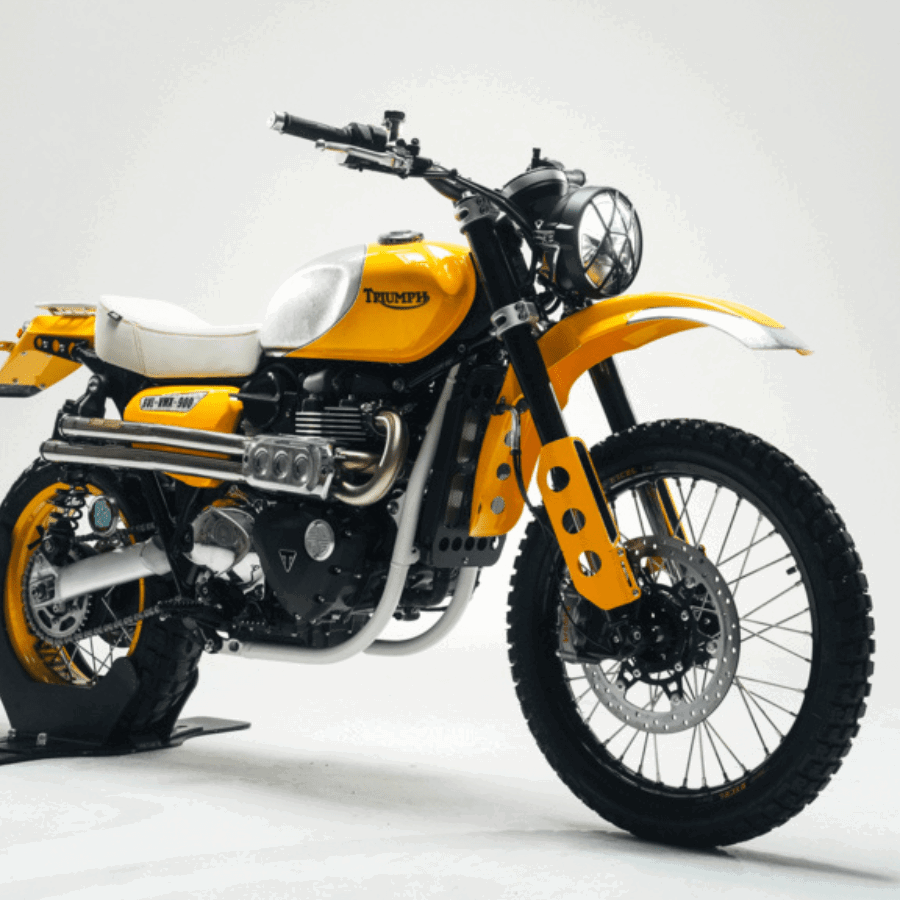
Price-wise, the Tracker lands at £5,745, with the more premium-styled Thruxton nudging up to £5,995. Colour options for the Tracker 400 are Aluminium silver, Racing yellow, and Phantom black. The Thruxton 400 arrives in Carnival red with Aluminium silver, Phantom black with Aluminium silver, Pearl metallic white with Storm grey, and Metallic racing yellow and Aluminium silver
Triumph Tracker 400 review

Of the two, the Tracker is the one that feels the most distinct the moment you climb aboard, with the riding position being the biggest shift. You’re sat upright, pushed forward over a wide set of bars, with the pegs swept slightly back. It gives the bike a roomy, open feel through the upper body, and that freedom translates directly into how it rides.
On the move, it’s easily the more compliant of the pair. With 140mm of travel from the 43mm Showa fork and 130mm at the rear, it deals with bumps and broken surfaces with a plushness that the Thruxton can’t quite match. Paired with the Pirelli MT60 rubber, there’s a slight looseness to the chassis if you go looking for it – but for me, that’s very much part of the appeal.

The bars are extremely wide, giving loads of leverage, and that makes it easy to really manhandle the bike into corners. Combined with its shorter wheelbase and more aggressive front-end geometry, it feels incredibly reactive. Even the smallest input through the bars has it tipping from one side to the other.
Push it harder, and it’ll happily move around underneath you, especially on tighter, slower corners when coming down the gears. There’s a bit of slide, a bit of squirm, and a general sense that it wants to play rather than just carve clean lines.

Crucially, it never feels wayward. It’s all predictable, all controllable, and it adds a layer of involvement that the rest of the 400 range doesn’t quite deliver.
Ride the Tracker back-to-back with the Thruxton, and it’s a bit of an eye-opener just how different they feel, despite sharing so much underneath.
Triumph Thruxton 400 review

Swing a leg over the Thruxton, and the contrast is immediate. Where the Tracker is open and upright, the Thruxton is compact and focused. The clip-ons are around 40mm narrower and more than 200mm lower than the Speed 400’s bars, putting a lot more weight over the front end. The pegs are higher and further back, too, roughly 80mm rearward and 26mm up, while the longer tank and reshaped seat give you space to hang off if you want to.
On paper, it sounds like a properly committed little café racer setup. And to a point, it is.

On the road, though, it’s noticeably less playful than the Tracker. The steering is still accurate and the Pirelli Rosso Corsa IV tyres offer plenty of grip and feel, but it doesn’t have that same loose, flickable character.
Interestingly, it’s also slightly harder to really get into a natural rhythm when cornering. Despite the sportier ergonomics, it doesn’t feel quite as easy to move around on as the Tracker, which is counterintuitive given the intent.

Where it does lean more heavily into its brief is in the riding position itself. It’s undeniably more focused, but that comes at a cost. There’s a lot of weight through the wrists, and combined with the engine’s vibrations, it becomes a bit tiresome after a couple of hours in the saddle. It also handles like it's on rails compared to its more lively sibling.
Still, that’s not really why you’d buy it, because visually, the Thruxton absolutely nails it. It’s one of those bikes that doesn’t fully land in photos, but in the flesh, it’s a genuinely striking bit of design, and in my opinion, it’s easily the best-looking machine in the A2 class right now.
Verdict and shared pros and cons

With both bikes sharing so much of their core hardware, there are some traits that carry across the pair.
The biggest drawback is vibration. From around 3,000rpm upwards, the single-cylinder motor starts to send a noticeable buzz through the bike, and by motorway speeds the mirrors are all but useless. It’s not unusual for a 400cc single, but it is something you will have to live with.

On the plus side, the updated engine does feel punchier through the mid-range. It pulls cleanly, drives well out of corners, and doesn’t demand constant gear changes to make decent progress. When you do need the gearbox, it’s excellent, with a slick, direct, and accurate lever action that is paired with a very light clutch.

As a package, both bikes make a strong case for themselves, but they go about it in very different ways. The Thruxton wins on style alone. If you’re buying with your eyes – and let’s be honest, most people in this segment are – it’s hard to argue against. But if you’re actually riding the thing, the Tracker is the more convincing all-rounder. It’s more comfortable, more engaging, and ultimately more fun to push along a good road.
If it were my money, that’s where it would go.

It just leaves one slight gap in Triumph’s line-up. Because if this engine and platform can deliver something this entertaining here, a properly focused small-capacity adventure bike to take on the likes of the BMW F450 GS or the Kawasaki KLE500 would make a lot of sense. I’m thinking a Tiger 400, with miniaturised Tiger 900 electronics and styling. A bike like that could properly throw a cat amongst the pigeons.
And based on how well these two perform, it’d probably be pretty good too.
Triumph Tracker 400 & Thruxton 400 spec
ENGINE | |
Type | Liquid-cooled, single-cylinder, DOHC, 4-valve |
Capacity | 398 cc |
Bore x Stroke | 89.0 mm x 64.0 mm |
Compression Ratio | 12:1 |
Max Power | 41.4 bhp (30.89 kW) @ 9,000 rpm |
Max Torque | 37.5 Nm (27.7 lb-ft) @ 7,500 rpm |
Fuel System | Bosch electronic fuel injection, ride-by-wire |
Exhaust | Stainless twin-skin header, stainless silencer |
Clutch | Wet, multi-plate, slip & assist |
Gearbox | 6-speed |
Final Drive | X-ring chain |
CHASSIS | |
Frame | Hybrid spine/perimeter, tubular steel, bolt-on subframe |
Swingarm | Twin-sided, cast aluminium |
Front Wheel | 17 x 3.0 in, cast aluminium |
Rear Wheel | 17 x 4.0 in, cast aluminium |
Front Tyre | 110/70 R17 |
Rear Tyre | 150/60 R17 |
Front Suspension | 43mm USD Big Piston forks (140mm Tracker / 135mm Thruxton) |
Rear Suspension | Gas monoshock, preload adjustable, 130mm travel |
Front Brake | 300mm disc, four-piston radial caliper, ABS |
Rear Brake | 230mm disc, single-piston caliper, ABS |
Instruments | Analogue speedo with LCD display |
DIMENSIONS & WEIGHT | |
Length | 2033 mm (Tracker) / 2042 mm (Thruxton) |
Width | 857 mm (Tracker) / 775 mm (Thruxton) |
Height (no mirrors) | 1050 mm (Tracker) / 1110 mm (Thruxton) |
Seat Height | 805 mm (Tracker) / 795 mm (Thruxton) |
Wheelbase | 1371 mm (Tracker) / 1376 mm (Thruxton) |
Rake | 24.4° (Tracker) / 24.5° (Thruxton) |
Trail | 107.6 mm (Tracker) / 101.5 mm (Thruxton) |
Wet Weight | 173 kg (Tracker) / 176 kg (Thruxton) |
Fuel Capacity | 13 litres |

Simon (AKA Toad) has been working within the motorcycle industry for more than twelve years, and a member of the motorcyclist family since birth. Growing up around British-built single and twins, it was inevitable that a life on two wheels was on the cards, from a very early age!