Honda expanding Durabio and recycled plastic use in motorcycles
Some Honda models are swapping plastics for bio-based materials, hinting that the next shift in motorcycles might be one we can’t see, but can measure.

Motorcycles aren’t just changing shape, they’re changing substance. Beneath the plastics and paint, Honda has begun a quiet but meaningful shift in what its bikes are made from. It’s not a concept, a prototype, or a greenwashing press release, as it’s already in production across six current models. It could signal a new era: a motorcycle built not just for performance, comfort or ability, but also for circularity.
The Materials Revolution – Beyond the Bike

Honda’s sustainability strategy isn’t just pinned to electrification. The company’s wider “triple action to zero” approach aims for carbon neutrality, clean energy and full resource circulation by 2050. Manufacturing, logistics, fuel, and – crucially – the materials themselves are all under scrutiny.
That last point has triggered a major push into bio-based engineering plastics and recycled materials, now standard equipment on several bikes in Honda’s European range.
Leading the charge is Durabio, a bio-based plastic derived from inedible corn and wheat. Developed by Mitsubishi Chemical Group, it replaces petroleum-based plastics using a process that extracts natural starches, converts them into glucose, and refines them into isosorbide – a chemical compound with a wide range of engineering uses.

From Honda’s side, this hasn’t been a sudden leap. The company began exploring the application of Durabio in its motorcycle division around 2020, making Honda the first motorcycle manufacturer in the world to adopt the material in series production.
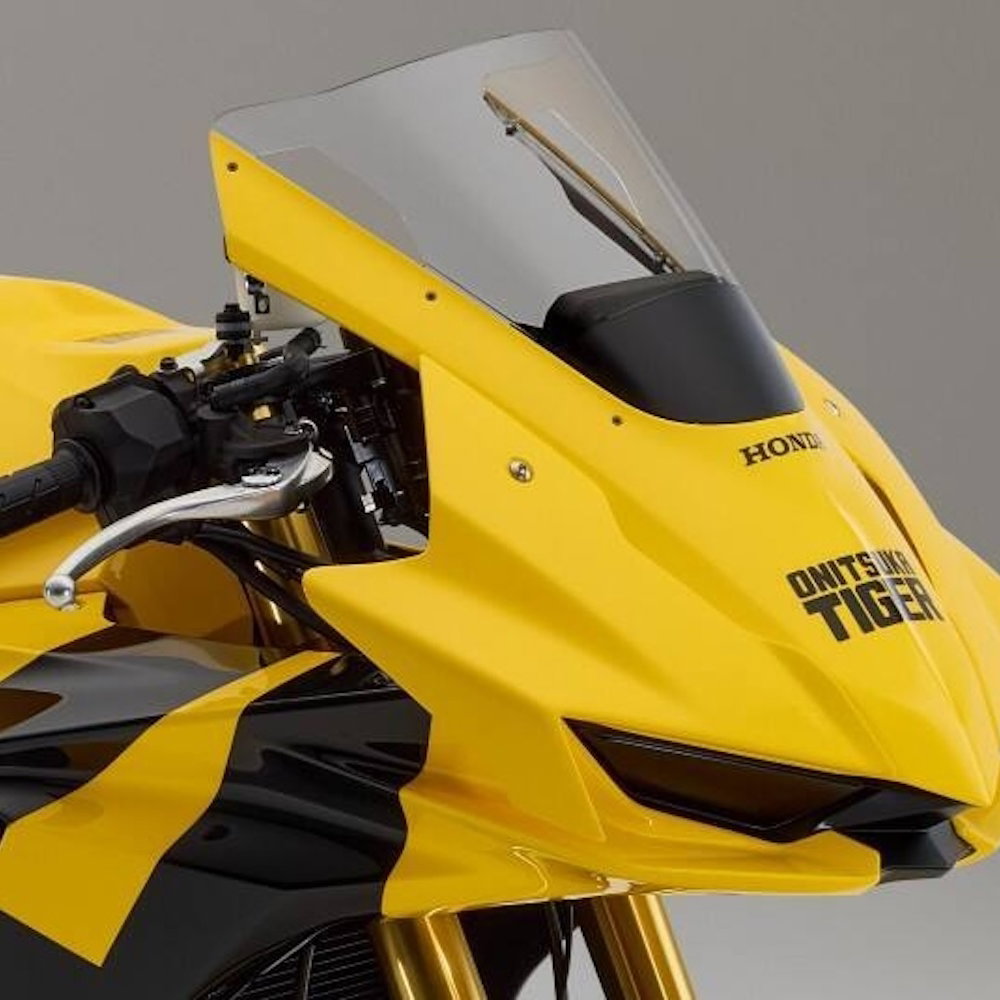
Durabio is particularly well-suited to motorcycle use thanks to its high optical clarity, which in turn allows colour and gloss without the need for paint – the part is coloured during manufacturing. It also boasts excellent scratch resistance for exposed components and strong UV and impact durability, boosting its suitability for adventure and touring bikes. Put simply, it’s durable in every sense, but more importantly, in this context, it allows Honda to finish bodywork without a paint shop. That alone removes an entire emissions-heavy production stage from the process of building a bike.
From Africa Twin to CB1000GT

The first real-world application came in March 2024 on the CRF1100L Africa Twin, which launched with the world’s first motorcycle windscreen made from bio-based Durabio. The X-ADV followed soon after, using it on both the windscreen and skirt cover, and the Forza 750 adopted it for its handlebar central cover and front side cowl.
Durabio has steadily spread across Honda’s motorcycle range. After debuting on the Africa Twin, it appeared on the X-ADV’s skirt cover and windscreen, then the Forza 750’s handlebar cover and front cowl. The NT1100 gained a redesigned front fairing using the material for 25YM, while the NC750X became the first model to feature coloured Durabio bodywork. Most recently, the 26YM CB1000GT joined the lineup with a Durabio windscreen, marking the latest step in its expanding use. So yes, it’s not just limited to concept bikes – it’s already on the showroom floor.

You may have noticed a pattern there. Most of the bikes using Durabio are ADV or touring-oriented, and that’s no accident. High-performance sports models like the Fireblade demand very different material properties from their exterior body panels, and Durabio simply doesn’t meet those specific requirements. In other words, this isn’t about marketing preference, but engineering suitability.
There’s also a cost conversation happening behind the scenes. At a raw material level, Durabio is more expensive than conventional petroleum-based plastics. Honda’s approach has been to offset that by optimising part design and component construction, working to minimise the cost disadvantage at the finished component level rather than treating the material in isolation.
Durabio isn’t the only experiment. Honda’s SH125i and SH150i Vetro scooters use semi-transparent unpainted fairing panels, cutting CO2 output by 9.5 per cent over standard production at Honda’s Atessa plant.
Recycling has also stepped up at Honda

Recycled automobile bumpers, once considered unsuitable for motorcycles, are now used on the luggage box of the NC750X and X-ADV, and the seat base of the Forza 750. Previously, both virgin and recycled automotive bumper materials had material properties that didn’t align with motorcycle component requirements. The breakthrough came through careful control of those properties, combined with redesigned component geometry that allowed the material to work as intended.

Pre-consumer recycled polypropylene (PP) – essentially clean manufacturing scrap – also plays a growing role. With physical properties that match new plastic and no contamination risk, it’s now used extensively on the X-ADV, Forza 750 and 26YM CB1000F, each featuring more than 15 components made from this recycled source. To support that shift, Honda has even built entirely new supply chains dedicated to processing and reintroducing the material.
And it doesn’t stop at plastics. Some aluminium and steel components across Honda’s motorcycle range are already manufactured using recycled materials, quietly broadening the scope of this circular approach.
From linear to circular use

Honda calls this transition a move away from a “take-make-dispose” model and towards a circular value chain, built around five principles:
- Business Innovation – built-in recycling systems from day one
- Advanced Recycling – investment in scalable material recovery
- Data Traceability – digital CO2 monitoring throughout the lifecycle
- Circular Design – disassembly-friendly construction
- Circular Value Chain – industry-wide supply collaboration
It’s a response to a simple problem: around 90 per cent of raw material in new vehicles still comes from fresh mining, and that won’t be sustainable forever. It also ties directly into Honda’s long-standing mantra that the “joy and freedom of mobility” must remain viable in the decades ahead – a future where virgin raw materials may be harder, and more expensive, to obtain.
There are limits, of course. Even with Durabio, Honda doesn’t design motorcycle components to be repaired via plastic welding or similar methods – and that’s true of conventional materials too. The focus here isn’t on repairability at the panel level, but on reducing impact at the point of creation.
The result is that the motorcycles arriving in showrooms now aren’t just evolutions of previous models, but early steps towards a circular future. One where fairings don’t come from oil, seats are made from car bumpers, and paint is replaced by bio-polymers derived from corn.
We may not yet be riding fully recycled motorcycles, but it increasingly feels like that’s the direction of travel.
Find the latest motorcycle news on Visordown.com

Simon (AKA Toad) has been working within the motorcycle industry for more than twelve years, and a member of the motorcyclist family since birth. Growing up around British-built single and twins, it was inevitable that a life on two wheels was on the cards, from a very early age!