Triumph Trident 800 (2026) review
Faster and more capable than the Trident 660, but calmer and more accommodating than a Street Triple – the Trident 800 could be Triumph’s most rounded naked bike yet.

* Handling and road manners
* Wet weather composure is excellent
* No trick wheelie control
Triumph’s naked and roadster range has always been a bit like Goldilocks’ porridge. One is a bit too small, one a bit too hot, and somewhere in the middle there’s supposed to be a bike that is just right. Since the Street Triple R is being phased out, that middle bit is looking suspiciously empty.
At one end, you’ve got the Trident 660 – approachable, friendly, and responsible for more than half of Triumph’s mid-weight naked sales. At the other end sits the Street Triple 765 RS, RX and Moto2 Edition. Each is a brilliant bike, but also quite a lot if all you actually want is a road bike, and not a track-focused supersport bike with its fairings removed. The Street Triple R used to bridge that gap, but since it is being quietly slipped out of the catalogue, a replacement is required.
That is where the new Trident 800 steps in.
For the press riding launch of the new Trident 800, we jetted off to Cyprus, for around 100 miles of mixed mountain roads and equally eclectic weather conditions.
Trident 800 price, colours and availability

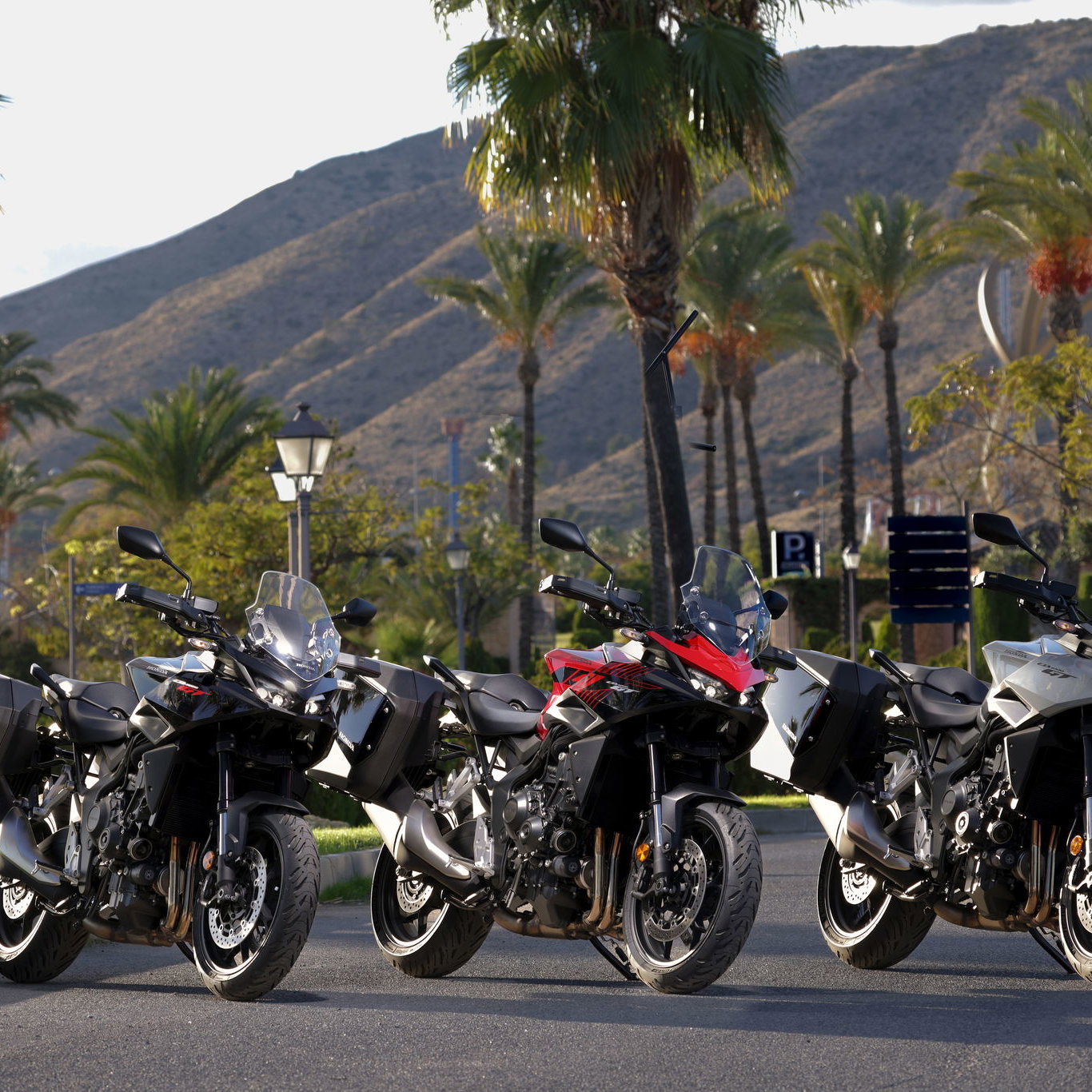
The Trident 800 will be arriving in UK dealers priced at £9,195 OTR, with bikes landing from March 2026 onwards. Colour options are Ash Grey with Diablo Red detailing (as ridden), Carnival Red with Graphite accents, and a Jet Black option for a more dark, moody vibe. Thankfully, each colour option gains the lovely gold wheels - because gold wheels make everything better.
Benchmarking that against the competition sees the new top-spec Trident coming in cheaper than the £11,995 Ducati Monster V2, the £9,810 Yamaha MT-09, and the £9,199 base-spec Kawasaki Z900. One bike that could also be considered to be a rival to the new Trident (going on price at least) is the Honda CB1000 Hornet, which undercuts the Triumph with its bargain basement £9,099 price tag.
What is the Trident 800 all about

On paper, the Trident 800 looks like a sensible extension of the Trident idea rather than a detuned Street Triple. And that’s important, because this bike isn’t trying to be an RS with the edges filed off. It’s something else.
Power comes from a 798cc inline triple, that is closely related to the Tiger Sport 800 (TS800) engine, but with its own mapping and tune. You get 115PS, 62lb ft of torque and an 11,500rpm redline. The engine is fed by triple throttle bodies, with the power being pushed through the same gearbox ratios as the TS800. There’s a new, higher-flow exhaust too, which explains the chunky silencer hanging off the side.
The frame is also new, with geometry that is more relaxed than a Street Triple’s. Suspension is Showa at both ends – 41mm SFF-BP forks with compression and rebound adjustment, and a rear shock with preload and rebound – while braking is handled by twin four-piston J.Juan calipers biting 310mm floating discs.

Add in Michelin Road 6 tyres, an up and down quickshifter, cruise control, Bluetooth connectivity, a hybrid TFT/LCD dash, IMU-based traction control and ABS, and three riding modes (Road, Rain and Sport), and the spec sheet reads exactly how you’d expect for a modern £9k-plus naked.
Ergonomically, it feels much the same as the Trident 660, but much more relaxed than the Street Triple. The bars are a generous 815mm wide, the seat height is 810mm, and the wet weight is quoted at just 198kg – making it only 3kg heavier than the Trident 660.
Triumph Trident 800 riding review

If you’ve ridden a Trident 660, you’ll feel immediately at home on the 800. Around town, it’s light, unintimidating and completely unfussy. Steering is easy without being vague, the clutch action is light, the throttle response is clean, and everything works exactly as you expect it to.
It almost sounds stupid to say it, but at urban speeds, the Trident 800 feels like a 660 that’s been to the gym. The same friendly manners, the same willingness to just get on with the job – only now there’s more midrange, more shove when you ask for it, and a stronger pull as the revs climb.
That relaxed geometry pays dividends here too. It doesn’t fall into turns like a Street Triple, but it also never feels reluctant or lazy. Filtering is effortless, U-turns are drama-free, and the wide bars give you plenty of leverage at walking pace.
Out of town, however, is where the 800 starts to earn its stripes.

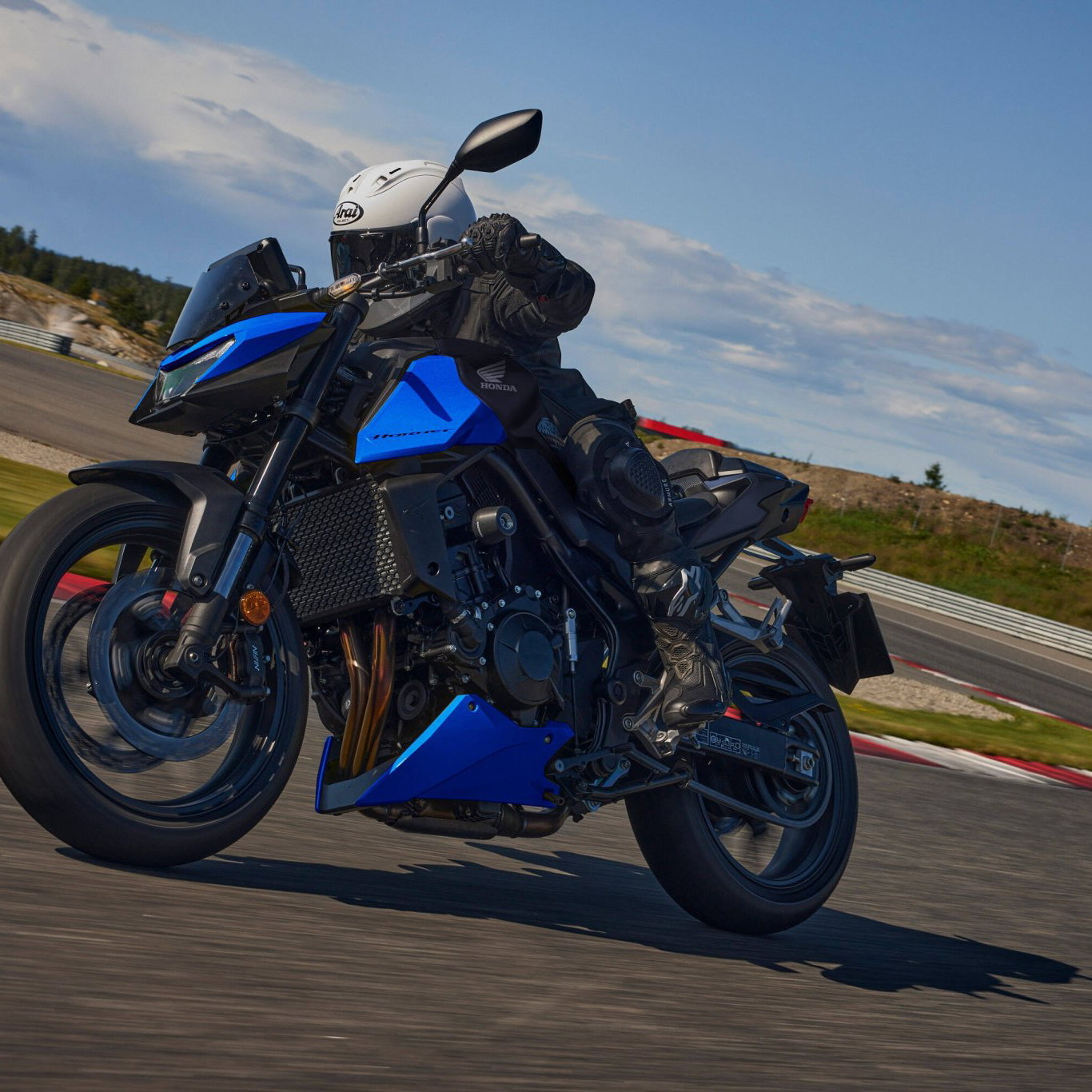
Once the roads open up, the differences between the 660 and the 800 become much clearer. The suspension is noticeably firmer, tuned in a sportier direction, and the whole bike has a more taut, planted feel.
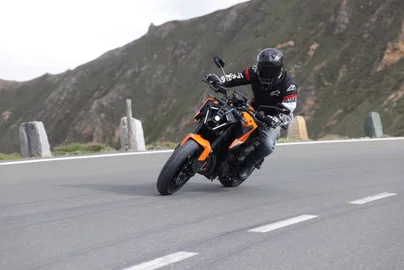
That said, it still sits a step back from the Street Triple in terms of outright aggression. Where the Street can feel like it’s permanently egging you on, the Trident 800 is calmer, more measured, and arguably better suited to the kind of riding most of us actually do.
The riding position plays a big part in that. The bars are higher, wider and closer to the rider than on the Street Triple, which gives you masses of leverage when flicking through tight, technical sections. It’s quick to turn, but never nervous, and that agility doesn’t come at the expense of stability when the speed picks up.
And it had plenty of chances to prove that.

The roads out in Cyprus were a proper mixed bag of surface conditions and grip. One minute you’re on a billiard-smooth strip of fresh tarmac, the next you’re dodging potholes, cracks and tree roots that look like they’ve been actively placed to ruin your day. Add in the weather, which swung wildly between sunshine, mist, drizzle and biblical rain, and it was a proper test.
The Trident 800 took it all in its stride. The suspension stayed composed over bumps and lumps, never flustered and never harsh, and the chassis gave consistent, predictable feedback no matter what was happening underneath.

A big shout-out has to go to the Michelin Road 6 hoops, which were faultless in everything from standing water to bone-dry tarmac. But the bike deserves credit too. In sketchy conditions, confidence is everything, and the Trident 800 delivers that in spades. The brakes are strong without being snatchy, the throttle is smooth and easy to modulate, and the quickshifter works cleanly whether you’re riding lazily or hammering it to the redline.
Rain mode deserves special mention, too, as rather than strangling the engine and turning every throttle opening into an exercise in patience, Triumph has kept full power but softened the throttle response and cranked up the traction control. It’s one of the few rain modes I’ve used on a road bike that doesn’t actively suck the joy out of riding in the wet. You can still make that overtake without getting frustrated at the electronics; it just builds its speed more progressively in the lower part of the rev-range.

Wheelie control is linked to traction control rather than being a standalone system, which works fine, though it does feel like a missed opportunity to not include the more sophisticated setup from the latest generation Speed Triple. That wheelie-on-command system is quite frankly brilliant, and made riding the Speed Triple a much more enjoyable experience. Adding that to the Trident 800 would have been a real USP in the middleweight segment.
That engine, though…

I need to talk about this engine. I spent a good chunk of 2025 riding the Tiger Sport 800, and there’s a reason it walked away with Visordown’s sub-1000cc sports tourer of the year award. In my opinion, this is the best sub-1,000cc inline triple Triumph has ever built.
It’s buttery smooth, beautifully fuelled, and has a character that feels properly developed rather than engineered by committee. The torque delivery is strong and usable, the top end is eager without being frantic, and it never feels like it’s trying too hard to impress you.
The good news is that Triumph hasn’t dulled any of that for the Trident 800. If anything, the naked format lets the engine shine even more. It pulls cleanly from low revs, surges through the midrange, and still rewards you for chasing the redline – all without ever feeling intimidating or unruly.
Any downsides?

A couple. I’m really not a fan of the stock exhaust. It looks like Triumph designed it to be just about ugly enough that you’ll have to buy the Akrapovič accessory option. Functionally, it’s fine, and it sounds great, but aesthetically, it’s a miss.
There’s also a strange open flange on the leading edge that looks like a magnet for dust, dirt, dog muck and, eventually, corrosion. It’s a small detail, but once you’ve seen it, you can’t unsee it.
And yes, I’m a bit gutted Triumph didn’t fit the trick wheelie control from the Speed Triple. This bike has the performance and polish to really stir things up in the class, and that would’ve underlined its intent.
Triumph Trident 800 verdict

Benchmarking the Trident 800 isn’t straightforward. Do I compare it to the Trident 660? The Speed Triple? Or do I look at the spec sheet and put it up against bikes like the Yamaha MT-09, Kawasaki Z900 and Ducati Monster?
In truth, it sits comfortably among all of them. On price, performance, equipment and riding experience, it’s right in the mix. If the MT-09 didn’t also have an inline triple, the Trident 800 would arguably be an even stronger proposition.
The real thorn in this bike’s side, though, is Honda’s CB1000 Hornet. For similar money, you’re getting 150bhp and a very generous spec list. Not everyone buys a bike purely on numbers, of course, but it’s hard to ignore. The Honda’s inline four doesn’t have the same low- and mid-range punch, though, and the Triumph feels like the more considered, more classy option. It’s also got that neo-retro twist, which some riders lean towards, and would arguably be the better choice for riders moving up the ladder than the Hornet would.
Ultimately, most riders won’t choose this bike based on its spec sheet. They’ll buy it because it’s the one they want – or the one they want to move up to. For Trident 660 owners in particular, this feels like a very natural step. There’s more of everything: power, ability, specification and technology. But crucially, it’s all delivered in a way that remains manageable and unintimidating.
Even when ridden hard on rubbish roads in awful conditions, the Trident 800 never feels like it’s trying to catch you out. And in the real world, that counts for an awful lot.

Triumph Trident 800 specs
ENGINE AND TRANSMISSION | |
Type | Liquid-cooled, 3 cylinders, 12 valves, DOHC |
Capacity | 798 cc |
Bore | 78.0 mm |
Stroke | 55.7 mm |
Compression | 13.2:1 |
Max Power EC | 113 HP / 115 PS / (84.6 kW) @ 10,750 rpm |
Max Torque EC | 61.9 lb-ft (84 Nm)@ 8,500 rpm |
System | Bosch Multipoint sequential electronic fuel injection with electronic throttle control. 3 rider modes (Rain, Road, Sport) |
Exhaust | Stainless steel 3 into 1 header system with sided mounted stainless steel silencer |
Final Drive | X ring chain |
Clutch | Wet, multi-plate, slip & assist |
Gearbox | 6 speed, Triumph Shift Assist |
CHASSIS | |
Frame | Tubular steel perimeter frame |
Swingarm | Twin-sided, fabricated pressed steel |
Front Wheel | Cast aluminium alloy 5 spoke, 17 x 3.5 in |
Rear Wheel | Cast aluminium alloy 5 spoke, 17 x 5.5 in |
Front Tire | 120/70 R 17 |
Rear Tire | 180/55 R 17 |
Front Suspension | Showa 41 mm upside down separate function big piston (SFF-BP) forks, 120 mm wheel travel, adjustable compression & rebound damping. |
Rear Suspension | Showa monoshock RSU, with adjustable preload and rebound damping, 130 mm wheel travel |
Front Brakes | Twin 310mm floating discs, 4-piston radial calipers, OCABS |
Rear Brakes | Single 220mm fixed disc, single piston sliding caliper, OCABS |
Instrument Display and Functions | LCD Multifunction Instruments with integrated color TFT screen |
DIMENSIONS & WEIGHTS | |
Length | 2,024 mm |
Width Handlebars | 815 mm |
Height Without Mirror | 1,088 mm |
Seat Height | 810 mm |
Wheelbase | 1,402 mm |
Rake | 24.5 ° |
Trail | 108 mm |
Wet Weight | 198 kg |
Tank Capacity | 14 liters |
SERVICE | |
Service Interval | 10,000 miles (16,000km)/12 months (whichever comes first) |

Simon (AKA Toad) has been working within the motorcycle industry for more than twelve years, and a member of the motorcyclist family since birth. Growing up around British-built single and twins, it was inevitable that a life on two wheels was on the cards, from a very early age!