Annual Motoverse event shows riders’ passion, love for Royal Enfield brand
An annual celebration of Royal Enfield is growing in size and spirit, reflecting the success of the brand itself.

The air is filled with coloured smoke, dust, and fireworks. The noise is almost tangible, enveloping me with the sound of engines, horns, shouts… maybe music somewhere. It’s hard to tell.
Maybe all the noises are creating a music of their own. I can feel my body moving in rhythm to something. The throng of people around me are stirring as well. Shouting, laughing, waving flags, sweating. The chaos is overwhelming. It is impossible to pay attention to any one thing. Impossible to separate them. There is just noise and movement and joy.
A large, bearded man, dressed as a kind of motorcycle commando – biker kutte, crisp beret, military-style shemagh – is holding a gun that fires Roman candles. He fires low and one of the fireworks pings off my left arm.
For the tiniest fraction of a second the chaos seems to slow as he and I make eye contact. His face is neither apologetic nor aggressive, it is more an expression of: “Hmm, interesting. Let’s see where this goes.”

Checking my arm, there is no mark and my mind registers that there is no pain. My natural instinct is to laugh. The world rushes back to pace, the bearded man grabs my shoulder, smiles, and shouts something in a language I do not understand. He fires another firework just over my head, then he and his raucous crew roll forward – making way for an equally loud group of riders in orange shirts.
It’s 11 am, and this is Day 1 of Motoverse.
For more than 20 years, fans of Royal Enfield have been coming together to celebrate the iconic brand.
It’s kind of like the ABR Festival – motorcycles, music, good food, and unpretentious – but more affordable. And four times larger. And louder. And dustier. And so much hotter. It is more genre-inclusive (ADVs, scramblers, modern classics, actual classics, cruisers, customs, and so on). There is no real commitment to health and safety. The number of old, white men present can be counted on one hand. Only one brand is represented here. And for the people in attendance that brand is really, really, REALLY important.

Up until 2023, Motoverse was known as Rider Mania. Why they changed it, I can’t say; people just liked it better that way. As is so often the case in Royal Enfield’s story, the incredible success of the present-day event is not something you would have guessed from the beginning.
“I remember that very first one,” says DJ Blackjack, who has performed every year since the event’s inception. “There were about 400 people. It was like an OK wedding, you know?”
That was in the mid 2000s. No one seems to agree on the exact year – perhaps a sign that they weren’t expecting much out of it. Or they had their minds on other things. The 2000s were a tough time for Royal Enfield.
“We were on our deathbed, from a company perspective,” observed Royal Enfield Chairman Siddhartha Lal at this year’s EICMA. “It wasn’t a time for celebrating.”

But like the brand it centres around, Motoverse moved exponentially from success to success, drawing more and more fans, and bigger and bigger names.
“When it started to get big, when people started really coming, I thought, ‘These guys, they’re done with me. I’m not big enough for them,’” says DJ Blackjack. “But this is what’s special about Motoverse. It’s family. They said to me: ‘You are with us forever. You can perform here until you die.’”
A sense of belonging is something that every motorcycle event promises, but the claim feels real here. You can see it in the car park as the riders groups arrive, can feel it in the way everyone wants to take a selfie with everyone else.
(Indians, it seems, LOVE taking selfies. I was drawn into dozens over the course of the three-day event. I can just imagine people showing off their pictures to one another: “Ah, here I am with a random, really tall white guy.” “Hey! I’ve got a picture with him, too!”)

This was the first year that foreign media had been invited to Motoverse. We haven’t been excluded in the past, but 2025 was the first time that the event made a focused effort to open itself up to the broader world. It’s an action that once again reflects the course of Royal Enfield itself.
The international market is growing in relevance for the brand. Last year, the company sold roughly 100,000 motorcycles internationally. Not too shabby; there are plenty of companies that would be delighted to be selling that many bikes. Ducati, for example, sold some 55,000 motorcycles across the board last year.
In the Royal Enfield context, though, those numbers represent only about 10 per cent of overall sales. In total, the company sold more than 1 million motorcycles in 2024 – the overwhelming majority in India.
It’s not surprising, then, that so much of Royal Enfield’s thinking is influenced by the needs and expectations of Indian riders. The goal is to land in the centre of the Venn diagram of desirability, affordability, and reliability. Chatting at one point with B. Govindarajan – CEO of Royal Enfield – I could hear in his voice how important these things are to him and the company.

‘Love’ is probably too mushy a word to describe his tone. That’s just the sort of thing that my American brain would use. But I’m certain that BGR (as Western journalists know him) would agree that he and the company have a deep respect for riders, perhaps even a sense of responsibility or duty to deliver the best product that they can.
At Motoverse, you can see that the love – and here it most definitely is love – flows both ways. The brand means a lot to its riders. For them, owning a Royal Enfield brings a sense of identity, connection, worth, community, and belonging.
Again, those are things promised by plenty of other brands. Some succeed. Most don’t.
The closest thing in my mind is the community and culture that surrounds Harley-Davidson. I’m from the United States. Where I grew up, there were only two kinds of motorcycles: Harley-Davidsons, and everything else.

The H-D and Royal Enfield communities are both passionate, but it would be incorrect to suggest that they are particularly similar to one another.
Within the world of Harley-Davidson, for example, there are set codes and etiquettes to adopt, even a kind of uniform. Although there are hundreds of HOG organisations around the world, to some extent they are all an extension of the same ethos
The riders groups that build themselves around Royal Enfield, however, are less rigidly structured. One group can be quite different from another. In my mind, I imagine the brand as being like a campfire – something to gather around. But each different group brings its own songs and attitudes and conversations to the campfire circle.
And this is how Royal Enfield likes things.

“It’s important that the riders’ groups be organic,” BGR told me, explaining that Royal Enfield doesn’t want to interfere in the communities that spring up around its bikes.
Whereas the Kings Royal Riders group arrived at Motoverse with coloured smoke and horns and fireworks, the Royal Pandiyas club showed up in T-shirts (and Crocs!) and somehow managed to coordinate their revving and engine popping to create a kind of drum circle.
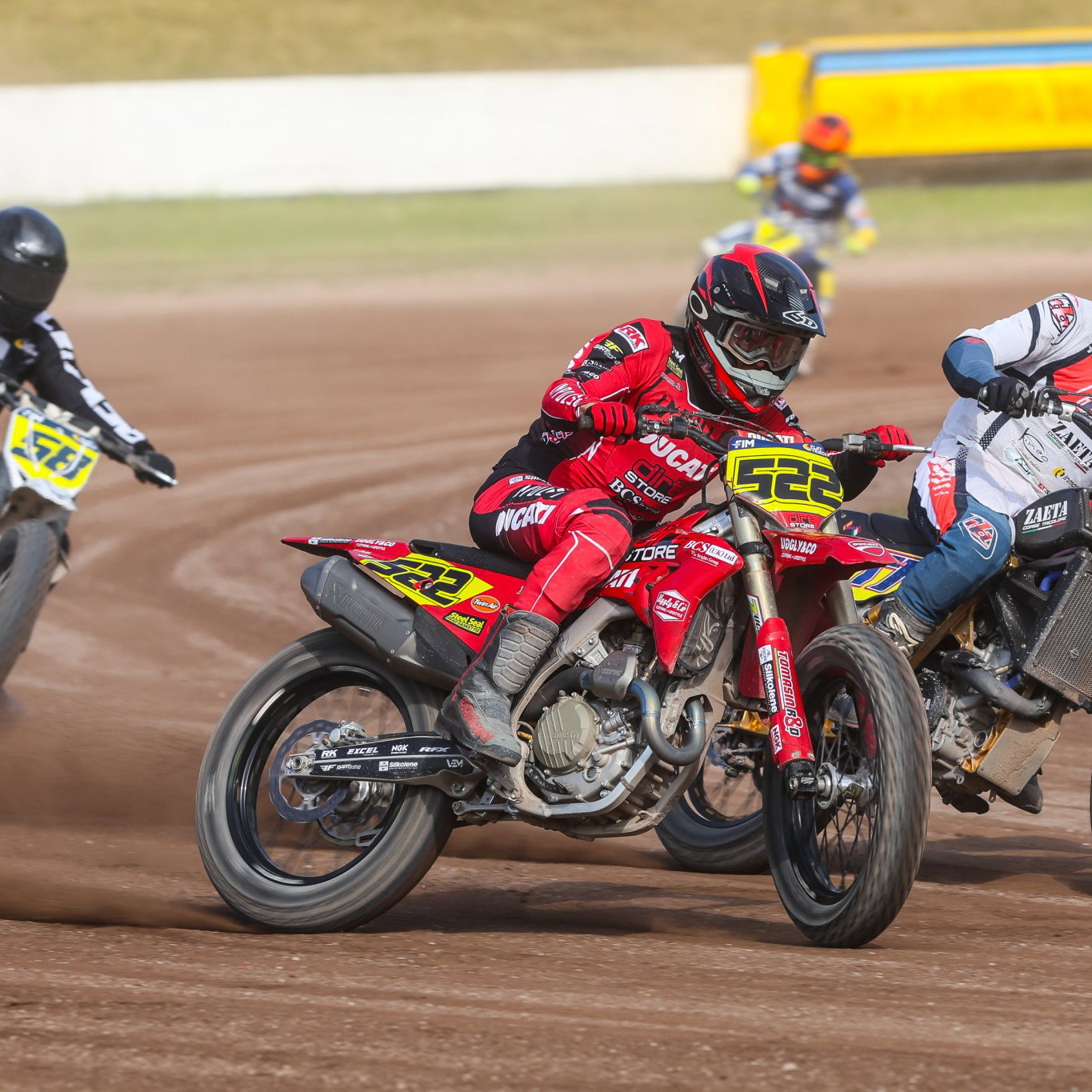
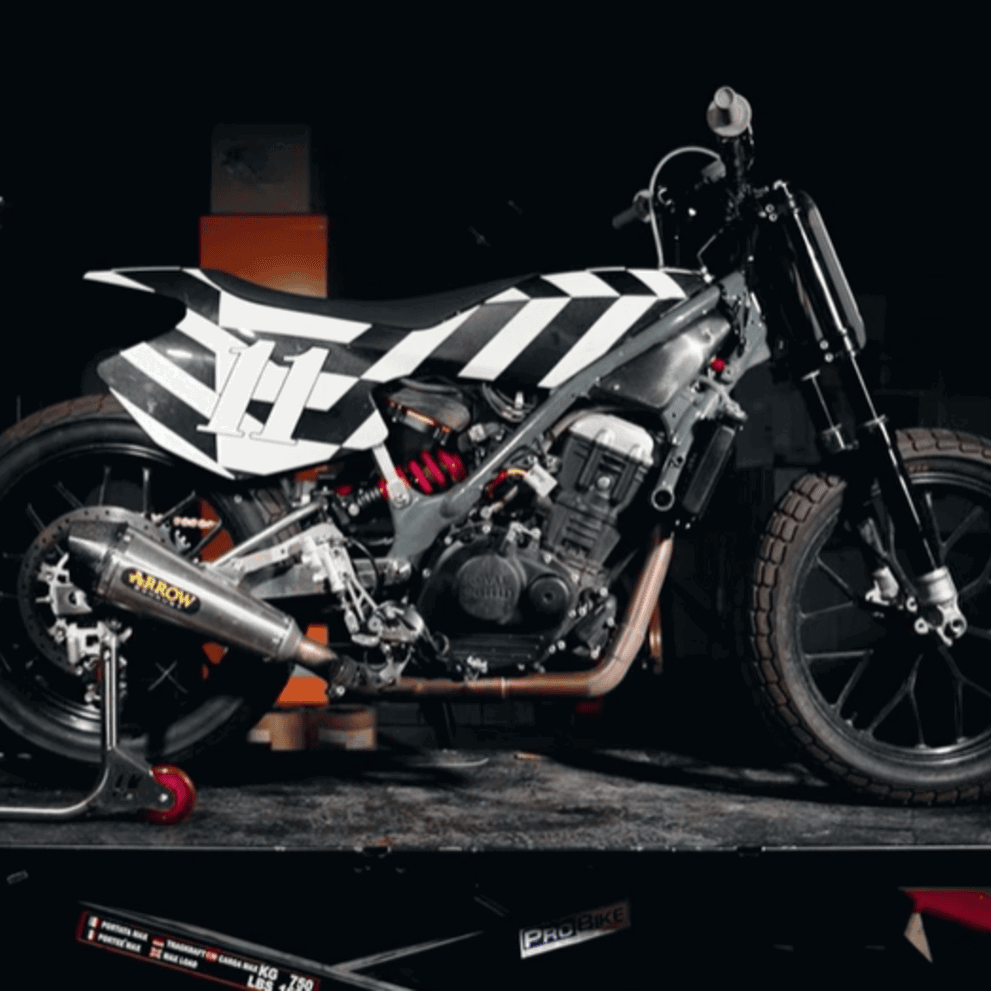
Over the three days of Motoverse there were concerts, a Wall of Death (held in a structure that shook and creaked terrifyingly under the weight of spectators and against the centrifugal force of the riders), stunt shows, flat track races, hill climbs, motocross races, prize giveaways, food stands – all the stuff you would expect.
And a few things you wouldn’t. A section dedicated to demonstrating Royal Enfield’s bikes ease of maintenance allowed you to compete to see who could change an oil filter and a spark plug fastest. I managed 1:27 on the air filter; 1:25 on the spark plug. The fastest times were 46 seconds and 42 seconds respectively.

Elsewhere, groups of four competed in a race to see which could pick up a Meteor 350 with their bare hands and sprint 25 metres with it. Not something you’d ever see at MCL, that’s for sure – imagine how much paperwork would be involved.
There were panja (arm-wrestling) competitions, planking battles, and a kind of cross-fit course that required participants to sprint a track carrying motorcycle tyres then do 20 burpees – all in 34ºC heat (again, imagine the paperwork for something similar in the UK).
But what made the event truly special was all those in attendance. I’ve been to a lot of motorcycle shows and rallies over the years, in the United States and across Europe. They’re fun, but Motoverse stands out as unique. Genuinely different. There was a kind of flow to everything. It was crowded but never felt that way. You just moved through it all as part of some bigger thing – an energy built around the world’s oldest continuously operating brand.
On that point, Royal Enfield celebrates 125 years of operation next year. BGR and the rest of Royal Enfield’s higher ups aren’t offering specifics, but it’s a good bet that next year’s Motoverse will be one to remember.

For more motorcycle features stick with Visordown.
In This Article


Chris Cope is a fourth-generation journalist, originally from Texas. He has lived in the UK for roughly two decades and has been writing about motorcycles for most of that time. He has written for dozens of publications and websites in the UK, US, Canada, and Australia.