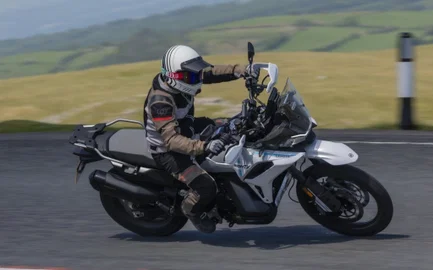
2026 BSA Bantam 350 road test update
BSA’s Bantam 350 topped sales charts last year. We didn’t love it initially, so we’ve ridden it again to see what we missed.

Vote for Visordown 2026 Bike of the year Awards in Association with Carole Nash

Carole Nash are delighted to be announced as the proud sponsors of the 2026 Visordown Awards. With over 40 years of experience in the motorcycling industry, their aim is to get riders out on the road with suitable bike insurance cover for their pride and joy. There couldn't be a better alignment with the Visordown Awards 2026.
- Easy to ride
- Affordable
- Budget suspension
- Doesn't live up to the 'heritage' hype
When BSA announced it was bringing back the iconic Bantam name last year, people got pretty excited. So excited, in fact, that the new Bantam 350 was the UK’s best-selling modern classic motorcycle in October and November, according to statistics from the Motorcycle Industry Association (MCIA).
But I’ll admit that when I first rode the motorcycle, I didn’t love it. Certainly, I didn’t hate it, but simply felt it didn’t quite live up to BSA’s hype or heritage. The suspension was budget, there were lots of plasticky bits, and some of the buttons on its unsightly left-grip switchcube didn't actually do anything.
That last quirk particularly annoyed me.
If you want to read our first ride review of the 2025 BSA Bantam 350 you can on that link. Or if you already have taken in that initial review, read on.
Time changes all things, however. With the Bantam 350 performing so well where it matters – in dealerships – I decided to take a second look at the bike, spending about two weeks riding it in all kinds of scenarios and places. Here’s what I found:
Some background
The BSA name can be traced all the way back to 1860, when the Birmingham Small Arms Company was established, producing everything from firearms to hand tools. It first began selling motorcycles in 1910. It sold quite a few of them over the ensuing decades, but things went south after the Second World War and BSA eventually went bankrupt in 1971.

The BSA name was purchased in 2016 by India’s Mahindra Group, a massive everything corporation headquartered in Mumbai. Mahindra sat on the name for a few years before eventually releasing the retro-styled Gold Star 650 in 2021.
The BSA Bantam 350 was launched in July 2025 alongside the Scrambler 650.
Here’s how my opinion stayed the same
I suspect that price is at the heart of the Bantam 350’s success. Bikes like the Zontes ZT350-GK manage to run neck and neck in terms of price, but the BSA easily undercuts other ‘modern classic’ motos like the Honda GB350S (which retook its modern classic crown in December) or Royal Enfield Bullet 350.
Unfortunately, you are able to SEE why BSA is able to charge less. You are able to see it from 15 feet away. The bike is plasticky. Its decals look like stickers from children’s toys. The fasteners are the sort bought by the palletload.
It still has that infuriating pointless switchgear. The suspension is still budget. I still don’t trust the tires. And it still looks like a bike that goes by different names in different countries. That’s because it does. In India, it’s a Jawa 42 FJ.

BSA talks a good game about ‘legacy,’ ‘history,’ ‘heritage,’ and all the other buzzwords, but that feels pretty hollow when you know this is just a rebadged Something Else. I have the same criticism for the BSA Thunderbolt that was unveiled at EICMA 2025; it’s a rebadged Yezdi Adventure.
On the plus side of things, the Bantam 350 still sounds fantastic. It is one of the better-sounding bikes I’ve encountered in a while. “Rorty” is the word I’d best use to describe it. It’s got depth that you simply wouldn’t expect from a 334cc single.
It still has a surprisingly comfortable saddle. And it still has ‘hop on and go’ ergonomics that make the bike easy to live with.
Here’s how my opinion was changed
On an unseasonably warm afternoon, I decided to head to a nearby cafe for a cup of tea and slice of Victoria sponge - the perfect setting for a ‘British’ bike, one might argue.
Running out the door with helmet and gloves in hand, I decided I was too lazy to go back upstairs to get a riding jacket. Instead, I threw on a heavy flannel shirt. The cafe was only a few miles away, I reasoned - via roads where the speed limit never exceeds 30 mph.

Equally, I eschewed other usual items: riding jeans, heavy boots, ear plugs, and neck buff. In other words, I was old-school and minimalist in my gear choice. Something that’s pretty uncommon for me. But not wearing my usual kit gave me a freedom of movement that was… liberating. It changed my perspective.
The feeling of being more free/vulnerable gave me a connection with the bike that felt more visceral. Unfettered. Unrefined.
“This is what it was like to ride bikes in the 1970s,” I said to myself.
Which is a very silly thing to have said, because I was 3 years old when the ‘70s ended. I have never once ridden a motorcycle from that era. So, how would I know? But, my point is: the Bantam 350 feels like what I imagine riding felt like half a decade ago.
Over the time that I had the bike, I decided to lean into this aspect, appreciating its simplicity: its inelegance that, in the right conditions, can feel like authenticity and character.

Good on country lanes
The Bantam 350, it turns out, is an ideal “Where does this lane go?” machine. I live in a part of the country that’s littered with dishevelled, hedgerow-threatened country lanes - the sort that exude charm and mystery - and usually hide a tractor that is barreling towards you.
But I’m not usually keen to explore them on my everyday machine - a 255kg Kawasaki Versys 1000. You don’t really want to be taking a bike that big and heavy down narrow lanes that are broken up, oddly cambered, muddy, or all of the above.
The low seat height and relatively manageable weight of the Bantam 350, however, is perfect for the job. It’s tractable. Its size is such that you can easily tuck yourself into a hedge when encountering the above-mentioned lane-swallowing tractor. Turning around in a dead end isn’t a nightmare.
And at lower speeds, the bike’s sound is still throaty but “putt-putt” enough to be cheerful - earning a friendly wave from villagers or people out for a country walk.
Good in the city
For much the same reason that it makes a good backroads explorer, the Bantam 350 absolutely shines in urban environments. You’d have to step down to a scooter or bicycle to find anything that can weave through tight traffic with as much ease as this.

At low speeds, visibility in the mirrors is good, and the riding position is such that it’s easy to twist and turn your body - 1989 Batman-style - to improve your field of vision.
Assisting city riding is a very light clutch pull and reasonably slick transmission. But there is one aspect of the gearbox that’s off-putting: it lacks feedback at the end of the gear range.
There’s no ‘floor’ or ‘ceiling.’ If you’re in first and attempt to click down, rather than get the feeling of resistance that you’d get on literally every other transmission I’ve ever experienced, there is an empty void - like being stuck in a false neutral. The same thing happens if you attempt to click up from sixth.
At the top end of the gearbox, this sensation is just sort annoying. At the low end, it’s off-putting. I’d find myself about to take off from a stop, tap down expecting to feel that positive response, get nothing, and instinctively think: “Oh, hell! I’m not in gear!”
I was in gear. It just didn’t feel like it. Having this panic at pretty much every traffic light, roundabout and junction was tiresome.

Tolerable on the motorway
With about a mile of straight, I managed to max out the Bantam 350 at around 80 mph. Not a lot, but enough. And I will say that they were a very thrilling 80 miles per hour. With the outclassed suspension bouncing me around, the mirrors blurring everything behind me to oblivion, and the engine screaming, it was an experience that made me want to shout: “What a thing it is to be alive!”
Again, it’s a bike that matches with my (unfounded) impressions of what riding in the ‘70s must have been like. None of this slick electronically adaptive suspension nonsense, just hold on and go.
I really enjoyed it. In short bursts. On dry roads. Gambolling about in this way for more than 20 minutes on a winter road, however, would have instilled all kinds of anxiety, rage, and questioning of life choices.
Good if you forget about the name
The Bantam 350 is not a forever motorcycle. That’s a truth that’s at the heart of my criticism of the bike. Which means it’s possible that I’m not being fair. The lack of forever-and-ever quality isn’t a criticism that I’d apply to any number of other bikes. The aforementioned Zontes, for example, or even a (markedly more expensive) Yamaha MT-03.
Sometimes a bike is just a bike is just a bike. And it can often be the case that a bike of 500cc capacity or less is a bike that is largely intended to be used to get from A to B. That’s it. It’s not an heirloom. It’s not a piece of art. It’s just a tool. And, you know, if you put better tires on the Bantam 350 (and overlook its quirky transmission), it’s as good a tool as any.

But that’s not really a character that fits with BSA’s heritage. It certainly doesn’t fit with what BSA says about the Bantam 350 or about itself. BSA’s hype makes you think of brands like Royal Enfield, Triumph, Harley-Davidson, etc. But its build quality just isn’t on the same level.
There’s a lot to like about the Bantam 350, but I think that how you feel about it will depend in no small part on how well you are able to mentally disconnect the bike from the name on its tank. Make the mistake of tying it to the storied heritage of British motorcycling and you’ll be disappointed. But if you just accept it as a simple, affordable, run-around tool that you’ll probably get rid of in a few years, it is a very agreeable thing.
Read more motorcycle reviews on Visordown

Chris Cope is a fourth-generation journalist, originally from Texas. He has lived in the UK for roughly two decades and has been writing about motorcycles for most of that time. He has written for dozens of publications and websites in the UK, US, Canada, and Australia.