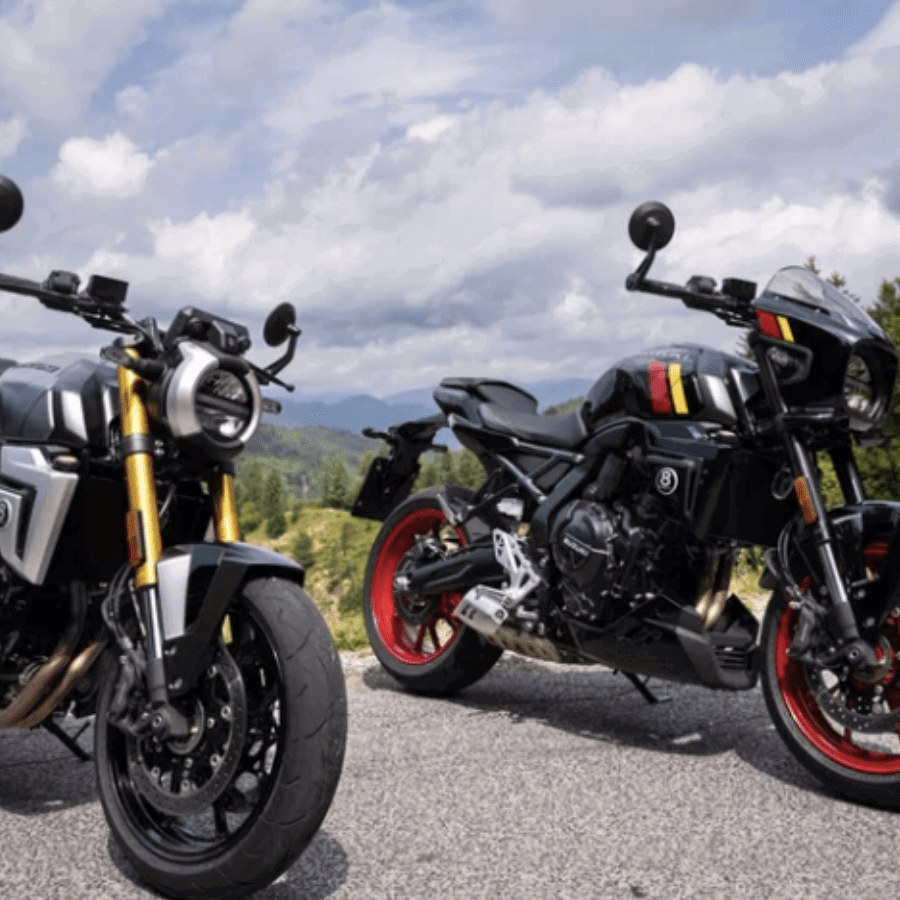
10 Best Supermotos You Can Buy Right Now
Woefully impractical and hilariously brilliant - that’s how you describe a supermoto. We list the 10 best models currently in production.

Supermotos are a particularly niche segment in the motorcycling world. INCREDIBLY important to some, unappealing to most.
According to the always-reliable internet, the segment’s roots stretch back to 1980s America, when television network ABC launched a show called “Superbikers.” It put motocrossers, road racers, and flat-trackers onto a single hybrid circuit of tarmac and dirt and had them race, because reasons. No one in the US was interested in this; I was a child in 1980s America, obsessed with cars and motorbikes, and until reading about “Superbikers” as part of my research for this article I had never heard of it.
The French, though, being French, were all in. They rebranded the sport as "Supermotard" - which, these days, sounds like a phrase that would get you cancelled - and slapped racing slicks onto dirt bikes. They had so much drifting, looks-unsafe fun that it became enough of a thing for European manufacturers to begin offering factory supermotos in the mid-1990s.
You might also be interested in: Bluffer’s Guide to Supermoto
Supermotos are uncomfortable, profoundly impractical, and highly focused toward activity that most law enforcement representatives would describe as anti-social. That means they are hugely fun but not hugely popular in terms of sales. As such, most brands do not even offer a supermoto; that’s why you’ll see a few repeat names in our list of the 10 best.
Every time we create a Top Ten list, people get upset about the order in which bikes are mentioned, feeling that our No. 1 pick is a crime compared to our No. 4 pick or whatever. In an attempt to avoid that, I’ve organised these according to engine size. The list only includes bikes that are currently in production.
1. Aprilia SX 125

ENGINE | 124.2cc liquid-cooled, four-valve, single cylinder |
POWER | 14.7bhp at 10500rpm |
TORQUE | 8.4 lb-ft at 8500rpm |
WEIGHT | 136kg |
SEAT | 880mm |
First introduced in 2008 and comprehensively updated since, the Aprilia SX 125 has long been the starting point for European supermoto fans. Deriving its liquid-cooled, 14.7 bhp four-stroke engine from the RS 125, it packages Italian racing heritage into a CBT-friendly format. The SX swaps the knobbly tyres of its RX sibling for 17-inch spoked wheels, creating a featherweight street scalpel.
It’s remained a top choice after all these years because it balances sharp handling with unintimidating power - nothing says "European racing dominance" quite like maxing out at 65mph downhill.
While some modern rivals boast slightly flashier TFT screens, the SX 125 relies on its proven chassis, Bosch ABS, and a responsive engine to deliver pure, unadulterated fun. It offers the perfect blend of urban commuting and weekend B-road hooliganism.
You may also be interested in: Aprilia SX 125 First Ride Review
2. QJMotor COV 125 S

ENGINE | 125cc liquid-cooled, four-valve, single cylinder |
POWER | 14.7 bhp at 9500rpm |
TORQUE | 8.9 lb-ft at 7000rpm |
WEIGHT | 129kg |
SEAT | 860mm |
The own brand of Chinese manufacturing giant Qianjiang, QJMotor has been in the UK market since late 2025. Its COV 125 S offers supermoto styling at a super-affordable price. It features a modern, Euro 5+ liquid-cooled single producing the maximum allowable 14.7 bhp.
Despite its price tag, it refuses to skimp on hardware, boasting 43mm upside-down forks and a 320mm front brake disc. With an accessible 860mm seat height and a claimed wet weight of just 129 kg, it’s an ideal choice. And with the money you save on buying this over a European alternative you can buy an aftermarket exhaust that will make your neighbours absolutely despise you.
3. Rieju Marathon 125 LC Pro SM

ENGINE | 125cc Minarelli 4T variable timing liquid-cooled single |
POWER | n/a |
TORQUE | n/a |
WEIGHT | 121kg (dry) |
SEAT | 870mm |
Spain’s Rieju has been quietly producing some of the most hardcore lightweight motorcycles in Europe since the 1940s. It recently began expanding its offerings in the UK. The Marathon 125 LC Pro SM represents the pinnacle of the brand’s A1 lineup. Rather than building a budget commuter, Rieju aimed squarely at the premium market, wrapping a high-tensile steel frame around a Yamaha engine. It is the connoisseur's choice for 17-year-olds who have a suspiciously large amount of disposable income. And 47-year-olds who want to reel back the years.
The "Pro" designation gifts the bike 41mm R16V upside-down forks, a progressive rear monoshock, and Galfer wave brake discs clamped by a radial calliper. Claiming a weight of 121 kg, it offers greater agility and stopping power than the other 125s on this list.
4. Suzuki DR-Z4SM

ENGINE | 398cc liquid-cooled, four-valve, single cylinder |
POWER | 37.5 bhp at 8000rpm |
TORQUE | 27.3 lb-ft at 6500rpm |
WEIGHT | 154kg |
SEAT | 920mm |
Bro, do you even supermoto if you haven’t ridden a DR-Z? The original DR-Z400SM launched in 2005 and became a cult classic, celebrated in part for its bulletproof reliability. It was killed off in Europe due to emissions but lived on in the God-bless United States of America (everyone knows that freedom tastes like petrol) until 2025, when Suzuki introduced the all-new DR-Z4SM.
The engine is updated to meet Euro 5+, but retains the soulful 398cc single-cylinder heartbeat, now producing 37 bhp. Suzuki modernised the hardware with fully adjustable KYB suspension and switchable ABS, yet it remains refreshingly free of overwhelming tech. Because it’s a Suzuki it is completely dependable and guaranteed to outlive us all.
5. KTM 390 SMC R

ENGINE | 399cc liquid-cooled single cylinder |
POWER | 44.3bhp at 8500rpm |
TORQUE | 28.7 lb-ft at 7000rpm |
WEIGHT | 154kg |
SEAT | 860mm |
KTM’s "Ready to Race" ethos has long dominated the supermoto sector, which is why you’ll see a number of KTMs and KTM-adjacent bikes on this list. I could have added a KTM to the collection of 125s, but it felt like overkill.
Utilising the 399cc LC4 engine from the 390 Duke, KTM repackaged its 44bhp powerplant with a dedicated supermoto chassis, complete with long-travel WP APEX suspension and angular styling.
It’s a solid choice because it offers a good power-to-weight ratio for the street. At 154kg, it is light enough to be thrown into corners with reckless abandon, yet powerful enough to easily dispatch traffic. Packed with lean-angle-sensitive cornering ABS and Supermoto ride modes, it is the weapon of choice for riders who want to arrive at their destination looking like an over-caffinated angry wasp.
6. Ducati Hypermotard 698 Mono

ENGINE | 659cc Desmodromic liquid-cooled, four-valve, single cylinder |
POWER | 76.4 bhp at 9,750rpm |
TORQUE | 46.5 lb-ft at 8000rp, |
WEIGHT | 160kg |
SEAT | 904mm |
When it was first revealed, the Hypermotard 698 Mono carried the distinction of being the first single-cylinder Ducati in half a century. Bologna engineers effectively sawed the 1299 Panigale V-twin in half, creating an ultra-short-stroke 659cc powerplant that revs like a superbike and produces a formidable 77 bhp. They then gave it a 904mm seat height and packed it with tech that actively encourages you to drift. What could possibly go wrong?
All that said, the suite of electronics - including a slide control system that actively helps riders execute perfect rear-wheel drifts - means that many riders find the bike to be remarkably tractable and civilised in town. Well, as civilised as a supermoto can be…
Get to know this bike better: Ducati Hypermotard 698 Mono review
7. KTM 690 SMC R

ENGINE | 692cc liquid-cooled, four-valve, single cylinder |
POWER | 73.7bhp (revs not given) |
TORQUE | 54 lb-ft (revs not given) |
WEIGHT | 162kg |
SEAT | 899mm |
The KTM 690 SMC R is one of the greats of the modern supermoto scene. Evolving from KTM’s off-road lineage, the current iteration is built around the LC4 engine, offering a 692cc single that produces 78 bhp. Continuously updated over the last decade or so, the bike strikes a balance between a raw, unbridled race tool and a semi-usable street machine.
Practical? Nope. Capable of comfortably carrying luggage or a pillion? Absolutely not. One of the best ways to lose your licence before lunchtime? Oh, yes.
Learn more: KTM 690 SMC R Review
8. Husqvarna 701 Supermoto

ENGINE | 692cc liquid-cooled, four-valve, single cylinder |
POWER | 73.7bhp (revs not given) |
TORQUE | 54 lb-ft (revs not given) |
WEIGHT | 148kg (dry) |
SEAT | 890mm |
Like that, but with blue and yellow. Husqvarna’s 701 Supermoto was first born after KTM acquired the historic Swedish brand in 2013. Powered by the same 74 bhp, 692cc single-cylinder engine as the KTM 690 SMC R, and utilising an identical steel trellis frame, the 701 Supermoto offers the exact same ferocious performance, but wrapped in minimalist Scandinavian aesthetics.
In other words, it’s uncompromising and impractical but it looks nice.
It’s hard to say whether Husqvarna will survive for long under the leadership of KTM’s new (since 2025) parent company, Bajaj Mobility AG. The India-based giant has a more streamlined attitude and may not want to hold onto KTM’s ‘like that but this’ brands of Husqvarna and GasGas. Speaking of which…
You may be interested in: First ride: Husqvarna 701 Supermoto review
9. GasGas SM 700

ENGINE | 692cc liquid-cooled, four-valve, single cylinder |
POWER | 73.7bhp (revs not given) |
TORQUE | 54 lb-ft (revs not given) |
WEIGHT | 148.5kg (dry) |
SEAT | 898mm |
Like those, but Spanish. GasGas was founded in Catalonia, Spain, back in 1985. It was bought up by KTM in 2019. Its traditional strength lies in trials, motocross, and enduro bikes. So, a supermoto makes sense from a brand perspective. Whether it makes sense to offer a supermoto that is effectively the same as the one being offered with KTM and/or Husqvarna badging is up for debate.
Once again, it’s the 74 bhp, 692cc LC4 single and trellis frame from the KTM 690 SMC R. But this time it’s painted red. It also differs from the KTM and Husky in rolling on fully cast 17-inch alloy wheels rather than traditional wire-spoked rims.
10. Ducati Hypermotard V2 SP

ENGINE | 890cc four-valve liquid-cooled V-twin |
POWER | 118.6bhp at 10750rpm |
TORQUE | 69 lb-ft at 8250rpm |
WEIGHT | 180kg (dry) |
SEAT | 880mm |
Would you like some crazy with your crazy? Introduced for the 2026 model year, the Hypermotard V2 replaced the outgoing 950 hooligan. The boys and girls of Bologna ditched traditional Desmo valves to utilise a new, lighter 890cc V-twin engine. Producing almost 120 bhp, the V2 platform shed weight, resulting in a machine that blurs the line between supermoto and naked superbike.
The flagship "SP" trim is THE choice for riders with far more money than sense. It bolsters the V2 with longer-travel Öhlins suspension, forged Marchesini wheels, and a dedicated track electronics suite. It costs roughly the same as a small house deposit, is laughably impractical, and makes absolutely zero sense. Naturally, I want one.
<H4>You might also like to read: 2026 Ducati Hypermotard V2 SP review
<H3>Honourable Mention: Kawasaki KLX300SM
Although it is not currently sold in the UK, I feel the Kawasaki KLX300SM deserves a nod (if not simply out of a weird sense of brand loyalty - I own a Kawasaki). Evolving from the KLX250 dual-sport platform (also not sold here), Kawasaki bored out its bulletproof liquid-cooled single to 292cc in 2021 to create a dedicated, lightweight street hooligan.
Pushing out 25 bhp and weighing just 138 kg wet, it swaps the dirt hoops of its dual-sport sibling for 17-inch alloy wheels, a massive 300mm front brake disc, and stiffer, street-tuned suspension.
What makes it a good choice? It’s bulletproof. The KLX300SM offers low-maintenance, turn-key reliability. It’s agile, forgiving, and hilarious.
<H3>The joy of not making sense
Whether you are a 17-year-old on a budget Chinese single taking delight in annoying your neighbours, or a full-licence lunatic willing to re-mortgage your house for an exotic Italian V-twin, the ultimate conclusion remains the same: supermotos do not make sense, and that’s kind of the point.
A supermoto will not keep you dry. It will not carry your weekly shop. But it will actively mock you if you try to take it on a motorway, and almost certainly put you on a first-name basis with the police.
And yet, every time you pitch the thing into a roundabout, or hoist the front skyward, some giggling, manic, nonsensical part of you will delight in the absurdity of it all.
FAQs
- What is a supermoto?
The original supermoto racers were motocross bikes with street wheels/tyres designed to race on a mixed dirt/Tarmac circuit. Their popularity spawned homemade street-legal versions, often based on trail bikes which then led to production versions. Most are still single cylinder but there are now some twin cylinder versions.
- What are the benefits of a supermoto?
With their punchy performance, light weight and nimble handling they are great fun bikes that deliver plenty of thrills and are great at stunts like wheelies and skids. They also look cool. Conversely, although decent A1 learner and town bikes they lack versatility and long-distance comfort.
- What licence do I need for a street supermoto?
Like any other bike it depends on their capacity/performance. 125cc versions can be ridden on an A1 licence as long as their maximum power is 1kW/15bhp; larger ones can be ridden on an A2 licence as long as they produce under 47bhp. More powerful versions require a full A licence.
Buying a used supermoto

Our guide to supermotos includes both new and used machines. If buying new, and so getting a machine with a warranty, obviously you have nothing to worry about. But if buying used, especially privately, you’re going into potentially dangerous territory.
OK, the softer bikes, typically from the Japanese manufacturers, are pretty reliable and tend to just get used as commuters and for everyday fun. But some of the more hard-edged bikes, generally made by the smaller European marques, may have been ridden extremely hard by A-grade loonies. Stunts, racing and off-road are all possibilities. And they can be maintenance-heavy bikes with plenty of reliability issues.
The safest option is to buy from a dealer but make sure you understand what the warranty covers and get it written down because they may class them as competition machines, not road bikes and that gives you much less comeback if you do have problems.
Dedicated internet forums or supermoto Facebook groups often have bikes for sale and forums give you the chance to check out owners’ post history to see if they’ve had any problems with that machine. Don’t be afraid to ask simple, honest questions about any bike for sale, such as: 'Is there anything wrong with it?' or 'What have you used it for?'.
Think before you buy too. The softer Japanese bikes work well on the road, but the edgier Euro offerings can be pretty impractical, and older bikes may not have electric starts, oil changes scheduled for as often as every 200 miles, rock-hard seats, loads of engine vibration and other rough edges. Don’t be too put off though as machines for dicking about on there’s little that can touch them for raw fun.

Chris Cope is a fourth-generation journalist, originally from Texas. He has lived in the UK for roughly two decades and has been writing about motorcycles for most of that time. He has written for dozens of publications and websites in the UK, US, Canada, and Australia.