Splitting heirs: Suzuki GSF600 V GSF1200
Suzuki's Bandit models brought brand-new sports motorcycles suddenly into the price range of just about anyone. Five years and one re-vamp later, how do the 1200 and 600 stack up against each other?

 |
Back in 1995 Suzuki started a new trend to answer some of the prayers of the less well-funded. They produced a more affordable bike, called it the Bandit 600 and spawned a whole new budget class of fun sportsbike. Since then, all the other major manufacturers have been obliged to follow the cost-cutter sportsbike trend, recognising a massive market when they see one.
The Bandit name was actually a bit of a misnomer. Its 72bhp performance and looks weren't particularly wild or nasty, though they were decent enough. But one thing which could be linked to its name, was its price. At just £3,999, it was said that the only people being robbed were the Suzuki dealers themselves.
Within months the Bandit 600 became the UK's best-selling bike. Buyers were more than happy. Suddenly there was no further need to lurk around for months checking out the best second-hand deals. No need to check the service history or how carefully a bike had been ridden. Now they could have a brand new bike that no one else had buggered about with. And there was a proper warranty, too.
A year later in 1996 the factory introduced a larger capacity version, the 1200 Bandit. This bike had heaps more attitude and genuine 100bhp power, but retained the same value for money philosophy. It cost £2,000 more than its smaller brother, but at £5,999 it still put a new big-bore bruiser within reach of many more potential customers. Suzuki's decision to release this larger variant was just as successful as the 600 and Big Brother Bandit soon earned stuntbike badass appeal.
A minor re-design in 2000 saw both bikes get a slightly different - and mainly cosmetic - frame design. Each naked bike gets an option of a half-faired model to keep the elements at bay. This is still available now (and much better looking than it was) for an extra £300 on the 600, and £400 more in the case of the 1200.
Even the price of the Bandits hasn't changed too much. Now it's just a £100 more for the unfaired 600 than it was in 1995, and in the case of the basic 1200, it's actually £300 cheaper than it was in '96! This will largely be down to the serious level of competition the Bandits now face, most of which perform better in certain areas than the Suzukis. But there's no doubt that the Bandit Brothers still represent fantastic VFM.
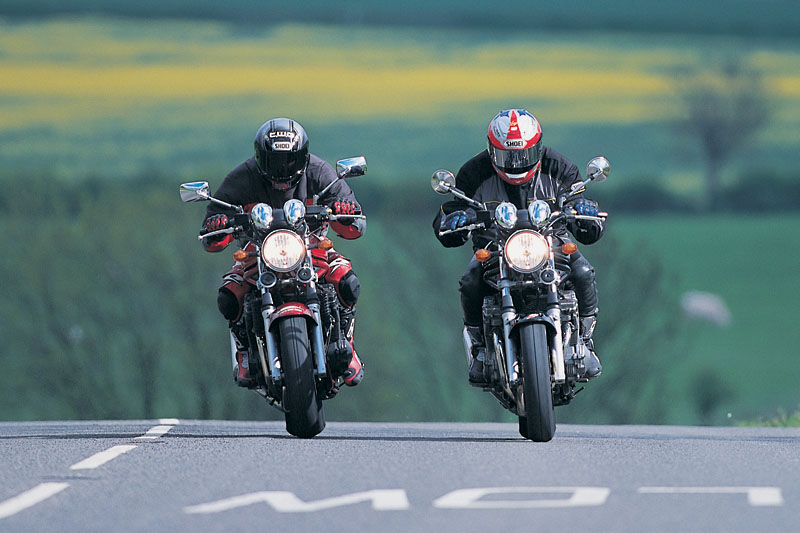
Walk up to the two Bandits and you'd be hard pushed to tell which was which. Apart from some visual giveaway details like the different brakes and swingarms, they appear almost identical. No bad thing, as both have a rugged and basic style to them. Ask a six year-old to draw you a picture of a motorbike, and he'd draw you a Bandit. Both show off their engines to full effect and the lack of plastic coverage gives each a stronger sense of purpose.
It's only when you start to push them around that the bigger bike's extra beef becomes obvious. The 600 feels very light and easy to manoeuvre and the 1200 just that bit weightier. 10 kilos weightier, as it happens. But the real difference between them is immediately apparent once you move off.
Let out the cable clutch on the 600 and the modest acceleration rate quickly reminds you of the capacity and heritage of its motor - it dates back over 10 years now, the same engine which powered the GSX600F, a sports-tourer launched in 1990 and commonly remembered as 'The Teapot.'. Okay, there's some decent drive at lower rpm if you're not in a rush, but to get anywhere quickly you must spin the smaller Bandit's engine really hard. Play with the slick gearbox and get the tacho needle to point at anything over 7,000rpm and it'll bring a smile to your face. Below that though, and the throttle response isn't very sharp at all, leading to frustration at the lack of guts - especially if you need to overtake something quickly.
Novice motorcyclists will be more than happy with what the 600 has to offer, and a top speed of 130mph is perfectly respectable. But the 600's urgent and frantic nature does highlight the much gruntier, smoother and laid-back behaviour of the 1200. Ride the bigger version just a few yards and its extra torque and stomp are obvious. Its power is its glory. It even sounds more impressive with its rortier engine and exhaust note.
Be as lazy with the five gears as you want, the 1200 still gathers speed very impressively. Ironically the main reason for this is the motor's actual state of tune as much as its capacity. Having almost double the 600's capacity is bound to give the 1200 superior engine performance, but because Suzuki decided to keep it to 100bhp peak power, it's engineered the engine to give more bottom end and mid-range stomp. As a result you don't have to be aggressive to make the 1200 go well, as you must on the 600. Just as the 1200's price is accessible to more people, so is its performance. And the seamless gain in horsepower is much easier to use than on the 600.
Handling manners of each Bandit also have similar character. There's no doubt the lithe, light and agile feel of the smaller bike will win it plenty of friends, especially female riders who find it very easy to ride. But as the speed gathers, though there's actually no misbehaviour from the bike, it can't quite match the more planted and composed feel of the 1200, and the 600 always feels slightly more nervous.
The 1200's weight helps it feel slightly more secure. And though you have to put a bit more effort into changing direction, especially at higher speeds, the extra kilos are more of a benefit than a penalty. The wide handlebar's leverage helps you to chuck it around and even at walking pace in town the 1200 feels positive and well-balanced. Its low seat height (actually 10mm lower than the 600's) make the bigger Bandit a good choice for the vertically challenged.
The suspension and brakes of each bike deserve equal praise. Both forks and shock are engineered with little scope for adjustment, but the balance of control and comfort offered on each bike has to be complimented and is certainly better than it was on the earlier Bandits. Braking is roughly equal in strength despite the 1200's six-pot calipers. The extra weight they need to haul up accounts for this, but both Bandits feature sharp and progressive stoppers.
Practicality is also in evidence on each Bandit. Pillions are catered for pretty well with well-sited footrests and a very useful grabrail. There's a bit of room under the seat, and plenty of hooks to help you strap on some luggage. And the centrestands evident on both bikes make chain maintenance so much easier, too. Each has a clock and two tripmeters, though the 1200 has the extra benefit of a fuel gauge. The faired 'S' versions will aid the long distance rider as naked bikes and motorways really don't mix.
COST OF LIVING
Tyres
The Bandits are fitted with different brands and sizes of tyres. The 600 wears Bridgestone BT56s, with a 120/60 ZR17 front and 160/60 ZR17 rear. Michelin Macadams are original rubber on the 1200, a 120/70 front and 180/55 rear.
BT56s are an excellent all-round tyre for the smaller Bandit, with good stability, grip and wear rates courtesy of their Dual Aligned Compound. The DAC arrangement effectively makes the rubber grippier on the sides of the profile for hard cornering, and tougher in the centre for longer life.
But the BT56s are becoming more difficult to obtain as they're being superseded by the BT010 type. These are superb alternatives. They have the same comprehensive performance as the BT56s, but give even more grip. They'll cost you around £200 to have fitted to loose wheels and balanced, and will last you around 7,000 miles, depending how you ride.
Michelin Macadam 100s for the 1200 Bandit ironically cost slightly less, despite the bigger size of the rear tyre. Around £190 will cover the cost of fitting and balancing them to loose wheels.
The performance of the Michelins is generally good and they're durable enough to last up to 5,000 miles. But their grip isn't so good when they're cold, and heavy-handed throttle use can wear them out in as little as 3,000 miles. That's the price of the 1200's extra power and weight. On the whole expect the bigger Bandit's tyre bills to be around double the 600's.
Fuel economy
Fuel costs are marginally higher on the bigger bike on the whole. Both Bandits have 20 litre tanks - just over 4 gallons in real money. That equates to a useful range of 180 miles on the 600 with its average consumption of 42mpg of unleaded, and 155 miles on the bigger Bandit which is a little thirstier with an average of 35mpg. This difference is reduced if the 600 is ridden very hard, as its engine has to be thrashed so much.
Fuel ranges of both Bandits are long enough to make them practical tourers. Both have fuel taps with a reserve position which gives a warning of only 25miles worth of fuel remaining before running dry. But the 1200 has the luxury of a digital fuel gauge, making the time before refill more predictable to gauge.
Depreciation
Depreciation is a fact of motorcycling life, especially when buying new. Initial losses on the Bandits aren't too bad due to their low cost and high popularity. But after a year expect to lose around £1,000-1,200 on the unfaired models and about £300 more on the faired ones.
Of course mileage and condition are the biggest influences on the value of a used bike, and it should be noted that the finish of the Bandits isn't particularly durable. Alloy parts corrode easily and the paintwork wears and scratches if it's not cared for. It's important to give the bike plenty of TLC to avoid premature deterioration, especially after rides in winter.
Try to get a Bandit a bit cheaper than RRP. Haggling with dealers on Bandits isn't that easy because they're in such demand. A little patience might net a £250 reduction on the price of a 600, and a little more on a 1200. But don't bank on it.
Servicing
Servicing costs for the two Bandits are identical, so there's no saving to be gained in this area one way or the other.
After the initial service at 600 miles when the oil and filter are changed, costing around £20, intervals are every 4,000 miles. These services alternate in cost as one is an interim, and one a major. Interim services, which occur at 4,12 and 20,000 miles, should be priced at around £100. Major work could cost as much as £160 depending on how much work needs to be done on the valve clearances.
The need for new consumables such as air filters, brake pads, tyres, chain and sprockets etc will obviously affect the bills. Expect to pay around £300 for servicing over a 2-year or 10,000 mile period, depending on how hard the bike is used.
It might sound a bit of an exaggeration but the 1200 really is in a different league to the smaller Bandit. It's all down to the bike's character and engine strength more than anything else.
Having a 30bhp advantage doesn't sound like it would translate to having such superior engine performance. But as they say it's not just the size, but the way it's used that really matters. And that's where the bigger Bandit's scorecard gets marked higher.
It's not really about power, anyway. It's about torque, and where the 600 is wheezing and whizzing, the 1200 just grunts away into the distance. The Bigger Bandit is so much more solid in this department and it's a relief to sample its lazier stomp after the frantic nature of the 600 which demands much more effort to keep it singing.
The 1200 is a whole lot easier to ride in every possible way. It's got more cred and desirability because of its engine size. And where the 600 only ever really feels like it's a competent and basic bike designed to get you from A to B (with a bit of style and excitement, admittedly), the 1200 has much more to offer. You can certainly do a lot more with it. And if you choose the faired example you could stick on a bit of luggage, pop the missus on the back and head off to somewhere very far away, have a bloody good time, both en route and when you arrive. The relatively powerless 600 doesn't give that same impression of useability.
Now of course the 1200's extra appeal comes at a price. At £5,699 it'll cost you £1,600 more than the 600 to wheel it away from a dealer's showroom and every mile you'll rack up after that will be more costly. All things considered you could be looking at spending around £2,500 more to have a 1,200 rather than a 600 - to buy and run for year.
If you're a sensible commuter who just wants to just get there competently and quickly, then choose the 600. If you're a dude who needs a bit more style and a lot more stomp and are willing to pay for it, opt for the bigger bike. The 1200 is every bit as manageable to ride as the 600, and despite the higher insurance costs and bigger tyre and fuel bills, we'd definitely have to say it was worth the extra.
Considering how similar they look it should be no surprise to learn the 600 and 1200 Bandits have much in common in their engine and chassis designs. Both Suzukis have inline four cylinder 16-valve DOHC air/oil cooled engines, though obviously the 1,157cc capacity of the bigger Bandit gives considerably more power than its smaller 599cc brother, and produces it in a very different manner.
The 1200 has a broad spread of 98bhp power, and a beautifully flat torque curve which peaks very early at just 4,000rpm. This means it doesn't need to be revved anywhere as hard as the 600, and also means it manages well with a five-speed gearbox. The revvier 600 has a six-speeder to help keep it singing high near its power peak of just under 70bhp at 10,500rpm.
Chassis format is very similar on both bikes. They both use a tubular steel cradle frame, though the 1200 features a chunky-looking alloy swingarm, while the 600 makes do with a cheaper and heavier steel item. The 1200's forks are 2mm thicker at 43mm in diameter and are adjustable for preload. The 600's forks have no adjustment, but like the 1200 its rear shock features adjustments for preload and rebound damping.
Both have triple brake disc arrangements and though the rear disc set-up is exactly the same on each, the 1200 has bigger 310mm diameter front discs gripped by six-piston calipers to deal with its extra performance and weight. The 1200's dry weight is 214kg, and the 600's 204kg.
SPECS - GSF600
TYPE - STREETBIKE
PRODUCTION DATE - 2001
PRICE NEW - £4499
ENGINE CAPACITY - 599cc
POWER - 72bhp10,500rpm
TORQUE - 38lb.ft@9400rpm
WEIGHT - 204kg
SEAT HEIGHT - 800mm
FUEL CAPACITY - 20L
TOP SPEED - 131mph
0-60 - n/a
TANK RANGE - N/A
SPECS - GSF1200
TYPE - STREETBIKE
PRODUCTION DATE - 2001
PRICE NEW - £6049
ENGINE CAPACITY - 1157cc
POWER - 98.4bhp8750rpm
TORQUE - 69.6lb.ft@4000rpm
WEIGHT - 214kg
SEAT HEIGHT - 790mm
FUEL CAPACITY - 20L
TOP SPEED - 143mph
0-60 - n/a
TANK RANGE - N/A

Back in 1995 Suzuki started a new trend to answer some of the prayers of the less well-funded. They produced a more affordable bike, called it the Bandit 600 and spawned a whole new budget class of fun sportsbike. Since then, all the other major manufacturers have been obliged to follow the cost-cutter sportsbike trend, recognising a massive market when they see one.
The Bandit name was actually a bit of a misnomer. Its 72bhp performance and looks weren't particularly wild or nasty, though they were decent enough. But one thing which could be linked to its name, was its price. At just £3,999, it was said that the only people being robbed were the Suzuki dealers themselves.
Within months the Bandit 600 became the UK's best-selling bike. Buyers were more than happy. Suddenly there was no further need to lurk around for months checking out the best second-hand deals. No need to check the service history or how carefully a bike had been ridden. Now they could have a brand new bike that no one else had buggered about with. And there was a proper warranty, too.
A year later in 1996 the factory introduced a larger capacity version, the 1200 Bandit. This bike had heaps more attitude and genuine 100bhp power, but retained the same value for money philosophy. It cost £2,000 more than its smaller brother, but at £5,999 it still put a new big-bore bruiser within reach of many more potential customers. Suzuki's decision to release this larger variant was just as successful as the 600 and Big Brother Bandit soon earned stuntbike badass appeal.
A minor re-design in 2000 saw both bikes get a slightly different - and mainly cosmetic - frame design. Each naked bike gets an option of a half-faired model to keep the elements at bay. This is still available now (and much better looking than it was) for an extra £300 on the 600, and £400 more in the case of the 1200.
Even the price of the Bandits hasn't changed too much. Now it's just a £100 more for the unfaired 600 than it was in 1995, and in the case of the basic 1200, it's actually £300 cheaper than it was in '96! This will largely be down to the serious level of competition the Bandits now face, most of which perform better in certain areas than the Suzukis. But there's no doubt that the Bandit Brothers still represent fantastic VFM.
Walk up to the two Bandits and you'd be hard pushed to tell which was which. Apart from some visual giveaway details like the different brakes and swingarms, they appear almost identical. No bad thing, as both have a rugged and basic style to them. Ask a six year-old to draw you a picture of a motorbike, and he'd draw you a Bandit. Both show off their engines to full effect and the lack of plastic coverage gives each a stronger sense of purpose.
Cost of Living
Tyres
The Bandits are fitted with different brands and sizes of tyres. The 600 wears Bridgestone BT56s, with a 120/60 ZR17 front and 160/60 ZR17 rear. Michelin Macadams are original rubber on the 1200, a 120/70 front and 180/55 rear.
BT56s are an excellent all-round tyre for the smaller Bandit, with good stability, grip and wear rates courtesy of their Dual Aligned Compound. The DAC arrangement effectively makes the rubber grippier on the sides of the profile for hard cornering, and tougher in the centre for longer life.
But the BT56s are becoming more difficult to obtain as they're being superseded by the BT010 type. These are superb alternatives. They have the same comprehensive performance as the BT56s, but give even more grip. They'll cost you around £200 to have fitted to loose wheels and balanced, and will last you around 7,000 miles, depending how you ride.
Michelin Macadam 100s for the 1200 Bandit ironically cost slightly less, despite the bigger size of the rear tyre. Around £190 will cover the cost of fitting and balancing them to loose wheels.
The performance of the Michelins is generally good and they're durable enough to last up to 5,000 miles. But their grip isn't so good when they're cold, and heavy-handed throttle use can wear them out in as little as 3,000 miles. That's the price of the 1200's extra power and weight. On the whole expect the bigger Bandit's tyre bills to be around double the 600's.
Fuel economy
Fuel costs are marginally higher on the bigger bike on the whole. Both Bandits have 20 litre tanks - just over 4 gallons in real money. That equates to a useful range of 180 miles on the 600 with its average consumption of 42mpg of unleaded, and 155 miles on the bigger Bandit which is a little thirstier with an average of 35mpg. This difference is reduced if the 600 is ridden very hard, as its engine has to be thrashed so much.
Fuel ranges of both Bandits are long enough to make them practical tourers. Both have fuel taps with a reserve position which gives a warning of only 25miles worth of fuel remaining before running dry. But the 1200 has the luxury of a digital fuel gauge, making the time before refill more predictable to gauge.
Depreciation
Depreciation is a fact of motorcycling life, especially when buying new. Initial losses on the Bandits aren't too bad due to their low cost and high popularity. But after a year expect to lose around £1,000-1,200 on the unfaired models and about £300 more on the faired ones.
Of course mileage and condition are the biggest influences on the value of a used bike, and it should be noted that the finish of the Bandits isn't particularly durable. Alloy parts corrode easily and the paintwork wears and scratches if it's not cared for. It's important to give the bike plenty of TLC to avoid premature deterioration, especially after rides in winter.
Try to get a Bandit a bit cheaper than RRP. Haggling with dealers on Bandits isn't that easy because they're in such demand. A little patience might net a £250 reduction on the price of a 600, and a little more on a 1200. But don't bank on it.
Servicing
Servicing costs for the two Bandits are identical, so there's no saving to be gained in this area one way or the other.
After the initial service at 600 miles when the oil and filter are changed, costing around £20, intervals are every 4,000 miles. These services alternate in cost as one is an interim, and one a major. Interim services, which occur at 4,12 and 20,000 miles, should be priced at around £100. Major work could cost as much as £160 depending on how much work needs to be done on the valve clearances.
The need for new consumables such as air filters, brake pads, tyres, chain and sprockets etc will obviously affect the bills. Expect to pay around £300 for servicing over a 2-year or 10,000 mile period, depending on how hard the bike is used.
It's only when you start to push them around that the bigger bike's extra beef becomes obvious. The 600 feels very light and easy to manoeuvre and the 1200 just that bit weightier. 10 kilos weightier, as it happens. But the real difference between them is immediately apparent once you move off.
Let out the cable clutch on the 600 and the modest acceleration rate quickly reminds you of the capacity and heritage of its motor - it dates back over 10 years now, the same engine which powered the GSX600F, a sports-tourer launched in 1990 and commonly remembered as 'The Teapot.'. Okay, there's some decent drive at lower rpm if you're not in a rush, but to get anywhere quickly you must spin the smaller Bandit's engine really hard. Play with the slick gearbox and get the tacho needle to point at anything over 7,000rpm and it'll bring a smile to your face. Below that though, and the throttle response isn't very sharp at all, leading to frustration at the lack of guts - especially if you need to overtake something quickly.
Novice motorcyclists will be more than happy with what the 600 has to offer, and a top speed of 130mph is perfectly respectable. But the 600's urgent and frantic nature does highlight the much gruntier, smoother and laid-back behaviour of the 1200. Ride the bigger version just a few yards and its extra torque and stomp are obvious. Its power is its glory. It even sounds more impressive with its rortier engine and exhaust note.
Be as lazy with the five gears as you want, the 1200 still gathers speed very impressively. Ironically the main reason for this is the motor's actual state of tune as much as its capacity. Having almost double the 600's capacity is bound to give the 1200 superior engine performance, but because Suzuki decided to keep it to 100bhp peak power, it's engineered the engine to give more bottom end and mid-range stomp. As a result you don't have to be aggressive to make the 1200 go well, as you must on the 600. Just as the 1200's price is accessible to more people, so is its performance. And the seamless gain in horsepower is much easier to use than on the 600.
Handling manners of each Bandit also have similar character. There's no doubt the lithe, light and agile feel of the smaller bike will win it plenty of friends, especially female riders who find it very easy to ride. But as the speed gathers, though there's actually no misbehaviour from the bike, it can't quite match the more planted and composed feel of the 1200, and the 600 always feels slightly more nervous.
The 1200's weight helps it feel slightly more secure. And though you have to put a bit more effort into changing direction, especially at higher speeds, the extra kilos are more of a benefit than a penalty. The wide handlebar's leverage helps you to chuck it around and even at walking pace in town the 1200 feels positive and well-balanced. Its low seat height (actually 10mm lower than the 600's) make the bigger Bandit a good choice for the vertically challenged.
The suspension and brakes of each bike deserve equal praise. Both forks and shock are engineered with little scope for adjustment, but the balance of control and comfort offered on each bike has to be complimented and is certainly better than it was on the earlier Bandits. Braking is roughly equal in strength despite the 1200's six-pot calipers. The extra weight they need to haul up accounts for this, but both Bandits feature sharp and progressive stoppers.
Practicality is also in evidence on each Bandit. Pillions are catered for pretty well with well-sited footrests and a very useful grabrail. There's a bit of room under the seat, and plenty of hooks to help you strap on some luggage. And the centrestands evident on both bikes make chain maintenance so much easier, too. Each has a clock and two tripmeters, though the 1200 has the extra benefit of a fuel gauge. The faired 'S' versions will aid the long distance rider as naked bikes and motorways really don't mix.
Verdict
It might sound a bit of an exaggeration but the 1200 really is in a different league to the smaller Bandit. It's all down to the bike's character and engine strength more than anything else.
Having a 30bhp advantage doesn't sound like it would translate to having such superior engine performance. But as they say it's not just the size, but the way it's used that really matters. And that's where the bigger Bandit's scorecard gets marked higher.
It's not really about power, anyway. It's about torque, and where the 600 is wheezing and whizzing, the 1200 just grunts away into the distance. The Bigger Bandit is so much more solid in this department and it's a relief to sample its lazier stomp after the frantic nature of the 600 which demands much more effort to keep it singing.
The 1200 is a whole lot easier to ride in every possible way. It's got more cred and desirability because of its engine size. And where the 600 only ever really feels like it's a competent and basic bike designed to get you from A to B (with a bit of style and excitement, admittedly), the 1200 has much more to offer. You can certainly do a lot more with it. And if you choose the faired example you could stick on a bit of luggage, pop the missus on the back and head off to somewhere very far away, have a bloody good time, both en route and when you arrive. The relatively powerless 600 doesn't give that same impression of useability.
Now of course the 1200's extra appeal comes at a price. At £5,699 it'll cost you £1,600 more than the 600 to wheel it away from a dealer's showroom and every mile you'll rack up after that will be more costly. All things considered you could be looking at spending around £2,500 more to have a 1,200 rather than a 600 - to buy and run for year.
If you're a sensible commuter who just wants to just get there competently and quickly, then choose the 600. If you're a dude who needs a bit more style and a lot more stomp and are willing to pay for it, opt for the bigger bike. The 1200 is every bit as manageable to ride as the 600, and despite the higher insurance costs and bigger tyre and fuel bills, we'd definitely have to say it was worth the extra.
Considering how similar they look it should be no surprise to learn the 600 and 1200 Bandits have much in common in their engine and chassis designs. Both Suzukis have inline four cylinder 16-valve DOHC air/oil cooled engines, though obviously the 1,157cc capacity of the bigger Bandit gives considerably more power than its smaller 599cc brother, and produces it in a very different manner.
The 1200 has a broad spread of 98bhp power, and a beautifully flat torque curve which peaks very early at just 4,000rpm. This means it doesn't need to be revved anywhere as hard as the 600, and also means it manages well with a five-speed gearbox. The revvier 600 has a six-speeder to help keep it singing high near its power peak of just under 70bhp at 10,500rpm.
Chassis format is very similar on both bikes. They both use a tubular steel cradle frame, though the 1200 features a chunky-looking alloy swingarm, while the 600 makes do with a cheaper and heavier steel item. The 1200's forks are 2mm thicker at 43mm in diameter and are adjustable for preload. The 600's forks have no adjustment, but like the 1200 its rear shock features adjustments for preload and rebound damping.
Both have triple brake disc arrangements and though the rear disc set-up is exactly the same on each, the 1200 has bigger 310mm diameter front discs gripped by six-piston calipers to deal with its extra performance and weight. The 1200's dry weight is 214kg, and the 600's 204kg.
Specifications
SPECS - GSF600
TYPE - STREETBIKE
PRODUCTION DATE - 2001
PRICE NEW - £4499
ENGINE CAPACITY - 599cc
POWER - 72bhp10,500rpm
TORQUE - 38lb.ft@9400rpm
WEIGHT - 204kg
SEAT HEIGHT - 800mm
FUEL CAPACITY - 20L
TOP SPEED - 131mph
0-60 - n/a
TANK RANGE - N/A
SPECS - GSF1200
TYPE - STREETBIKE
PRODUCTION DATE - 2001
PRICE NEW - £6049
ENGINE CAPACITY - 1157cc
POWER - 98.4bhp8750rpm
TORQUE - 69.6lb.ft@4000rpm
WEIGHT - 214kg
SEAT HEIGHT - 790mm
FUEL CAPACITY - 20L
TOP SPEED - 143mph
0-60 - n/a
TANK RANGE - N/A