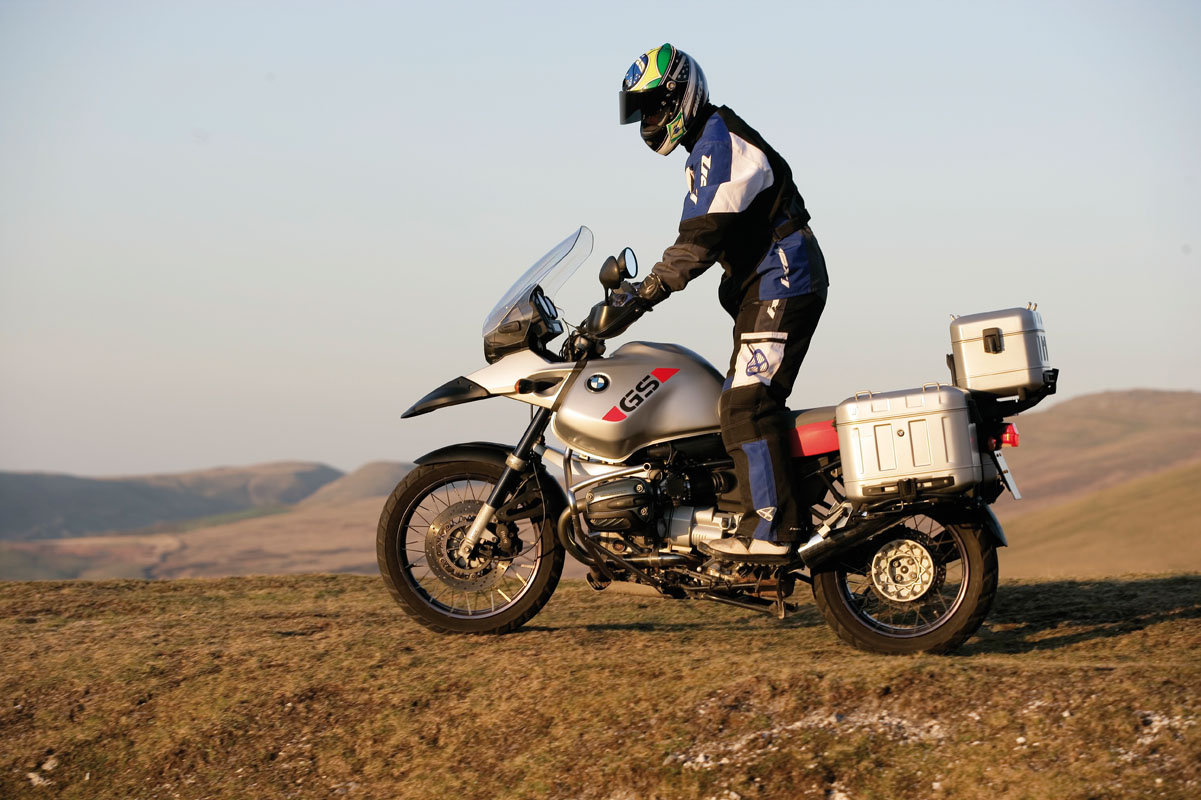
Road Test: BMW R1150GS V R1200GS
The bold, brash and huge 1200 GS Adventure takes on its dad - the tough, slugging film star 1150 GS Adventure in the wilds of Wales.

 |
BMW made R1150GS Adventures for some three years before Ewbie and Charlie Bikeman blagged a couple, no, sorry, three, bikes for their Long Way Round odyssey. That said, their hugely publicised trek bestowed added superstar status to an already high-profile machine.
Sales of the biggest dirt bike known to mankind went stellar. The R1150GS Adventure became, and remains, an icon.
But now it's being consigned to the annuls of history. The R1200GS Adventure, launched last year, has redefined BMW's huge-overlander bike concept. Faster, lighter and certainly flashier (in the most macho manner possible) it's also quite a lot lighter than the outgoing model. The question is, is it actually better?
ENGINE
Okay this is easy; the 1200 motor aces the 1150's, quite considerably. The spec charts tell it pretty much like it is. And on the dyno the 1200 makes a good 20bhp more than the 1150 and there's around 12 percent more torque too. And as all this extra grunt is propelling a substantially lighter bike it really is a non-contest. Or is it? Jump on the 1150 and you'll be immediately impressed. Our example, now some five years old (and owned by snapper Oli) has a hefty 41,000 miles on the clock, yet the motor feels as good as new. Tweak the throttle and it bounds energetically up the road. The motor feels solid, dependable with just enough shuddering surge to be interesting. Its forte is low to mid, simply short shift at about 4000rpm and let the torque punt you along.
The 1200 feels immediately different. Despite giving nothing away to the 1150 in low down pull, the 1200's character is typified by a feeling of being quicker revving with most of the thrust coming through the mid range. To quote Oli, it feels, 'airy'. But he's a photographer and should not be trusted with words. We think he means it's a light flywheel feel, free spinning - rev happy (for a BMW flat twin, that is)
We put the two head-to-head for some top gear roll-ons and the 1200 simply tears away, even from as slow as 40mph, which shows that even while the 1150 feels to have impressive bottom end, the 1200 has more.
However, if you are off-road oriented then the character of the 1150's motor will still feel the better of the two. It's fair to say when you're hitting the dirt with these monsters you will, by necessity, be doing it in a slower, more considered manner - these are not motocrossers and neither have the suspension to tackle gnarly stuff at speed. And so the 1150's better suited to this pace with its wonderfully rich low to mid range grunt. Again the 1200 will probably surge past like a raped ape but that won't stop the 1150 rider from feeling at peace with his bike and the world.
On the road though, you ultimately have to tip the nod to the 1200. It's in the overtakes you notice it most, with the 1200 you twist the throttle and you're past. On the 1150, you plan ahead, you time the move and then peg down a gear and finally give it the herbs. Okay, it's better than that, but by comparison, it is more work. On the motorway the 1150 feels best at around 85mph, the 1200 at 90mph.
Of course if you exercise a modicum of restraint you'd find these air-cooled flat twins are far more fuel efficient when you drop back to a cruising speed of 56mph (ish) - then they'll go a good 400 miles on their huge tanks, both types. Not that's you'd ever cruise at 56mph.
We should mention the transmissions too. Both feature six speed 'boxes matched to massive dry single-plate clutch units. Surprisingly they feel identical, despite the age of the 1150 and the brand-newness of the 1200. Both shift well for their type, being reasonably positive and accurate when shifted under load. And both make the peculiar dropped-spanner clank when shifting gear mid town centre when there's no load. Both could probably stand to have a longer top gear too.
Should you slip the clutch on either, for a wheelie or to initiate a slide in the dirt, then both will emit a stench akin to a British Rail shunting yard - it must be something in the friction plate material. Quite simply, we're talking reliability and robustness here. Odd thing is the 1200 is said to have a new gearbox and of course that's a much revised Paralever system - yet is there a quantifiable improvement? Maybe the message is once a BMW always a BMW.
Oh, except for the case of electrical and electronic components. We're talking CAN bus, the onboard digital network come wiring loom fitted to the 1200. This is technology so advanced (apparently) that few understand and certainly no one without BMW's own software and a laptop can repair in the event of a malfunction. For those riders who like to ride to the back and beyond, outside the protective apron of the BMW dealer network, then this is bad news. Overlanders like nothing better than to field fix their bikes using little more than a multi-tool and some baler twine. An inert GS with a flashing digital message 'refer to service manager' is an Outer Mongolian nightmare. So the 1150 is the pick for outback man.
BRAKES
Both these bikes rely on 305mm discs matched to four-piston calipers for primary retardation. Both examples too came with ABS, which can be switched off for off-roading.
Unsurprisingly they both offered a very similar level of performance. That said, braking styles differed considerably. Maybe it's the way the 1200 is ever so slightly taller, but on the newer Adventure you use considerably more rear brake - we suspect to counter the amount of forward pitching that accompanies a handful of front brake. The rear also gets used a fair deal mid corner where subtle variances in speed are called for. The 1150, however, is as good as gold. A handful of front brake here worked in the same manner as any sports bike rider can relate to: Simply pile it on.
However, the 1200 does have the benefit of a revised ABS system, the primary benefit (for us) being nothing more than an easier manner of disabling it. On the 1200 you merely press the ABS button anytime and immediately a light flashes 'brake failure' (slightly disconcerting, if not to say inaccurate) to confirm. With the 1150 we're talking a far more complicated and bothersome procedure. Something like holding the ABS down while switching on the ignition then keep on pressing for 10-seconds etc etc. In short, a bother.
CHASSIS
As the salesman shouted, "Which part of all-new do you not understand?" Okay, you can see the genealogy, but the reality is so many parts bear no more than a passing resemblance to the previous model. The forks, or sliders perhaps (this is Telelever), are up from 35mm to 41mm diameter. The Paralever rear you can see now carries its torque arm above the shaft drive, not below (p115). The steering head angle and trail have been significantly changed - less angle, more trail. BMW have engineered a full 30kg weight saving, so you start to appreciate no spacer was left unturned.
And yet once again, when it comes to how this conveys to the rider we seem to be picking at incidentals rather than an overall paradigm shift. You notice you are sitting higher, probably storming along just a bit faster, but perhaps more so you're picking up incidentals like screen protection, seat height, tank width, pretty clock dials.
With both bikes you have these high and wide handlebars so you have almost ludicrous amounts of leverage on the steering. And with both bikes you are ever mindful that you are forcing god-knows how much weight, lets say circa 350kg of kinetic mass through what are 110- and 150-section tyres. And given these are tall beasts that's a lot of weight moving its centre of gravity. Enough to make you moderate your aggression somewhat.
So does the 1200 feel better? No. It feels about the same. Only it feels the same carrying about an extra 5-10mph everywhere. That's enough to make the 1150 rider pedal considerably harder to keep up, but not enough to call 1200-land an all-new place.
However, our 1200 owner hasn't been short-changed. There are many improvements that really help improve the Adventure's status. For a start those are cool anodised alloy motocross bars to steer by - light years ahead of the black painted steel bars on the 1150. Same goes for the new oversize alloy footpegs. Compared to the finger-thin steel pegs on the 1150, again a massive improvement. The screen's quite something too, offering more protection without compromising the view forward. It adds at least two-degrees more warmth to the rider too - standing up while on a night run confirmed it much cooler 'out there' than behind that screen. As well the rider is well protected by the 33-litre tank, which is now sculpted to the rider's legs. The downside to that is when your legs get tired you can no longer stretch them out over the cylinders - a favourite pastime of Boxer owners.
The seat too is now adjustable. The lower position is 'seriously tall', the higher position, 'stratospheric'. Alas, it's no more comfortable than the old bench seat of the 1150. For real distance on either bike you'd be inclined to order an aftermarket item.
LOOKS
The 1150 is a classic. When launched it re-wrote the book of neo-industrial automotive design. Not since the Tiger Ausf. E (we call them Panzer) of 1942 has Germany created such an imposing touring tool. Forget how impressive the 1150 Adventure is off-road, with looks like this it was a must-have for anyone who fancied long distance work coloured with a frisson of attitude. Big counts.
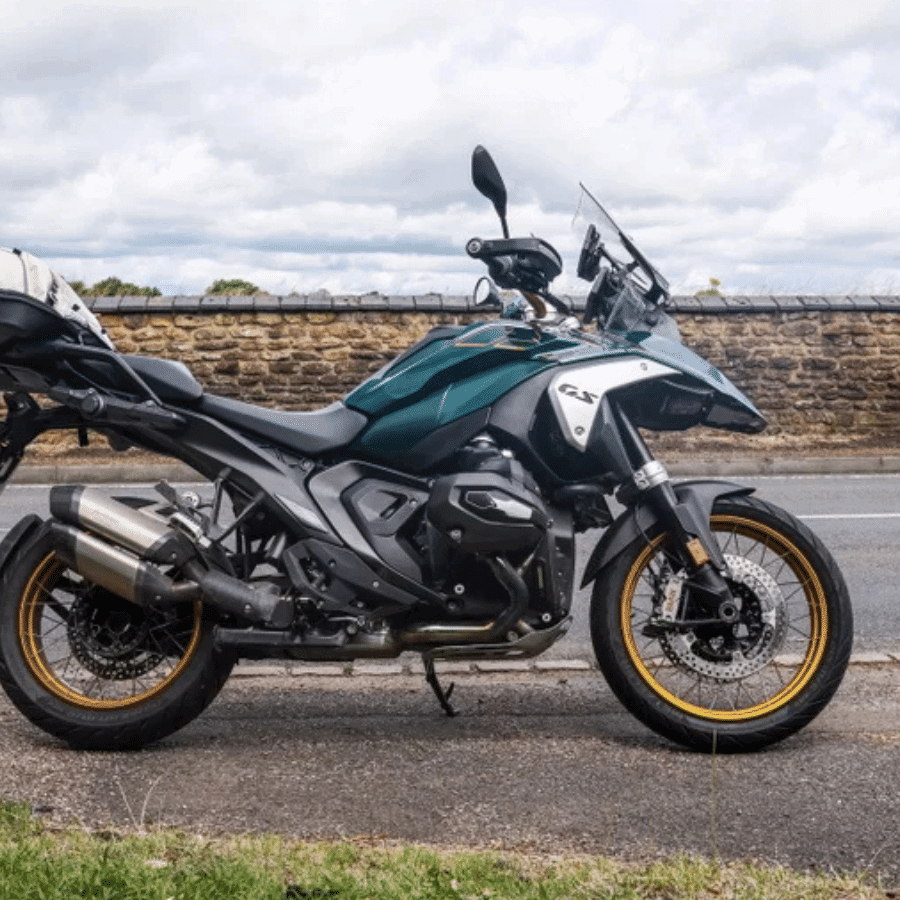
Bigger counts even more, and the 1200 Adventure is even bigger, in bulk if not weight. Parked together on their centre stands the 1200 towers over the 1150. With the screen close to reaching an altitude of six-foot it's a case of stepladders for anyone shorter than 5'10". That new 33-lite tank does a hell of a job of creating the 1200's imposing broad-shouldered posture. Added to this are the now fitted-as-standard crash bars for tank and cylinders, which help suggest adventure pending, on a Herculean scale.
After five years the 1150 was certainly due an update and with the demands of meeting Euro3 regulations the time had come for a makeover. Aesthetics are a personal, emotive issue. We can argue for informed educated opinions, but with bikes like the 1200 Adventure there is only one uniform reaction - awe.
CONCLUSION
There has been among the GS brotherhood muttered words of dissent on the 1200GSs. That they're not proper GSs, since they utilise too much plastic and light alloys. And sin of all sins, CAN bus takes away nearly all notion of field-fixes for electrical failures. On that last point they may have an argument. But for the vast majority of GS Adventure purchasers, CAN bus is a non-issue, throughout much of Europe the nearest BMW dealer will be little more than a 30mph-limited limp, or even a truck-bound relay trip away.
In truth, the 1200 is bigger and better, faster and meaner. And Euro3 compliant. It does nearly everything better than the 1150. Yet unlike the 1098 vs 999 splitting heirs of a couple of months back it does nothing to show-up the shortcomings of its predecessor, if anything it highlights the 1150's strengths. Eventually math replaces emotion: if you've got £5000 you buy the 1150; £10,000 you buy the 1200. Either way you're not going to be disappointed.
AN EXPERT SAYS...
Nick Plumb is King Kahuna at Touratech UK, purveyors of bespoke adventure kit to BMW owners. Twice a Dakar finisher he lives and breathes Adventures
"THE 1150 ADVENTURE was an amazing bike, so big you thought it couldn't physically do what it did - but it did. Following on from the R80 and R100GSs it really created the market for Touratech, it was a brute and enthusiasts loved modifying it.
The 1150 is of course heavier than the 1200, but with weight you only feel it when you're pushing it or riding very slowly and there are occasions where weight helps. The 1150 used its weight well.
When the 1200GS came out I tried one and immediately went back to the 1150 Adventure - it was so much better. But the 1200 Adventure has moved things along. BMW have worked with Touratech in developing the bike and you can see our input in items like the handlebars and pegs, the crash bars and racks - all Touratech influenced.
But the 1200 Adventure does seem to be veering toward sport bike mentality. You can feel it in the engine's character and the owners are different, the kind of products they buy are more personalisations - sort of bling - over the functionality that 1150 owners sought. And I worry about the CAN bus. Maybe this is BMW's version of perfection - but we all know perfection can go wrong. And this system relies on you calling the number on the key tag for a repair. Not good for rugged go-anywhere riding.
For me the 1150 is THE Adventure. Yet I'm getting a 1200 very soon and I'm still very excited about that!"
Touratech UK: 01792 816660
ANOTHER EXPERT SAYS...
Simon Pavey is Big Cheese at BMW's Off-Road Skills in West Wales. Multiple Dakar Rally finisher, thrasher extraordinaire of GS Adventures in the dirt he is, alas, an Australian. Which goes to show, no one's perfect
"ALTHOUGH I HAVE considerable experience of both BMW GS Adventures it has been two years since I have ridden the 1150. I loved the 1150 and when the new 1200 came along I was worried that it just wouldn't have the same character.
Worry I shouldn't have, as within days I loved the newer Adventure even more. Having them side-by-side served to remind me why - because it's an 1150 Adventure with more... more power, more torque, more wind protection, more features and all round more capability.
Don't get me wrong, the 1150 is still a great bike because the smooth tractable engine makes it a silky joy to ride in its own special way. If you can afford the latest GS grab one now, but if the 1200 Adventure is stretching the seams of your wallet too far then you really shouldn't fret - I guarantee that every time you swing your leg over either GS Adventure, you'll get back off with a giant grin on you face."
BMW Off-Road Skills: 0800 131282
SPECS - R1150GS ADVENTURE
TYPE - TRAIL
PRODUCTION DATE - 2005
PRICE NEW - £5000 (USED)
ENGINE CAPACITY - 1130cc
POWER - 74.8bhp@6800rpm
TORQUE - 66.6lb.ft@5300rpm
WEIGHT - 253kg
SEAT HEIGHT - 900mm
FUEL CAPACITY - 30L
TOP SPEED - 121mph
0-60 - n/a
TANK RANGE - N/A
SPECS - R1200GS ADVENTURE
TYPE - TRAIL
PRODUCTION DATE - 2007
PRICE NEW - £9895
ENGINE CAPACITY - 1170cc
POWER - 94.9bhp@7500rpm
TORQUE - 78.8lb.ft@5500rpm
WEIGHT - 223kg
SEAT HEIGHT - 890mm OR 910mm
FUEL CAPACITY - 33L
TOP SPEED - 128.7mph
0-60 - n/a
TANK RANGE - N/A

BMW made R1150GS Adventures for some three years before Ewbie and Charlie Bikeman blagged a couple, no, sorry, three, bikes for their Long Way Round odyssey. That said, their hugely publicised trek bestowed added superstar status to an already high-profile machine.
Sales of the biggest dirt bike known to mankind went stellar. The R1150GS Adventure became, and remains, an icon. But now it's being consigned to the annuls of history. The R1200GS Adventure, launched last year, has redefined BMW's huge-overlander bike concept. Faster, lighter and certainly flashier (in the most macho manner possible) it's also quite a lot lighter than the outgoing model.
The question is, is it actually better?
ENGINE
Okay this is easy; the 1200 motor aces the 1150's, quite considerably. The spec charts tell it pretty much like it is. And on the dyno the 1200 makes a good 20bhp more than the 1150 and there's around 12 percent more torque too. And as all this extra grunt is propelling a substantially lighter bike it really is a non-contest. Or is it?
Jump on the 1150 and you'll be immediately impressed. Our example, now some five years old (and owned by snapper Oli) has a hefty 41,000 miles on the clock, yet the motor feels as good as new. Tweak the throttle and it bounds energetically up the road. The motor feels solid, dependable with just enough shuddering surge to be interesting. Its forte is low to mid, simply short shift at about 4000rpm and let the torque punt you along.
The 1200 feels immediately different. Despite giving nothing away to the 1150 in low down pull, the 1200's character is typified by a feeling of being quicker revving with most of the thrust coming through the mid range. To quote Oli, it feels, 'airy'. But he's a photographer and should not be trusted with words. We think he means it's a light flywheel feel, free spinning - rev happy (for a BMW flat twin, that is).
We put the two head-to-head for some top gear roll-ons and the 1200 simply tears away, even from as slow as 40mph, which shows that even while the 1150 feels to have impressive bottom end, the 1200 has more.
However, if you are off-road oriented then the character of the 1150's motor will still feel the better of the two. It's fair to say when you're hitting the dirt with these monsters you will, by necessity, be doing it in a slower, more considered manner - these are not motocrossers and neither have the suspension to tackle gnarly stuff at speed. And so the 1150's better suited to this pace with its wonderfully rich low to mid range grunt. Again the 1200 will probably surge past like a raped ape but that won't stop the 1150 rider from feeling at peace with his bike and the world.
On the road though, you ultimately have to tip the nod to the 1200. It's in the overtakes you notice it most, with the 1200 you twist the throttle and you're past. On the 1150, you plan ahead, you time the move and then peg down a gear and finally give it the herbs. Okay, it's better than that, but by comparison, it is more work. On the motorway the 1150 feels best at around 85mph, the 1200 at 90mph.
Of course if you exercise a modicum of restraint you'd find these air-cooled flat twins are far more fuel efficient when you drop back to a cruising speed of 56mph (ish) - then they'll go a good 400 miles on their huge tanks, both types. Not that's you'd ever cruise at 56mph.
We should mention the transmissions too. Both feature six speed 'boxes matched to massive dry single-plate clutch units. Surprisingly they feel identical, despite the age of the 1150 and the brand-newness of the 1200. Both shift well for their type, being reasonably positive and accurate when shifted under load. And both make the peculiar dropped-spanner clank when shifting gear mid town centre when there's no load. Both could probably stand to have a longer top gear too.
Should you slip the clutch on either, for a wheelie or to initiate a slide in the dirt, then both will emit a stench akin to a British Rail shunting yard - it must be something in the friction plate material.
Quite simply, we're talking reliability and robustness here. Odd thing is the 1200 is said to have a new gearbox and of course that's a much revised Paralever system - yet is there a quantifiable improvement? Maybe the message is once a BMW always a BMW.
Oh, except for the case of electrical and electronic components. We're talking CAN bus, the onboard digital network come wiring loom fitted to the 1200. This is technology so advanced (apparently) that few understand and certainly no one without BMW's own software and a laptop can repair in the event of a malfunction. For those riders who like to ride to the back and beyond, outside the protective apron of the BMW dealer network, then this is bad news. Overlanders like nothing better than to field fix their bikes using little more than a multi-tool and some baler twine. An inert GS with a flashing digital message 'refer to service manager' is an Outer Mongolian nightmare. So the 1150 is the pick for outback man.
2005 BMW R1150GS Adventure Specifications
TYPE - TRAIL
PRICE - £5000 (USED)
ENGINE CAPACITY - 1130cc
POWER - 74.8bhp@6800rpm
TORQUE - 66.6lb.ft@5300rpm
WEIGHT - 253kg
SEAT HEIGHT - 900mm
FUEL CAPACITY - 30L
TOP SPEED - 121mph

BRAKES
Both these bikes rely on 305mm discs matched to four-piston calipers for primary retardation. Both examples too came with ABS, which can be switched off for off-roading.
Unsurprisingly they both offered a very similar level of performance. That said, braking styles differed considerably. Maybe it's the way the 1200 is ever so slightly taller, but on the newer Adventure you use
considerably more rear brake - we suspect to counter the amount of forward pitching that accompanies a handful of front brake.
The rear also gets used a fair deal mid corner where subtle variances in speed are called for. The 1150, however, is as good as gold. A handful of front brake here worked in the same manner as any sports bike rider can relate to: Simply pile it on.
However, the 1200 does have the benefit of a revised ABS system, the primary benefit (for us) being nothing more than an easier manner of disabling it. On the 1200 you merely press the ABS button anytime and immediately a light flashes 'brake failure' (slightly disconcerting, if not to say inaccurate) to confirm. With the 1150 we're talking a far more complicated and bothersome procedure. Something like holding the ABS down while switching on the ignition then keep on pressing for 10-seconds etc etc. In short, a bother.
CHASSIS
As the salesman shouted, "Which part of all-new do you not understand?" Okay, you can see the genealogy, but the reality is so many parts bear no more than a passing resemblance to the previous model. The forks, or sliders perhaps (this is Telelever), are up from 35mm to 41mm diameter.
The Paralever rear you can see now carries its torque arm above the shaft drive, not below. The steering head angle and trail have been significantly changed - less angle, more trail. BMW have engineered a full 30kg weight saving, so you start to appreciate no spacer was left unturned.
And yet once again, when it comes to how this conveys to the rider we seem to be picking at incidentals rather than an overall paradigm shift. You notice you are sitting higher, probably storming along just a bit faster, but perhaps more so you're picking up incidentals like screen protection, seat height, tank width, pretty clock dials.
With both bikes you have these high and wide handlebars so you have almost ludicrous amounts of leverage on the steering. And with both bikes you are ever mindful that you are forcing god-knows how much weight, lets say circa 350kg of kinetic mass through what are 110- and 150-section tyres. And given these are tall beasts that's a lot of weight moving its centre of gravity. Enough to make you moderate your aggression somewhat.
So does the 1200 feel better? No. It feels about the same. Only it feels the same carrying about an extra 5-10mph everywhere. That's enough to make the 1150 rider pedal considerably harder to keep up, but not enough to call 1200-land an all-new place.
However, our 1200 owner hasn't been short-changed. There are many improvements that really help improve the Adventure's status. For a start those are cool anodised alloy motocross bars to steer by - light years ahead of the black painted steel bars on the 1150. Same goes for the new oversize alloy footpegs. Compared to the finger-thin steel pegs on the 1150, again a massive improvement.
The screen's quite something too, offering more protection without compromising the view forward. It adds at least two-degrees more warmth to the rider too - standing up while on a night run confirmed it much cooler 'out there' than behind that screen. As well the rider is well protected by the 33-litre tank, which is now sculpted to the rider's legs. The downside to that is when your legs get tired you can no longer stretch them out over the cylinders - a favourite pastime of Boxer owners.
The seat too is now adjustable. The lower position is 'seriously tall', the higher position, 'stratospheric'. Alas, it's no more comfortable than the old bench seat of the 1150. For real distance on either bike you'd be inclined to order an aftermarket item.
LOOKS
The 1150 is a classic. When launched it re-wrote the book of neo-industrial automotive design. Not since the Tiger Ausf. E (we call them Panzer) of 1942 has Germany created such an imposing touring tool. Forget how impressive the 1150 Adventure is off-road, with looks like this it was a must-have for anyone who fancied long distance work coloured with a frisson of attitude. Big counts.
Bigger counts even more, and the 1200 Adventure is even bigger, in bulk if not weight. Parked together on their centre stands the 1200 towers over the 1150. With the screen close to reaching an altitude of six-foot it's a case of stepladders for anyone shorter than 5'10". That new 33-lite tank does a hell of a job of creating the 1200's imposing broad-shouldered posture. Added to this are the now fitted-as-standard crash bars for tank and cylinders, which help suggest adventure pending, on a Herculean scale.
After five years the 1150 was certainly due an update and with the demands of meeting Euro3 regulations the time had come for a makeover. Aesthetics are a personal, emotive issue. We can argue for informed educated opinions, but with bikes like the 1200 Adventure there is only one uniform reaction - awe.
CONCLUSION
There has been among the GS brotherhood muttered words of dissent on the 1200GSs. That they're not proper GSs, since they utilise too much plastic and light alloys. And sin of all sins, CAN bus takes away nearly all notion of field-fixes for electrical failures. On that last point they may have an argument. But for the vast majority of GS Adventure purchasers, CAN bus is a non-issue, throughout much of Europe the nearest BMW dealer will be little more than a 30mph-limited limp, or even a truck-bound relay trip away.
In truth, the 1200 is bigger and better, faster and meaner. And Euro3 compliant. It does nearly everything better than the 1150. Yet unlike the 1098 vs 999 splitting heirs of a couple of months back it does nothing to show-up the shortcomings of its predecessor, if anything it highlights the 1150's strengths. Eventually math replaces emotion: if you've got £5000 you buy the 1150; £10,000 you buy the 1200. Either way you're not going to be disappointed.
2007 BMW R1200GS Adventure Specifications
TYPE - TRAIL
PRODUCTION DATE - 2007
PRICE NEW - £9895
ENGINE CAPACITY - 1170cc
POWER - 94.9bhp@7500rpm
TORQUE - 78.8lb.ft@5500rpm
WEIGHT - 223kg
SEAT HEIGHT - 890mm OR 910mm
FUEL CAPACITY - 33L
TOP SPEED - 128.7mph