Road Test: 2007 Z750 v FZ6 v GSR v Hornet
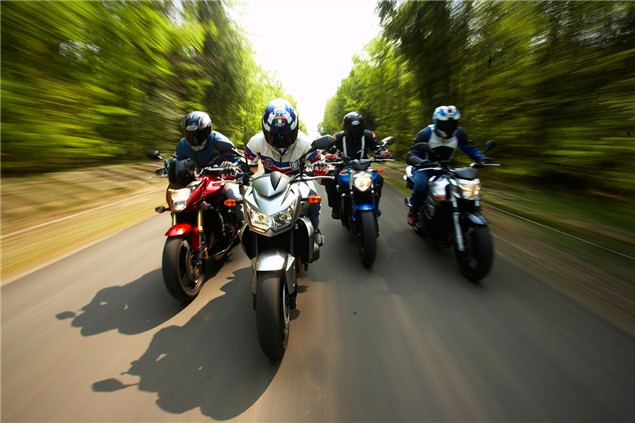
Welcome to a world of high tea, cucumber sandwiches, and screaming petrol engines as the naked middleweights tear into...

 |
There's something wonderfully British about the Goodwood Estate. It's the kind of haven of eccentricity that can only ever exist within the glorious boundaries of the British Isles. Within its 12,000 acres it boast two golf courses, a horse race track, a flying club, farm and most importantly, a racetrack.
This estate really is every schoolboy's dream, and luckily Lord March, who manages it, is a right petrol head. Goodwood hosts one of the most unique motor racing events on the calendar. Forget MotoGP, forget WSB, if you want a truly unique day out with a dazzling array of four and two wheeled machinery head to 'Glorious Goodwood' and its Festival of Speed.
For those new to this event, check out the preview after this test but for those who are a bit impatient let me explain. Basically loads of amazing cars and bikes charge up Lord March's drive in front of around 150,000 spectators in a celebration of all things based on the wonder of the internal combustion engine. It's not a race, it's a demonstration, but everyone still gives it the berries from the off, usually in virtually priceless classic racing vehicles. How quintessentially British.
So what were we doing there?
Well, the hill climb course offers a great mini-track to test the latest generation of naked middleweights while the roads around the Sussex Downs are fantastic for a group ride out. Also, and let's be truthful here, when a Lord of the realm invites you to thrash a few bikes up and down his drive you can't really say no, can you? Exactly.
So Niall, John Hogan, Evil Jim - fingers freshly glued back together after a ZX-10R incident (see the 1000s group test, p52) - and myself rolled into the Goodwood Estate on the latest mid-sized fairing-free tools to see what they were made of.
As soon as we arrived it became apparent that both these bikes and our coloured leather jackets were out of place in the tranquil green surroundings of Goodwood.
Not only had Niall forgotten to wear his cravat but also the modern styling of the bikes clashed against the historic surroundings. Goodwood is used to seeing classic race fairings, not the quirky lines of the Z750.
But lines are what these bikes are all about. The Japanese are always prepared to push out the styling boat when it comes to naked middleweights because the target audience are young, vibrant trendsetters who like to create an impact. Also with each so evenly matched on price, styling can be the deciding factor when it comes to a sale.
Which explains why Kawasaki has gone even more over the top with the '07 Z750, Honda has looked for Italian flair with its new Hornet, Yamaha has made the FZ6 more aggressive with funky graphics and wheel tape and Suzuki, well the GSR is unchanged for 2007, but it still looks new and fresh.
But as well as styling there's also another trend with the naked middleweights - using a re-tuned sports bike engine. These bikes, with the exception of the Z750, can all trace their engine roots back to a supersports 600s, which is both a blessing and a curse. A blessing because the 600cc sports bike market is so fiercely contended the engines are at the very cutting-edge of design, a curse because they are usually rev-happy frenzied monsters.
However this year Honda bucked the trend with its CBR600RR. The latest generation has a very impressive mid-range, something we discovered to our surprise in last months 600s group test, and this trait has been passed on to the new Hornet. Unlike Hornets of old this one won't vibrate your eyeballs out at 70mph and while it still has a slight tingle, just to remind you it's a Hornet, it's nowhere near as intrusive. There's a surprising amount of bottom end power too.
Last year the Z750 was head and shoulders above the competition when it came to low and mid-range power thanks to its larger motor. The extra 150cc it offered over the dated old Hornet's engine and FZ6's re-tuned racer motor was clearly noticeable and made the Kawasaki a much better day-to-day machine. Now, despite keeping the same capacity, Honda's actually made its Hornet feel almost as powerful.
It's most noticeable in the higher gears. Overtaking a car at 70-odd mph on the Hornet no longer requires dropping a few gears to get the revs up, now it simply involves opening the throttle and letting the bike do the work. Like the CBR600 the power delivery is very linear and doesn't have any point in the revs where it decides to take off, building steadily to max power instead, which is why it feels like the Z750.
The beauty of a 750 compared to a 600 one is the extra torque that comes with the capacity hike. As these bikes are generally used on a daily basis the extra practicality and ease of riding that comes with a strong mid-range is vital. There's no fun having to continually change up and down gears as you overtake the rush hour traffic, it's unnecessary extra hassle. Kawasaki, by bucking the 600cc trend of middleweights, negated this whole problem.
Even compared to the new Hornet the restyled Z is still the middleweight king when it comes to engines. Although Kawasaki has meddled slightly with the engine it still keeps its strong and smooth power throughout the range with a good, non-jerky, throttle response. Because the Hornet has closed the gap so much between the engines though, it's easy to think the Kawasaki has lost a bit of bottom end, but hop on the Yamaha and you instantly realise it hasn't, it's just the competition has caught up.
I admit I'm not a huge fan of the new-style Fazers. I've always found them too revvy, harsh and generally hard work to ride, so I was interested to see if the updated FZ6 would be any better.
Well, the Yam doesn't get off to a good start. I know this is a small thing but it really wound me up. The clutch cable runs right over the ignition lock, which means to get the key in and out you have to push the cable out of the way. If I owned an FZ6 this would drive me bananas and I can't believe Yamaha has let a bike out with such a stupid design fault. Rant over, onto the rest of the bike.
For me the FZ6 has always been the better of the two Fazers because its aggressive styling suited the character of the engine and chassis. Fazers of old were gentle, smooth and softly sprung bikes, which is why they won so many commuting fans. The new style of Fazer isn't like this. Tightening EU emissions laws forced Yamaha to stop using the old Thundercat engine and to re-tune the R6 motor instead for the new underseat piped Fazers. Which, in my opinion, is where most of the FZ6's problem come from.
For me the R6 engine isn't a good naked middleweight motor due to its revvy nature. Even compared to last year's Hornet the FZ6 felt lacking in mid-range. This year because the Hornet's so improved it feels even more asthmatic.
Yamaha has gone a long way to ironing out some of the FZ6's niggles though. Although the gearbox is still stiff the clutch feels less grabby, the fuel injection is considerably better and you can now read the clocks, but it still feels so weak in the mid-range. Hit around 10,000rpm and it flies, but do you want to commute with an engine revving its tits off? Not really.
As it's unchanged this year the GSR feels like an old friend. Hogan had one as a longterm test bike last year (he had two in fact, one of which he snapped in half in an altercation with a VW Polo) so it's a bike I'm familiar with. Until Honda updated its Hornet motor the GSR was the 600 with the best engine, but worst throttle response. Going from a closed to open throttle isn't a smooth affair on the GSR. Although it still retains a hint of the donor GSX-R's top end manic rush, the GSR combines it with a decent mid-range that, although not as strong as the Hornet or Z, is better than the FZ6. It hits a nice compromise between a bike that feels great to thrash and one that can handle the daily grind.
Wind protection isn't an issue on these bikes as none have any. The tiny zit on the front of the Z750 does next to nothing, the Hornet's screen's fairly useless and neither the GSR nor FZ6 have bothered to try, so it's down to seating position. Now here's the irony with the FZ6, engine aside it's brilliantly thought out. The riding position is just right, the seat's well padded for rider and pillion, it has a huge steering lock, pillion grab rail and, best of all, a massive 160-plus mile tank range. Although the Hornet's very comfortable, and shorties will appreciate its low seat height, I only averaged around 115 miles to reserve and the GSR is about the same. Both bikes are comfortable though, and come with fuel gauges, but neither match the FZ6 for tank range. And now we come to the Z750. For a bike stealing everyone's heart at the start of this test the Z750 now comes crashing back to earth.
When you initially sit on the Z it feels great. Then you notice the seat. As well as pushing your nuts up against the tank (assuming you're a man that is) the Z comes with a horribly hard seat. I rode it home the 100 miles from Goodwood and within a mile was wishing I was on something else. The seat's as hard as nails, it has a ridge down the centre and there are no grab rails for the pillion. Funky styling's all very well, but these should be practical bikes.
Commuting dealt with, naked middleweights should also be fun. These are do it all bikes which should also pack a weekend thrill, which is where Yamaha has concentrated with the FZ6. Of the four the Yamaha feels the sportiest and although it's still a bit firm when you hit a bump that's just the price you pay for a sharper chassis.
In comparison the Hornet feels softly set, but capable. Unlike the FZ6 it's lacking in ground clearance and doesn't feel as sharp in the chassis, but is far better on slightly uneven roads. The Hornet has the Honda feel of total control about it while the Yamaha still has that exciting rough edge. Niall reckoned for a back road thrash he'd choose either the Honda or Yamaha for all round ability, despite actually rating the GSR a better handling bike.
In keeping with its slightly raw character the GSR's handling is sharper than the other middleweights, but at a cost. The GSR's agility means it isn't the most stable on bumpy roads. Get a shift on and the suspension feels like it's getting a bit overwhelmed and Niall thought it understeered too. It's fun, but the Honda and Yamaha rider are ultimately as fast with less effort, and it's the same with the Kawasaki.
The Z750 has always had a slightly front-endy feel to it, but last year's model combined this with a poor rear shock. Now Kawasaki has sorted the rear end out, but the slightly odd front feel is still there. Personally I didn't find it a problem, but it isn't as positive as the Honda or Yamaha. Not a big issue, and to be truthful I doubt many will find it a problem, but when you're riding hard and Goodwood's trees are as close as they were to us it was a slight worry.
HOGAN'S SECOND OPINION - HONDA
The Honda whups the competition. The new engine's a peach with useable power from way down the rev range and it embarrasses the others on bottom end drive, even the bigger engined Zed. It feels composed cornering hard and really lends itself to scratching. Looks are subjective and I quite like them, from the right angle. The small screen has a tacky last minute add on feeling though , as do the dodgy smoked indicator lenses. Even so, I'd put the Hornet down as the hot tip for best-selling middleweight by a mile this year.
HOGAN'S SECOND OPINION - KAWASAKI
Having been on the launch I was worried the Zed would be too firm for British pot-holed roads. Not the case though. Everyone else complained the seat was too firm, but I didn't think it was that bad. Maybe I've just eaten more pies than them. The Zed was the clear looker here too. The fairing around the clocks and the kicked up tail really give it an edge. Power delivery could be crisper though. Last year the Zed didn't feel like it was trying and it won this test. Now power's down, weight's up and it's lost its snap.
HOGAN'S SECOND OPINION - SUZUKI
I'd love to say the GSR's way better than the competition having just ridden one for a year, but the competition have evolved and only the Fazer remains the same. I still like the manic nature of the GSR but can't forgive Suzuki for the budget forks. Fuelling's still an issue too. Buy a GSR if you want to feel like a hooligan and don't mind a few rough edges to your daily ride but remember, only the engine is from a GSX-R, not the chassis, so don't expect it to provide race-rep kicks anywhere other than in a straight line.
HOGAN'S SECOND OPINION - YAMAHA
The Yam's so far off the mark. You think it'll make the ideal commuter tool, but having ridden it I'd rather take the bus. The levers are miles away, the pegs are on the sloppy rubber mounts, every time I got on I bashed my leg on the stupid
pillion handle, then couldn't get the key in the ignition because the clutch cable was in the way. If I could ride everywhere at 10,000 rpm in second gear and never have to touch the brakes I may like the Fazer more, but I can't so I don't. Better luck next year Yamaha. John Hogan
CONCLUSION
Honda could have so easily ruined the new Hornet by using an inappropriate, rev-happy engine, but it hasn't. The CBR600RR derived motor is a gem transforming the bike from a very capable machine to a very capable one with some serious grunt. For the daily commute and weekend fun the Hornet ticks all the right boxes. It's comfortable, well built, good handling and now has power to boot.
The Kawasaki is so nearly there. At TWO we are all huge fans of the old Z750 and this is so nearly a great bike, it's just let down by the seat. To put a bike into production that's so uncomfortable really is a huge oversight by Kawasaki. Although John Hogan didn't find it that bad Niall, Jim and myself found the seat ruined the whole riding experience. For a bike aimed at day to day use this one factor would be more than enough for me to choose the Honda over it.
Then there's the GSR and FZ6, which are hard to split. Yamaha is certainly moving in the right direction with the FZ6, especially after its 2007 updates. Although the new brakes are in truth only really a visual improvement the fuel-injection is much better, it's just the gearbox and continual lack of mid-range that lets it down. If you don't mind revving a bike then the FZ6 has some great practical touches and is very good on a smooth back road.
For a bike with a bit of attitude the GSR is easier to live with and has a stronger engine than the FZ6, it just lacks the sharp handling and has a slight throttle snatch. Overall the FZ6 looks better built, which probably just edges it over the GSR for third in this line-up.
SPECS - HONDA
TYPE - STREETBIKE
PRODUCTION DATE - 2007
PRICE NEW - £5495
ENGINE CAPACITY - 599cc
POWER - 89bhp@12,300rpm
TORQUE - 39.7lb.ft@10,600rpm
WEIGHT - 173kg
SEAT HEIGHT - 800mm
FUEL CAPACITY - 19L
TOP SPEED - N/A
0-60 - n/a
TANK RANGE - N/A
SPECS - KAWASAKI
TYPE - STREETBIKE
PRODUCTION DATE - 2007
PRICE NEW - £5445
ENGINE CAPACITY - 748cc
POWER - 90.1bhp@9900rpm
TORQUE - 52lb.ft@8000rpm
WEIGHT - 203kg
SEAT HEIGHT - 815mm
FUEL CAPACITY - 18.5L
TOP SPEED - N/A
0-60 - n/a
TANK RANGE - N/A
SPECS - SUZUKI
TYPE - STREETBIKE
PRODUCTION DATE - 2007
PRICE NEW - £5199
ENGINE CAPACITY - 599cc
POWER - 88bhp@13,500rpm
TORQUE - 39lb.ft@8300rpm
WEIGHT - 183kg
SEAT HEIGHT - 785mm
FUEL CAPACITY - 16.5L
TOP SPEED - N/A
0-60 - n/a
TANK RANGE - N/A
SPECS - YAMAHA
TYPE - STREETBIKE
PRODUCTION DATE - 2007
PRICE NEW - £4699
ENGINE CAPACITY - 599cc
POWER - 86.2bhp@11,700rpm
TORQUE - 41.9lb.ft@9700rpm
WEIGHT - 180kg
SEAT HEIGHT - 820mm
FUEL CAPACITY - 19L
TOP SPEED - N/A
0-60 - n/a
TANK RANGE - N/A

There's something wonderfully British about the Goodwood Estate. It's the kind of haven of eccentricity that can only ever exist within the glorious boundaries of the British Isles. Within its 12,000 acres it boast two golf courses, a horse race track, a flying club, farm and most importantly, a racetrack.
This estate really is every schoolboy's dream, and luckily Lord March, who manages it, is a right petrol head. Goodwood hosts one of the most unique motor racing events on the calendar. Forget MotoGP, forget WSB, if you want a truly unique day out with a dazzling array of four and two wheeled machinery head to 'Glorious Goodwood' and its Festival of Speed.
For those new to this event, check out the preview after this test but for those who are a bit impatient let me explain. Basically loads of amazing cars and bikes charge up Lord March's drive in front of around 150,000 spectators in a celebration of all things based on the wonder of the internal combustion engine.
It's not a race, it's a demonstration, but everyone still gives it the berries from the off, usually in virtually priceless classic racing vehicles. How quintessentially British.
So what were we doing there?
Well, the hill climb course offers a great mini-track to test the latest generation of naked middleweights while the roads around the Sussex Downs are fantastic for a group ride out. Also, and let's be truthful here, when a Lord of the realm invites you to thrash a few bikes up and down his drive you can't really say no, can you? Exactly.
So Niall, John Hogan, Evil Jim - fingers freshly glued back together after a ZX-10R incident (see the 1000s group test) - and myself rolled into the Goodwood Estate on the latest mid-sized fairing-free tools to see what they were made of.
As soon as we arrived it became apparent that both these bikes and our coloured leather jackets were out of place in the tranquil green surroundings of Goodwood.
Not only had Niall forgotten to wear his cravat but also the modern styling of the bikes clashed against the
historic surroundings. Goodwood is used to seeing classic race fairings, not the quirky lines of the Z750.
But lines are what these bikes are all about.
The Japanese are always prepared to push out the styling boat when it comes to naked middleweights because the target audience are young, vibrant trendsetters who like to create an impact. Also with each so evenly matched on price, styling can be the deciding factor when it comes to a sale.
Which explains why Kawasaki has gone even more over the top with the '07 Z750, Honda has looked for Italian flair with its new Hornet, Yamaha has made the FZ6 more aggressive with funky graphics and wheel tape and Suzuki, well the GSR is unchanged for 2007, but it still looks new and fresh.
But as well as styling there's also another trend with the naked middleweights - using a re-tuned sports bike engine. These bikes, with the exception of the Z750, can all trace their engine roots back to a supersports 600s, which is both a blessing and a curse. A blessing because the 600cc sports bike market is so fiercely contended the engines are at the very cutting-edge of design, a curse because they are usually rev-happy frenzied monsters.
However this year Honda bucked the trend with its CBR600RR. The latest generation has a very impressive mid-range, something we discovered to our surprise in last months 600s group test, and this trait has been passed on to the new Hornet. Unlike Hornets of old this one won't vibrate your eyeballs out at 70mph and while it still has a slight tingle, just to remind you it's a Hornet, it's nowhere near as intrusive. There's a surprising amount of bottom end power too.
Last year the Z750 was head and shoulders above the competition when it came to low and mid-range power thanks to its larger motor. The extra 150cc it offered over the dated old Hornet's engine and FZ6's
re-tuned racer motor was clearly noticeable and made the Kawasaki a much better day-to-day machine. Now, despite keeping the same capacity, Honda's actually made its Hornet feel almost as powerful.
It's most noticeable in the higher gears. Overtaking a car at 70-odd mph on the Hornet no longer requires dropping a few gears to get the revs up, now it simply involves opening the throttle and letting the bike do the work. Like the CBR600 the power delivery is very linear and doesn't have any point in the revs where it decides to take off, building steadily to max power instead, which is why it feels like the Z750.
The beauty of a 750 compared to a 600 one is the extra torque that comes with the capacity hike. As these bikes are generally used on a daily basis the extra practicality and ease of riding that comes with a strong mid-range is vital. There's no fun having to continually change up and down gears as you overtake the rush hour traffic, it's unnecessary extra hassle. Kawasaki, by bucking the 600cc trend of middleweights, negated this whole problem.
Even compared to the new Hornet the restyled Z is still the middleweight king when it comes to engines. Although Kawasaki has meddled slightly with the engine it still keeps its strong and smooth power throughout the range with a good, non-jerky, throttle response. Because the Hornet has closed the gap so much between the engines though, it's easy to think the Kawasaki has lost a bit of bottom end, but hop on the Yamaha and you instantly realise it hasn't, it's just the competition has caught up.
I admit I'm not a huge fan of the new-style Fazers. I've always found them too revvy, harsh and generally hard work to ride, so I was interested to see if the updated FZ6 would be any better.
Well, the Yam doesn't get off to a good start. I know this is a small thing but it really wound me up. The clutch cable runs right over the ignition lock, which means to get the key in and out you have to push the cable out of the way. If I owned an FZ6 this would drive me bananas and I can't believe Yamaha has let a bike out with such a stupid design fault. Rant over, onto the rest of the bike.
For me the FZ6 has always been the better of the two Fazers because its aggressive styling suited the
character of the engine and chassis. Fazers of old were gentle, smooth and softly sprung bikes, which is why they won so many commuting fans. The new style of Fazer isn't like this. Tightening EU emissions laws forced Yamaha to stop using the old Thundercat engine and to re-tune the R6 motor instead for the new underseat piped Fazers. Which, in my opinion, is where most of the FZ6's problem come from.