Fork in the road: Harley Street Rod vs. Yamaha R1
One man's floor is another man's ceiling. The words 'sports bike' can mean very different things, so we compare two contrasting takes takes on a common theme.


There comes a time in the life of many a motorcyclist when facts have to be faced and decisions made. Whether father time has finally caught up and riding race replicas has become physically challenging, or the long arm of the law has administered enough intimidation for you to consider 180mph motorcycles an unacceptable threat to your driving licence. Or perhaps marital pressures have been applied and a pillion seat the size of a Brillo pad is no longer appealing. Sometimes, something has to give.
We live in a country where the cutting edge sports bike is still King, but where 30 million non-motorcyclists are trying to get somewhere, clogging up the roads and knocking us into hedges where policemen are already hiding with their radar guns. Speed limits are coming down while speed cameras are going up and will no doubt soon generate more revenue than Internet pornography. That's enough digs at the establishment, but the point is this: until we trick the French into moving over to China we're stuck here with little in the way of alternative venues.
I've spent the last three years since my ban trying not to ride sports bikes on the road. I still love them but prefer the peaceful confines of the race track where cops and comfort are never an issue. I'm also stupid enough to ride in the same manner as I did 10 years ago, but paranoid enough to believe I'll get caught every single time from now on, which is an unhealthy combination. This slots me neatly into the category of 'nervous has-been seeking easy going type with GSOH and reasonable sporting ability.'

The purpose of combining a 2007 Yamaha R1 and Harley Street Rod on the same pages is not to put them through pointless rigorous testing, as you only need to look at the technical specifications to come to the obvious conclusions. But more interestingly, they both represent the pinnacle of performance for each manufacturer, while approaching the market from entirely different directions and no doubt selling to very different customer bases.
In some respects, if you compare the company's respective backgrounds, the Street Rod sits in the Harley portfolio as a more extreme representative than the R1 in Yamaha's . With the opening comments in mind, we're keen to see if Harley-Davidson is actually offering a real-world alternative to hard-edged road rockets.
My first impression of the Street Rod is that of comfort. Its low seat is well padded and the stretch to the handlebars is natural and relaxed with a bias towards cruising for long periods in the saddle. The big, 60-degree V-twin has a smoother rumble than the Evo motors and even sat idling shows a willingness to rev. It's a big bike with a long wheelbase but launching it straight into series of bends gives a feeling of soft yet planted confidence. You have to lean a fair way over on the 180-section rear tyre before the pegs make contact with the road, which means enthusiastic scratching is permitted without the constant distraction of metal on Tarmac.
The configuration of the engine means there is useable power everywhere, and quite a lot of it from very low down. Enough power, in fact, to haul the bike from standstill to 60mph in much the same time as the Yamaha at around 3.5 seconds, despite carrying an extra 100kg.

Harley Davidson Street Rod Specs
- TYPE - CRUISER
- PRODUCTION DATE - 2007
- PRICE NEW - £10,995
- ENGINE CAPACITY - 1130cc
- POWER - 116bhp@8000rpm
- TORQUE - 78lb.ft@7400rpm
- WEIGHT - 280kg
- SEAT HEIGHT - 762mm
- FUEL CAPACITY - 19L
- TOP SPEED - 135mph
- 0-60 - n/a
- TANK RANGE - N/A

It's a lot more fun than expected too, as it doesn't get overly excited when you turn up the wick - it just needs a little more physical effort. Corner entry preparation is necessary as the Street Rod doesn't have the geometry to start making sudden alterations mid-turn, but the weight keeps it steady and you can punch hard out of bends in the middle three gears, with a steady supply of horsepower up to 8000rpm, and a peak of 116bhp at 8200rpm. Thankfully, to match the relentless surge, it has plenty of braking ability courtesy of Brembo. And with three 300mm discs, the rear contributes significantly to proceedings. Four fingers are required on the lever but feel and feedback is pretty good, and an hour of hard charging failed to produce a hint of fade from the four-piston calipers.
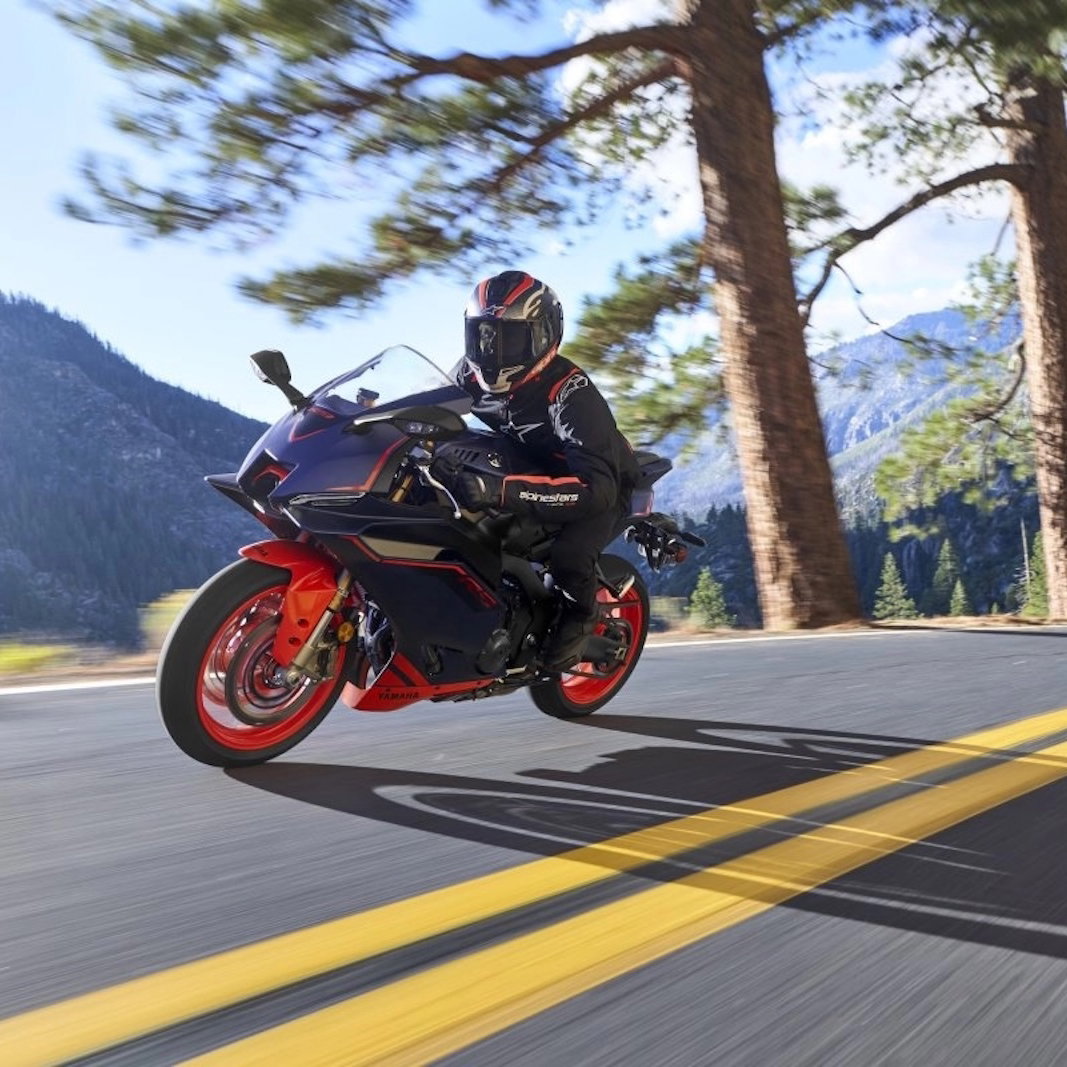
After a few hours on the Street Rod, hopping aboard the R1 was a revelation. The extreme riding position seems exaggerated after being upright for so long. Your body assumes a racing crouch with your backside at the same level as your hands (the seat is 7cm higher than the Harley's) and you mould into the sculptured bodywork of what is a truly beautiful machine. Of course it's purposeful and minimalist, but the sheer lack of bulk makes the Yamaha seem tiny and slightly intimidating by comparison.
Press the starter button and you instantly know what you're in for. The 20-valve motor is 130cc down on the Harley's, but has double the cylinders and produces an extra 40-plus bhp and at 4000rpm higher. It's about as hardcore as they come.

I rode nothing but sports bikes for 10 years but it still takes a few miles to adjust. Surging forward in first gear is enough to get the adrenalin levels up, and this is where they'll stay. Working through the gearbox at 7000rpm into sixth provides rapid forward motion, and it hasn't even started to get going. Three figure speeds are reached in seconds (like the Harley) but you always feel like you're flying whereas the Street Rod disguises its performance.
Even for a 1000cc Japanese bike everything seems to happen high up in the rev range. Break through the 7000rpm barrier and there's another 5000rpm of sheer power as the world becomes a blur. It's addictive and exhilarating, which is why I'm constantly glancing at the mirrors. The handling is razor sharp and the suspension a little firm, but it can easily handle anything I throw at it. Being 30cm shorter than the Street Rod, it's considerably more agile and quick steering, but far less relaxing too. I think I'm getting a little old for this.
While these two machines couldn't be more different to ride, in some respects they have more in common than you might imagine. Both are good fun, both look cool and both turn heads wherever they go. Running costs will be similar as they share the same insurance groups, return 40mpg and have
similar service intervals. The Harley costs a couple of grand more but will have a stronger residual value as it doesn't compete in a high-tech war.
You could cruise comfortably at high speed on the Harley for a whole day; you could cruise much faster on the Yam, but where and for how long? The R1 comes alive on the racetrack, its natural habitat. The Street Rod will gladly give it a go but is obviously more at home on the road. They both like being revved but the Yamaha begs for more, and indeed requires more to get the best out of it. And, if it's of any importance, the Street Rod will be the winner with the ladies. Hands down.
And in answer to the all-important question: yes, the Street Rod is a realistic alternative to the hyper sports bike. But whether or not this is the future remains to be seen.

Yamaha R1 Specs
- TYPE - SUPERSPORTS
- PRODUCTION DATE - 2007
- PRICE NEW - £8799
- ENGINE CAPACITY - 998cc
- POWER - 158bhp@12,300rpm
- TORQUE - 76lb.ft@9700rpm
- WEIGHT - 172kg
- SEAT HEIGHT - 835mm
- FUEL CAPACITY - 18L
- TOP SPEED - 186mph
- 0-60 - n/a
- TANK RANGE - N/A