Road Test: BMW R1200ST
The rain in Spain fell mostly as snow. Jon Urry discovers it's not all glamour in this job as he tests BMW's new sports tourer.

 |
Heading up into the mountains outside the Spanish town of Jerez I got the feeling all was not well ahead. The driving rain that had started the minute we left the hotel wasn't really too much of a problem. Luckily enough I'd remembered to pack my waterproofs, but what was worrying me were the cars coming down the mountain. Every one of them appeared to have a covering of snow over their front number plate.
Sure enough, a few minutes later the rain turned into snow and a little further on we found out that the road ahead had been closed due to the weather. Oh well, never mind. At least there was a nearby cafe to shelter in and dry off a bit.
Despite BMW choosing to launch the new R1200ST in southern Spain the weather dealt a cruel blow during the time I was there. The usual sunshine that accompanies a trip to Spain was missing, and instead the whole of Europe was gripped by a cold spell. Because of this I won't pretend to have tested the bike to its limits; it simply wasn't possible. The ride home, however, was in the dry so I can give you a fairly clear impression of what it is like when the pace heats up.
BMW describe this bike as a 'long-distance sprinter', or sports tourer to you and me. It is designed to fill the gap between the new R1200RT, which is a more touring dedicated machine, and the old R1100S, which is BMW's 'sports' model. But rather than actually create a new machine BMW has chosen to give the R1200RT a bit of a nip and tuck, subjected it to a controlled diet and sent it down the gym.
Although the frame is virtually identical between the RT and ST, BMW has beefed up the 'front tubes' to 41mm. By which I mean forks, but as the BMW has a Telelever front end they aren't actually forks, just tubes. Confused? Me too, but never mind, apparently it improves the handling by reducing 'fork' flex, or tube flex. Or whatever it is that is or isn't flexing any more or less.
The engine is the same new generation Boxer twin as used in the R1200GS and R1200RT, in this case the higher-spec 110bhp version as used in the RT, not the 100bhp de-tuned GS's. BMW also say it should be run on 98 RON fuel, which I can't remember on them insisting before. Clever anti-knock sensors mean it will run on lower-spec 95 RON, although performance may be affected.
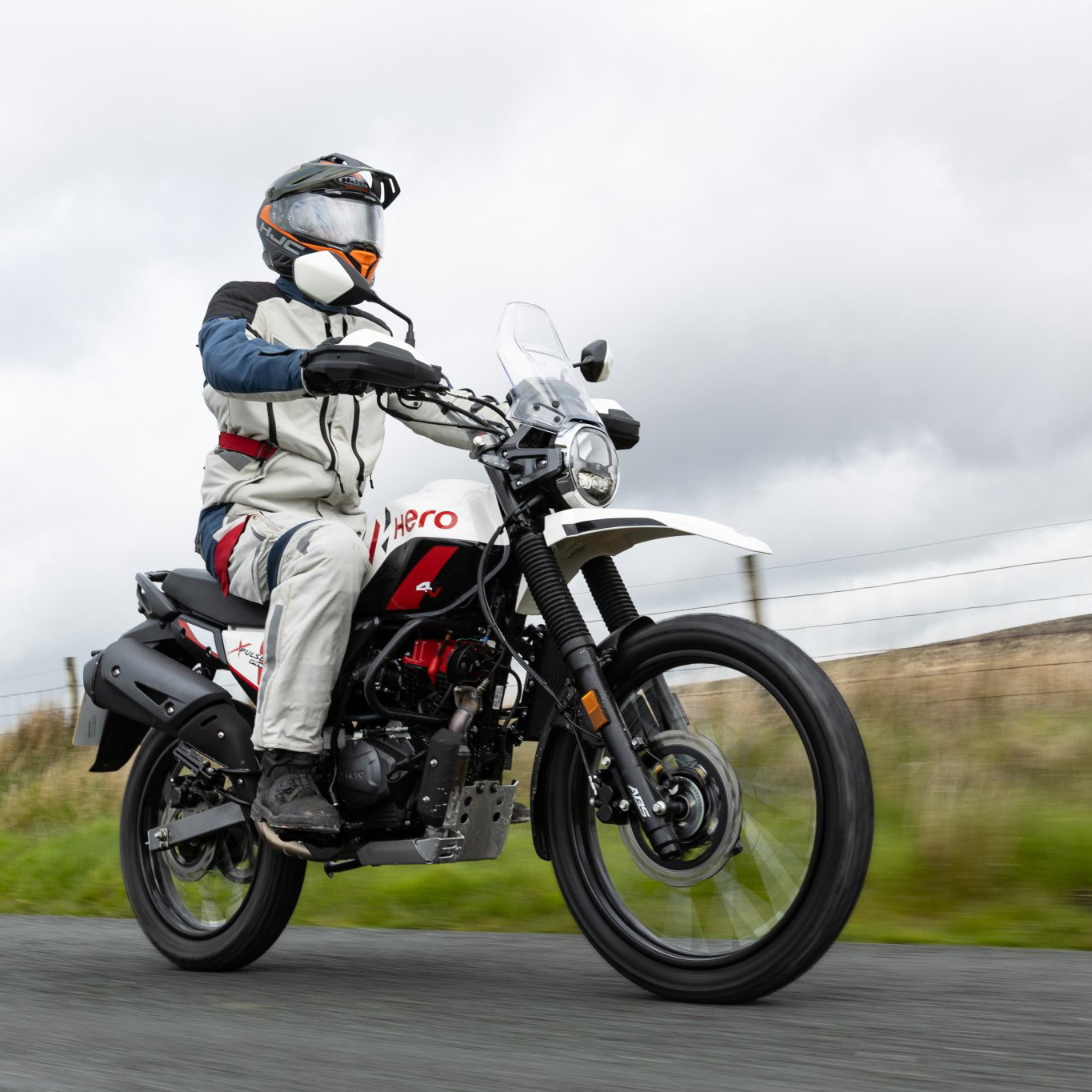
The RT's huge fairing is gone, replaced by a small half fairing and a three-way adjustable screen that you kind of wrench into position until it clicks home. It's a manoeuvre that, with practice, can be performed on the move, although there is almost certainly something in the user's manual about not doing this. The tail unit is the same as the RT's and comes complete with a two-way adjustable seat and pannier mounting points. Although on the ST the optional extra panniers aren't colour coded to the bike, which is a bit surprising.
By dumping the RT's big fairing the ST's weight is down to 205kg - 24kg less than the RT- to speed the handling up. And it does. I was actually very impressed by the handling of the big RT and the ST, despite the weather, did seem better. It isn't a lightning fast turner or sporty sports tourer like the VFR or Sprint ST, but it doesn't have the R1150RS's tendency to run wide and is definitely an improvement. I can't really see any ST owners reaching for a new set of knee sliders every five minutes, so the fact that the bike is more in the tourer section of the sports tourer market than the competition probably won't be a problem.
The bars can be moved up and down by 25mm to increase the sporty feeling of the bike but personally I wouldn't bother as simply moving the bars doesn't really alter the handling much. And it makes the extremely comfortable riding position slightly less comfortable.
Like all BMWs the ST has the comfort thing taped. If you want to do miles without having to pre-book an osteo appointment at your destination then the BMW is the way forward. A great seat, perfect stretch to the bars and well positioned pegs, and with the adjustable seat you can tailor this fit. Again, like all BMWs, the instrument display is excellent, clear and with loads of information although, strangely for BMW, I wasn't too impressed by the mirrors. Just because it's a sports tourer doesn't necessarily mean the mirrors have to show all elbows.
As the engine is the same as the RT's it came as no surprise that it delivers the same lazy power, which is almost a problem with the ST. On the RT you kind of expect a more relaxed style of motor, but on a sports tourer, with its more sporty attitude, you expect an engine with a bit of oomph. Now there is nothing wrong as such with the Boxer engine. It's smooth, the gearbox is much better and the torque is always on hand, it just doesn't really inspire on a sporty bike. When accelerating hard or really using the engine it doesn't provide the same thrills or involve the rider in the experience like, say, Honda's V-four or Triumph's triple. I can't fault the Boxer twin, but as a sports touring experience it's just a bit, well, dull.
Which kind of sums the bike up. Reading between the lines this bike appears to simply be a R1200RT with a new fairing, different forks - sorry, 'tubes' - and not a lot else. Which is exactly what it is. Speaking to the BMW people at the press conference I was told they expected 'moderate sales' in the UK, which doesn't exactly sound inspiring. So why has it been made?
To me it seems the ST is a case of BMW ticking its boxes off. It has a big tourer in the RT, a sports bike in the forthcoming R1200S and a big trailie with the GS. But it needed a sports tourer, and built one in the cheapest possible way. The problem is that if you put the ST in the same 'sports tourer' box as Honda's VFR, Triumph's Sprint ST and Ducati's ST3 - all around £1000 less - and expect it to comepte, it gets roundly beaten.
But BMW categorise their bikes differently to everyone else, and many of its customers won't be asking 'Which sports tourer shall I buy next?' Instead, they'll ask 'Which BMW shall I buy next?' In that context the ST makes a bit more sense, although in my opinion the R1100S is the best sports tourer BMW make and I reckon the new one will prove to be a fine handling, sporty bike that isn't up to taking on the true sportsbikes but will make a good, solid sports tourer. I hope I'm proved wrong.
The R1200ST isn't a bad bike, but it simply doesn't do enough to justify its price. It will only really appeal to owners of the old model R1150RS who want to get a bike that handles better, has a better motor and looks different. Personally I can't see any new owners being persuaded onto it when the competition is so strong and offers as much at a better price. Having said that, I spoke to an owner of the current model R1150RS who didn't reckon the R1200ST was that much better than his current bike.
If you want a BMW to go touring on I would go for the excellent RT; if you're after something sporty take the R1100S or Boxercup rep - or wait until next year for the all-new R1200S. If you're after a sports tourer then try Triumph's Sprint ST or go with the crowd and pick the VFR. Can that many people really be wrong?
BMW has tried to enter a very tough class without making a dedicated model. Which I reckon doesn't really cut it.
VERDICT
Not a bad bike, but the competition is more exciting and cheaper. Refined and well built, but one for BMW enthusiasts only
SPECS
TYPE - SPORTS TOURER
PRODUCTION DATE - 2005
PRICE NEW - £9060
ENGINE CAPACITY - 1170cc
POWER - 110bhp@7500rpm
TORQUE - 85lb.ft@6000rpm
WEIGHT - 205kg
SEAT HEIGHT - 820 - 840mm
FUEL CAPACITY - 27L
TOP SPEED - 140mph
0-60 - n/a
TANK RANGE - N/A