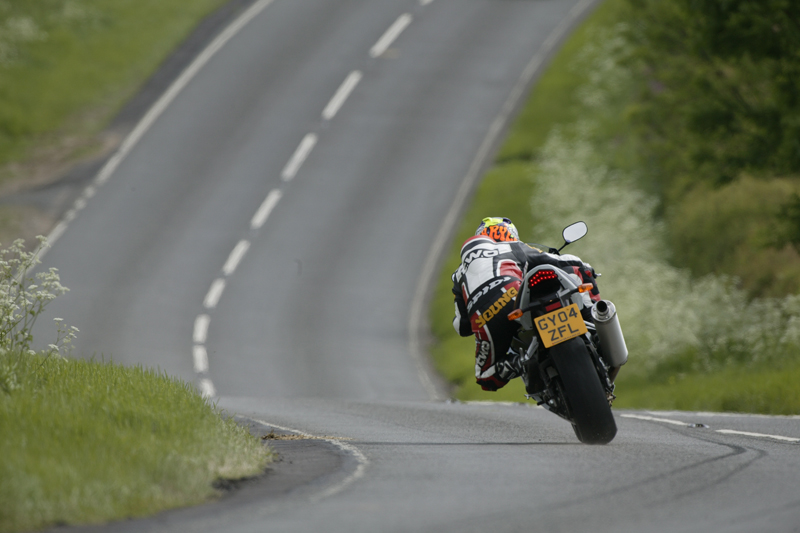
To the right
In an ideal world, the approach to a right-hand bend would put you as far to the left as possible, positioning yourself for an optimum view into and through the corner. Keep to the left until you can see your exit then turn in, gas it and go. If the view allows, depending on hedgerows, other vehicles and the general topography, and keeping within the confines of your side of the road, the line needn't necessarily be all that far removed from what you'd use on the track.
But the world isn't ideal, and any combination of a number of factors can force a change of position and line. Putting yourself in the nearside gutter can have you riding through all manner of roadside debris or running over potholes or drain covers, which may be sunken by a good few inches. That's all stuff to be avoided when your suspension and tyres have better things to be getting on with. Be aware of cambers, too; riding in the nearside gutter on a steeply crowned road means the camber is working against your tyres and steering.
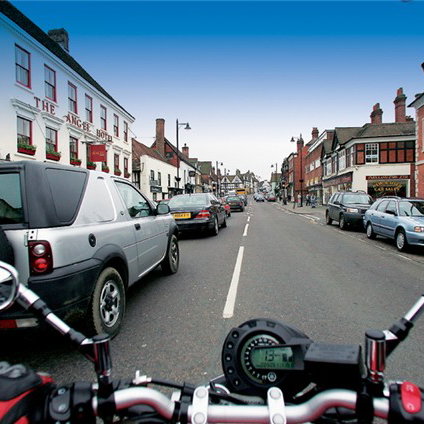
Extreme left-hand positioning can also be dodgy if there are junctions or driveways on the left before the bend. On rural roads many side roads are poorly sighted for drivers wanting to pull out, and it may be necessary for them to nudge forward of the 'Give Way' lines to get a view onto the main road. If you're inches from the gutter as you pass the junction, it could put you in direct conflict with a vehicle wanting to pull out. Your extreme positioning could also mean drivers are blind to your presence for longer or, if they see you, they may interpret your position as an intention to turn left into the junction, and so pull across your path. Best avoided.
Your line through the bend is determined by an assessment of all the above plus a few more. How far ahead can you see? Is it wet? Are there manhole covers or patches of extra-slippery Tarmac to be avoided? Are there oncoming vehicles close to or crossing the centre line? Does your restricted view mean there could be but you can't see them yet? It sounds like a lot to think about, but all this stuff needs to be ticking over in your brain pretty much all the time.
If your exit is blind, or oncoming vehicles are overhanging the centre line, then ultimately you won't turn in to the corner as such at all, instead tracking a wide arc away from the centre line, ready to get on the gas as soon as your forward view allows.
Conversely, if all is appears to be in your favour, a wide entry will give an early view to a clear exit, allowing something approaching a traditional 'apex' near the centre line.
"Generally we say be as accurate as you can," says Gary, "and if that means being six inches from the kerb, so be it. Have the confidence to put the bike where it needs to go - but if the gutter is full of potholes don't ride there. It's about getting over to people that in this world they invent for themselves where they're the only person on the roads then this is where they'd ride, but in the real world be ready to compromise."
We won't suggest you force yourself to ride in the gutter on the way into right-handers if you're not happy doing so, but it's something you should be aware of and give thought to in the right situations. But first work out what those situations are. While it often can be advantageous and safe, if you're not happy there brain power will be wasted worrying about it which could be better spent doing other things. "As a rule I stay away from the nearside kerb," says Niall. "Some people disagree with it, but I'm just not comfortable there."
The left hand line