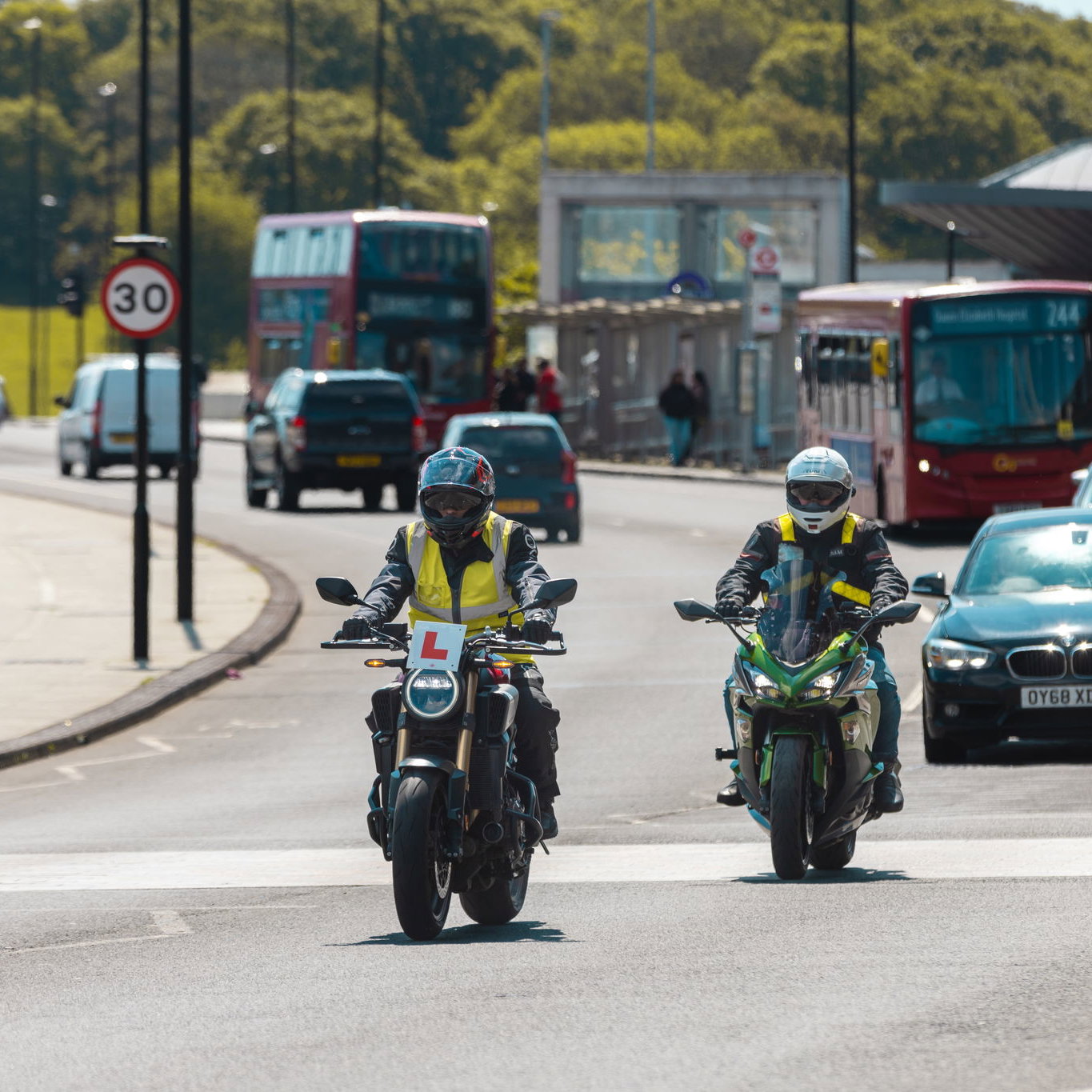
Advanced Motorcycle Riding Course: Further Education
Passed your test and got your bike licence? Congratulations, but there's still a lot to learn. Do you want to take your riding to the next level? Here's eight things you need to know

Riding a bike ain't easy. Even the experts accept that learner training is, at best, no more than a solid grounding to work from. In fact, learner training leaves some stones well and truly unturned, and it's these moist, dark areas of riding we're going to look at.
And we're not making this stuff up. To ensure at least a veneer of credibility, we enlisted the expert know-how of Kevin Williams, a riding instructor offering a range of courses tailored to all levels of riding under the 'Survival Skills' banner, and Gary Baldwin, an accident investigator with Thames Valley Police and the man behind Bucks-based Rapid Training.
"Learner training isn't far off," says Gary, "but you need to look at the end result and ask where riders have
problems after their test. And experience tells us that braking and cornering are two of the key areas that need more work doing. Riders are obviously meant to sort it out for themselves, which is fine if they do but if they don't it leaves them struggling.
Kevin Williams teaches both qualified and learner riders, and sees the problem as one of self-perceived competence. "To some extent it's down to how well the rider feels they are in control as they come away from the test centre. Many blokes will be happy they're riding at a good standard; okay, they can keep the examiner happy for half-a-hour, but that doesn't mean they're riding well, only adequately. On the other hand you get others who feel they have a problem and know they have problem areas. The issue is to persuade people there is something more to learn."
��
Road Positioning
Positioning
Hugging the kerb or middle of the road?
A motorcycle's width, or its lack of it, gives riders huge flexibility for changing position to their best advantage. Moving a couple of feet to the right or left can make the difference between seeing approaching hazards or not and being seen by other drivers or not. And correct positioning in corners is key to smooth progress. Yet learners are taught to remain in a largely inflexible position a metre or so from the left-hand kerb. "The Driving Standards Agency (DSA) are so regimented on it," says Gary. "Moving towards the centre of the road is like slaughtering your first born to them, but positioning correctly on a bike is crucial."
Kevin explains that need not be the case:"I think it's partly a hangover from what was true 10 or 12 years ago. If you read the DSA manuals in depth they do say you should consider changing your position when dealing with a hazard. If one of my pupils is approaching an on-coming articulated lorry and they can just make out the headlamp of a car behind it, I would tell them to move to their left to give them line of sight to the car - see and be seen. The essence of that isn't very different from what you would do on an advanced test.
"There isn't quite the gulf there needs to be, but I would say a lot of CBT/DAS instructors will stick to the 'one third of the way across the lane from the left' position at all costs. That can be over-emphasised. You can position flexibly during learner training, but the examiner will be asking 'Do you know why you're doing it?' and if you are doing it are you moving to a safe position or making your life more dangerous?"
The key is to be flexible and think about the best place to be in any given situation. While moving to the centre of the road on the approach to a left-hander gives a much better line through the corner, rigid insistence on doing so every time doesn't take into account the occasions when it isn't safe: oncoming lorries, traffic waiting to turn out of a junction on your right or any number of other hazards might mean a position nearer the left is safer. Likewise, moving as far left as possible on the approach to right-handers may hide you from the view of cars turning right across your path, or put your tyres in debris at the side of the road.
Look at the picture on the left. By moving from a left-hand position to one nearer the centre of the road on this gentle curve, the rider has opened up his forward view to see all the way to the crest at 'A' . He has also brought himself out from behind the Land Rover in front, and into the view of any vehicles waiting to turn out of the driveway ahead ('B'). While this position opens up the forward view, it's not the best place to be in if there are oncoming vehicles, especially large lorries. If that was the case, sacrifice the enhanced view for a safer position back towards the left.
If you're experimenting with road positioning make sure you know what's going on around and behind before you move around too much - you don't want to be lurching across to the centre of the road as someone tries to overtake. Try small changes in position at first to improve your forward view on the approach to junctions and corners, but keep your movements smooth and don't put yourself in a position you're not comfortable with.
��
Counter steering
Counter steering
The topsy-turvy world of steering
Here's something they don't usually teach you in CBT: you turn the bars left to go right, and right to go left. Perhaps understandably, the DSA like to keep that quiet to avoid confusing learners, but 'countersteering' is key to getting a bike round corners.
"It's not in the official book," says Kevin, "and it's a technique that the DSA question as relevant for learners. It's often asked, 'What do you gain from learning about countersteering?' Well, you learn to stay out of hedges. We teach people to twist the throttle, change gear and use the clutch, and all that is far more complicated than simply understanding that you push the bars left to go left. But because it doesn't have DSA approval, it's left to the training schools to teach it or not."
If you ride a bike and get it safely round corners, you're already countersteering. There's no other way to get a bike to change direction at speed - and by 'speed' we mean anything above 20mph or so. However, by putting conscious thought and effort into it, countersteering can transform your machine control.
We're not talking about massive physical input. Far from it, in fact. All that's needed is brief, gentle pressure pushing forward on the inside handlebar: push the left bar to turn left, push the right to turn right. But be careful if trying it out- countersteering is so effective that too much force can have your bike veering to one side or the other if you're not expecting it.
��
Overtaking
Overtaking
Or how to get ahead in motorcycling
Once you're free of the shackles of strangled learner bikes, a whole new world of overtaking is open to you. But be careful. While the temptation to fly past every car you come up on is enormous, the risks are high. There's more to a safe overtaking opportunity than an apparently clear stretch of road ahead.
A significant number of bike v car accidents occur when a bike tries to overtake as the car turns right so, before you go for an overtake, ask yourself the following questions. First, is the overtake legal? Make sure you're not going to illegally cross a solid white line or, god forbid, break a speed limit (see your Highway Code for all the other 'You Must Nots'). Is the vehicle you're planning to overtake about to do the same to the car it's following? Or is it about to move to the right to pass a bicycle or pedestrian you can't see? Is someone in the process of overtaking you? Is the car you're looking to overtake about to turn right into a side road, driveway, lay-by or farm track? Is a vehicle about to turn right out of one of those and into your path without looking to the left first? Remember, overtaking near junctions is specifically advised against in the Highway Code, so if you pass someone as they turn right (even if they weren't indicating), you're at least partly to blame.
While that lot may make overtaking sound like too hazardous to risk, with enough forward planning and awareness of what's going on it needn't be. If you're unsure about overtaking go on a 'dummy run' and follow some cars around, looking for overtaking opportunities without necessarily taking advantage of them.
See where it might be safe to pass, and learn to spot the potential hazards. There's a lot to take in and in a relatively short time, so don't rush yourself. If you're not comfortable with an overtake or unsure about it, simply hold back and return to a safe following position. Looking for a pass? Move closer and assess the situation, but don't put yourself in a dangerous position or intimidate the driver you're following.
Look at the pictures above as the bike approaches two cars following a cement lorry. It's a wide rural road but not free of danger. In picture 1, we can just see the entrance to a car park on the left, ahead of the lorry. In pic. 2, the car closest to the lorry has started to overtake, but don't assume it's safe to go just because someone else has - they might be mental. By the time we get to pic. 3 we can see the car park on the left is empty (no one about to make a mad-dash right turn out of it between the lorry and red car), and the road is clear well ahead. It's also pretty obvious the car we're about to pass isn't looking to overtake the lorry, so we can safely overtake.
��
Town riding and filtering
Town riding and filtering
Feeling congested? Cut a dash in the morning rush
Halving the time taken on the morning commute is one of the reasons so many people switch to two wheels, but once on the road many find grid-locked traffic an intimidating place to be. There are a lot of potential hazards to be aware of, so take your time and don't rush into anything.
One thing to be aware of is that, as far as the law is concerned, filtering is classed as overtaking. That means many of the points covered in 'Overtaking' on the next page apply equally to filtering, albeit in a slower and more condensed environment.
While caution and uncertainty holds some riders back in heavy traffic, over-confidence can equally be a problem in others. Rushing headlong between queues of stationary traffic may appear a tempting proposition, but there's a lot to be aware of.
Have a look at the picture example. We're approaching the back of a queue of traffic stopped at a red light, and moving to the centre of the road to see if it's safe to take advantage of the lack of oncoming traffic and filter past the stationary vehicles. What should we be aware of? Most obviously, the silver Fiesta has also taken advantage of the clear lane and pulled out of its parking space. Are any other parked cars about to do the same? Secondly, we're blind to anything about to appear from in front of the lorry on our left - pedestrians crossing the road or cars turning right across our path - so we need to pass with caution. Remember, that clear lane is as tempting to other road users as it is to us.
In the second, smaller picture the lights are on amber, so oncoming cars will soon be approaching and we need to get out of their way. There's space in front of the dark Lexus, but again be aware of pedestrians obscured by the silver 4x4. We also need to look out for cars turning left out of the junction on our right.
That's an awful lot to think about in a small stretch of high street. Filtering safely is about being aware of potential dangers and taking steps to avoid them. Don't fixate on getting to the front of every queue to the exclusion of all else going on around you. At the same time, learn to recognise safe routes through heavy
traffic to make the most of your two-wheeled advantage.
��
Low-speed control
Low-speed control
Relax, it's just a question of balance
There's a reason for all that wobbling round cones taught in CBT. As with braking and the emergency stop, it's not simply there to impress the examiner, only to be forgotten and never used again. If you want to master filtering and town riding (see left), you'll need to ensure your low speed control is up to scratch. Paddling feet-down through rows of cars may feel more secure at first, but in reality you don't have proper control over the bike.
There's no shame in finding a quiet car park and practicing feet-up U-turns and figure-of-eights, especially if you're riding a new, unfamiliar machine.
Bad posture is the key to sub-walking pace, full-lock balancing on a bike. Forget sitting bolt upright, back straight and arms tensed. Instead, relax and slouch in the seat with your lower back arcing outwards slightly - the same technique works on unicycles. Relax your arms, neck and shoulders and let your hands flop onto the bars. Pull away and, with both feet on the pegs, try trickling along at walking pace, balancing clutch control against a gentle squeeze of back brake to keep your speed right down.
To make a U-turn, look right over your shoulder to where you want to go before turning the bars to follow. They key is to stay relaxed and slouched in the seat. And stay off the front brake. Touching it will compress the forks which, at low speed with the bars turned, will affect the radius of the turn you're attempting and send the bike off line and possibly you off balance.
��
Braking
Braking
Start stopping properly
"Emergency stops are taught for a reason, explains Kevin, "but keep practising. They're not just something to do in front of the examiner and never do again."
The trouble with the emergency stop on the test is that you know it's coming. Real life isn't like that, and it's all too easy to grab a handful of front brake and lock up when a real panic braking situation arises.
"Some people have no idea how hard they can brake," says Gary. "But you get both extremes: brake madly and lock up, or 'I don't like this', so they don't brake at all."
If you are going out to practise braking make damn sure there's no one behind you, or find a quiet - ideally empty - car park. Remember, you're squeezing the lever, not grabbing it. It's how firmly and how quickly you squeeze that determines the rate you slow. Developing a 'feel' for front tyre grip comes with experience. The more you have the better off you'll be in a real emergency.
Another thing to be aware of is the road surface and how much - or how little - grip it gives. Car drivers are often oblivious to the changing nature of road surfaces; new motorcyclists have a lot to learn. White lines, manhole covers and loose chippings are to be avoided, but also look out for extra-grippy surfaces such as Shellgrip, found in the braking areas on the approach to some junctions and roundabouts.
��
Group riding
Group riding
With friends like these
A social blast with mates is a real temptation for new riders, but the mob mentality group riding can encourage may create an environment not suited to them.
"Group riding has become a cause of accidents," says Gary, "and in 2003 it became a real issue. You'd get 20 blokes riding together at a pace only one was happy with. That is a recipe for disaster."
Again, Kevin agrees: "Without doubt the worst riding I see is group riding. I don't think it could be covered in learner training, but any rider who has passed their test should think about."
So what to do? Only ride with those sympathetic to your limitations. Ideally avoid large groups, and certainly avoid riding with people whose priority is to show you how much faster/ more reckless than you they are. If you want to ride with someone, pick a mate you can trust who's happy to ride at your pace. If you're following, avoid the temptation to fixate on them; look through, not at them. Be aware that following a rider who knows where to position themselves will mean they block your view if you're too close. Make your own decisions and think and ride for yourself.
��
�
Just go and ride
Get your motor running, head out on the highway
You're not going to get any better at riding your bike by not riding it, so get out there and put the miles in. And don't just confine them to sunny Sunday afternoons; experience is best gained in all weathers (well, most of them), and on all kinds of roads. If your planned commute to work makes you nervous, ride the route on a quiet Sunday morning to familiarise yourself with it. Likewise, if the thought of riding on motorways puts the willies up you, put some miles in on free-flowing ones before tackling the M25 in Monday morning rush hour.
"There's no substitute for mileage," says Gary. "With my training head on, one of the most frustrating things we find is that people want to be God on a bike but they're not prepared to put the time in practising. You have to ride, you have to get familiar with the whole process. Riding your bike is the key to getting good at it. Do some serious mileage and learn the skills." And take some extra training. There's lots you don't yet know.
Not good enough?
One problem with advanced training is getting people to consider it. There's a misconception among new riders that they're 'not good enough' for it.
"'Advanced' is a bad word," says Gary, "it puts some people off. All we're talking about is enhancing the skills you built on when learning and taking them to the next stage in your development."
Kevin: "While people do take further training, we have a problem persuading many of them that they're good enough to try it in the first place. It's a particular problem with the ladies, many of whom think advanced training is going to be far too advanced."
��


_0.JPG?aspect_ratio=1:1)